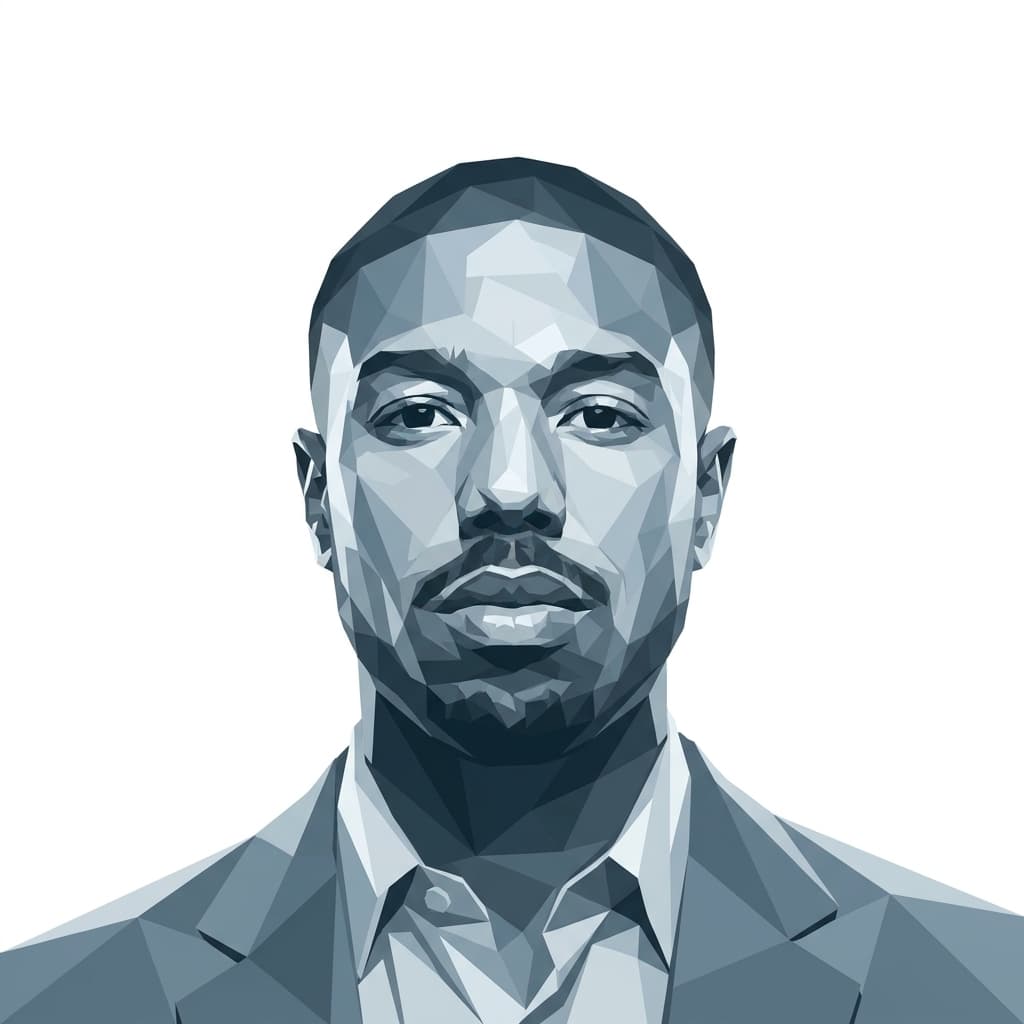
American actor and director known for Creed, Black Panther, and producing through Outlier Society.
Design
- Q43.5
- h23.5
- R24.5
- g51.6
- i57.6
- S1.5
- T28.6
- U49.5
- V63.2
- W9.5
- X26.5
- Y58.1
- Z44.1
Personality
- Q49.3
- h4.3
- R39.1
- g21.4
- i48.4
- S37.4
- T58.2
- U42.3
- V36.3
- W26.3
- X11.4
- Y58.4
- Z44.3
Michael B. Jordan is a Projector — the kind of actor who works less from raw output than from the quality of his eye, studying a role, a director, a system until he can move through it like he built it himself. That's not the standard movie-star profile, and the arc of his career tells on him: he didn't blow up overnight, he was recognized, repeatedly, by the right people at the right time, and each time he came back transformed.
The early run was trial by fire in the most literal 3/5 sense. Wallace on The Wire, Vince on Friday Night Lights, Alex on Parenthood — he kept getting cast, kept getting killed off or written out, kept learning what TV could and couldn't do for him before Fruitvale Station arrived. He has talked openly about the years of auditions, the rejections, the Chronicle moment that didn't quite convert. That's a profile that learns by living through it, not by planning around it, and by the time Ryan Coogler put him in front of a camera as Oscar Grant, the wisdom was earned, not theorized.
His preparation is famously immersive — the kind of focus that disappears into a role for months, isolating himself for Creed, living as Killmonger in character on the Black Panther set, reading Malcolm X and bell hooks to build the politics of a villain into someone audiences couldn't dismiss. Killmonger worked because the insight arrived through long contemplation rather than performance choices stacked on top of a script. He's said the role cost him emotionally, that he needed therapy afterward — a willingness to surrender into the intensity rather than armor up against it.
Outlier Society, the production company he founded in 2016, is the Projector move underneath the movie star. He adopted the inclusion rider early, produced Just Mercy and Raising Dion, and started taking control over the resources and who gets to use them. The directing debut on Creed III — going up against Jonathan Majors, shooting in anime-influenced close — was him deciding he'd watched enough masters from the inside to trust an instinct he couldn't fully explain in advance. He doesn't talk like a director who plotted it on a whiteboard. He talks like someone who knew, in a specific moment, that it was time.
What's interesting about him in interviews is the restraint. He's careful about when to share what he's actually thinking, often deflecting questions about his personal life, his relationships, his ambitions beyond the next project. Friends describe him as quietly competitive, the one in the room willing to be first and push past where it gets uncomfortable, but in public he reads as measured, even shy. He waits for the invitation — to direct, to produce, to lead a franchise — and when it comes, he says yes with everything he has. That patience, in an industry built on noise, is the through-line of how he's actually been recognized by the people whose recognition matters.
Sources: biography · birth data
What do you and Michael B. Jordan have in common?
Enter your birth details to find out