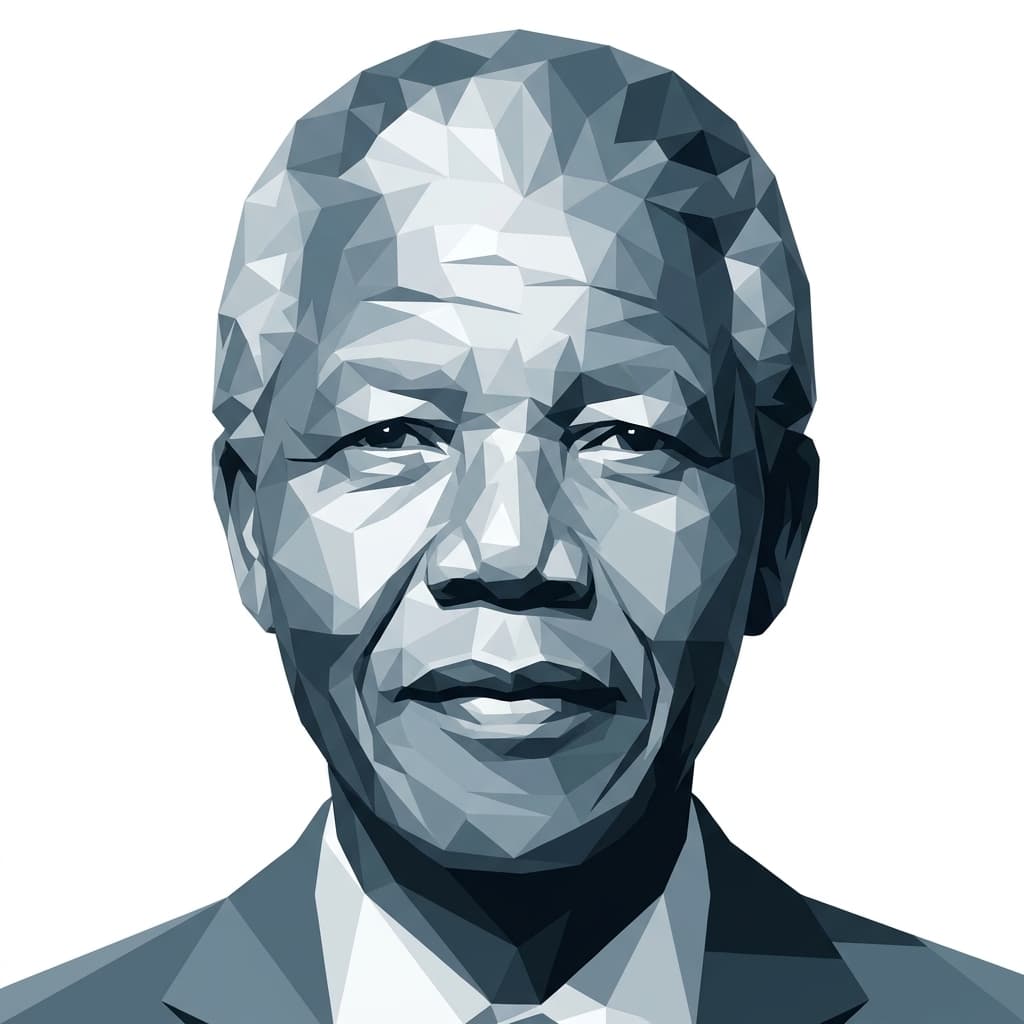
South African anti-apartheid leader, political prisoner, and first democratically elected president of South Africa.
Design
- Q3.1
- h50.1
- R62.4
- g11.2
- i12.2
- S24.3
- T37.6
- U64.4
- V16.6
- W33.1
- X30.3
- Y31.3
- Z15.6
Personality
- Q62.5
- h61.5
- R43.2
- g26.6
- i45.6
- S7.4
- T45.6
- U48.4
- V15.4
- W7.2
- X30.3
- Y31.5
- Z52.2
Nelson Mandela was a Projector — built not for ceaseless output but for seeing systems clearly and guiding others through them, which is exactly what the long arc of his life required. He was never the loudest figure in the African National Congress, and in his early years he was often described by colleagues as watchful, deliberate, almost reserved. What he had instead was a knack for recognizing what a movement actually needed and the patience to study law, tribal politics, military strategy, and his adversaries with equal seriousness before stepping forward.
His 5/1 profile — the practical problem-solver who must first build a foundation through investigation — shows up everywhere in his biography. As a young lawyer in Johannesburg he ran the country's first Black law practice with Oliver Tambo, learning the machinery of apartheid from inside its courtrooms. Later, on Robben Island, he turned a prison into a university, reading constitutions, studying Afrikaans, bringing order to the chaos of incarcerated life by organizing classes, hunger strikes, and quiet negotiations with wardens. He understood that he would eventually be called to solve a problem nobody else could solve, and he prepared accordingly.
Decisions that shaped a continent came to him with a quiet, instantaneous knowing that he rarely tried to explain. When he secretly began talks with the apartheid government in the 1980s — without consulting the ANC leadership in exile — he was acting on instinct, sensing the moment before anyone else could see it. He had the same instinct on the day of his release in 1990, choosing reconciliation over revenge in a speech he largely wrote himself. His sense of when to speak and when to wait was almost preternatural; he had spent twenty-seven years rehearsing restraint.
Mandela embodied a kind of leadership that only worked because people kept asking him to lead. He refused early conditional release offers, understanding that accepting them would forfeit the recognition his eventual freedom required. He waited until the invitation was unconditional, and then he stepped into a role that carried the weight of stewarding a whole nation's future. His influence emerged from authenticity rather than force — the famous Madiba smile, the Springbok jersey at the 1995 Rugby World Cup, a vision of the future that millions could trust.
He carried a profound responsibility to the values and traditions of a people he was determined to protect, and an equally profound commitment to managing the new country's resources for collective benefit rather than personal enrichment. He served one term as president and walked away, a decision that quietly stunned a continent accustomed to leaders who clung to power. In retirement he wrote, told stories, and distilled decades of experience into wisdom for the next generation, founding the Elders and continuing to speak — but only when invited, and only when he had something worth saying.
What made him singular wasn't endurance alone. It was the breakthrough insight, arriving without warning, that an enemy could become a partner if you were patient enough, prepared enough, and willing to be seen exactly as you were.
Sources: biography · birth data
What do you and Nelson Mandela have in common?
Enter your birth details to find out