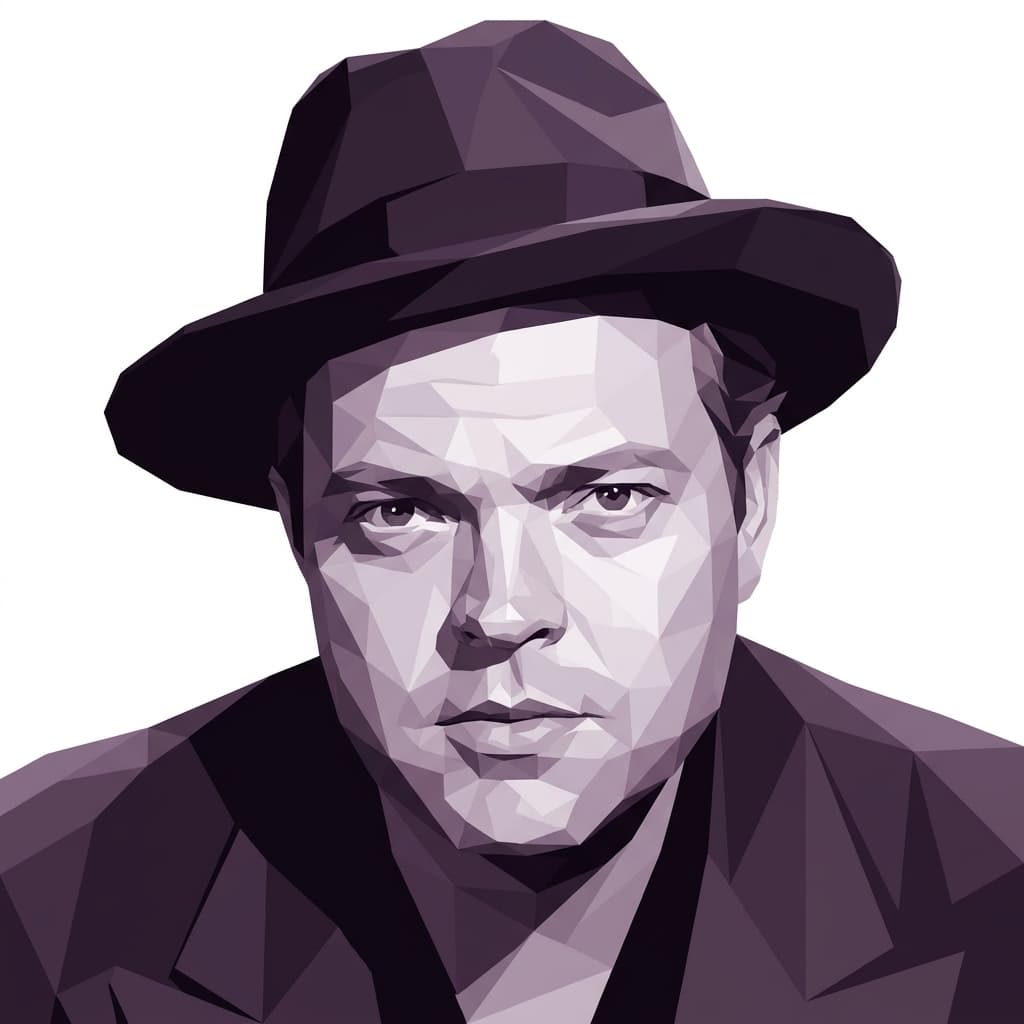
American filmmaker, actor, and radio provocateur behind Citizen Kane and the War of the Worlds broadcast.
Design
- Q13.4
- h7.4
- R44.4
- g30.3
- i29.3
- S55.6
- T10.2
- U41.5
- V55.1
- W12.4
- X19.5
- Y56.3
- Z15.3
Personality
- Q2.2
- h1.2
- R13.6
- g49.5
- i4.5
- S23.2
- T21.2
- U51.1
- V22.5
- W15.2
- X13.3
- Y56.2
- Z15.3
Orson Welles was a Manifestor — built to kick things into existence on his own terms, then hand them off or walk away — and his career reads like a long argument with a world that wanted him to finish what he started the way everyone else finished things. At 23 he had a national radio show, a theater company, and a contract at RKO that gave him near-total control of his first picture. He never had that kind of leverage again, and he spent the next forty years initiating anyway.
The 1938 War of the Worlds broadcast is the clearest snapshot of his wiring: a young man who acted on a sudden inspired impulse and forgot, or declined, to sufficiently prepare his audience for the shock. Panic followed, then fame. He had a gift for shocking people out of familiar patterns — the newsreel-style opening of Citizen Kane, the deep-focus ceilings, the fractured chronology — and a corresponding restlessness that made him chase the next new experience before finishing the last. The Magnificent Ambersons was taken from him and recut while he was in Brazil shooting something else. He kept moving.
His 2/4 profile — the hermit who works through his network — showed up in a strange rhythm: months holed up writing and editing in Rome or Madrid, then sudden emergence at a friend's dinner party or a talk show couch, charming money out of producers he'd known for decades. Chimes at Midnight, F for Fake, The Other Side of the Wind — all funded through the relationships he'd tended across continents, because studios wouldn't touch him. He undervalued how much of his output depended on the community that kept reflecting his gifts back to him when he couldn't see them himself.
As Emotional Authority he was famously mercurial, and the good decisions were the ones he'd sat with long enough for the charge to burn off. The bad ones — signing away Kane's sequel rights, taking the Paul Masson wine gig, agreeing to narrate almost anything — tended to come from a heated moment or a tight financial window. He was a natural storyteller who moved people through tone and timing as much as content; the voice alone could sell a documentary about forgery and make you believe you'd learned something profound about art. F for Fake is essentially that voice, cut against itself.
Welles carried the mind that couldn't stop asking why — why Kane, why Falstaff, why the magician deceives — and paired it with a stubborn refusal to flatten himself into what Hollywood wanted. He'd rather be misunderstood as a genius who squandered his gifts than compliant as a director who finished on schedule. Toward the end, living in Los Angeles, still editing The Other Side of the Wind on a moviola in his house, he was working on maybe a dozen projects. He died in 1985 at his typewriter, mid-sentence, having just given an interview earlier that day. The unfinished work is the point. He was always going to be a man who started more than he closed.
Sources: biography · birth data
What do you and Orson Welles have in common?
Enter your birth details to find out