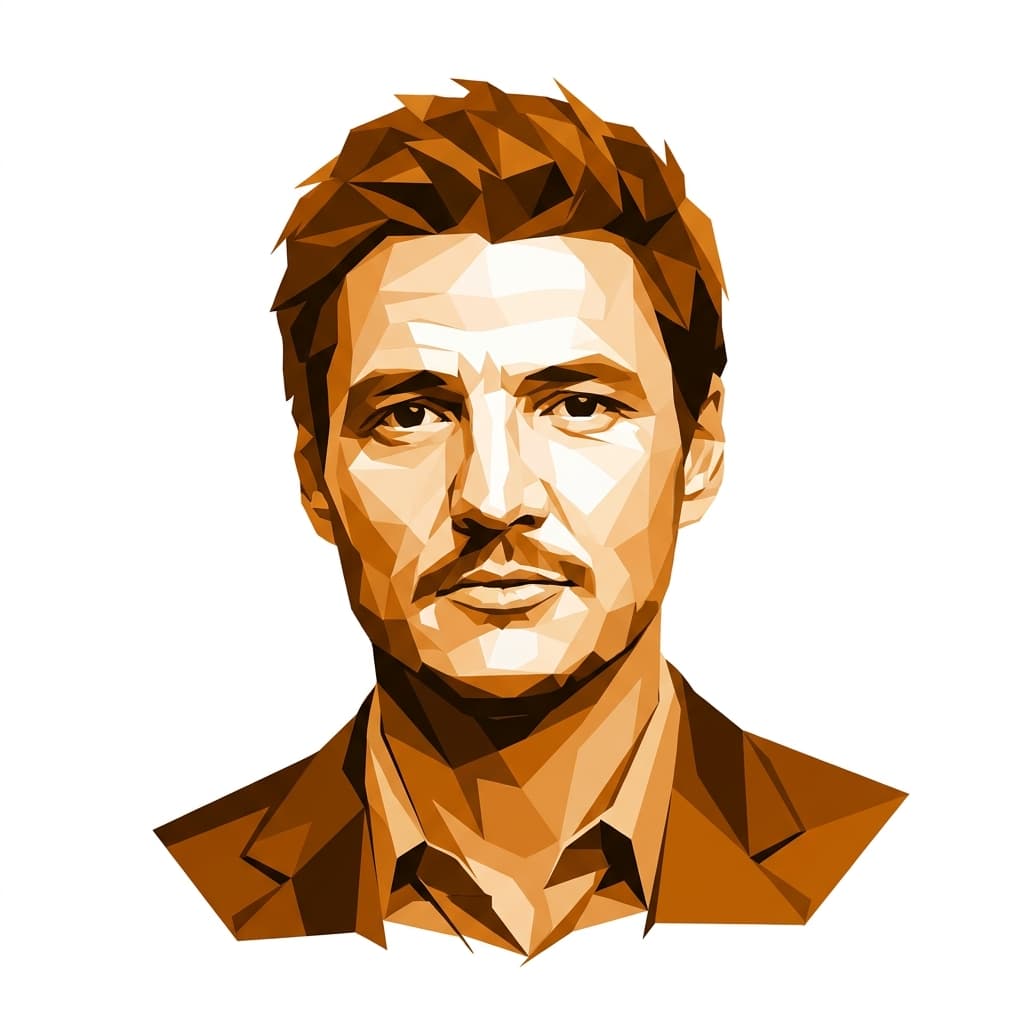
Chilean-American actor known for The Mandalorian, The Last of Us, and Game of Thrones.
Design
- Q38.6
- h39.6
- R32.1
- g9.5
- i16.5
- S61.4
- T60.3
- U26.2
- V63.3
- W53.1
- X28.1
- Y9.6
- Z18.6
Personality
- Q21.4
- h48.4
- R10.6
- g34.3
- i20.3
- S36.5
- T2.4
- U49.5
- V25.6
- W39.3
- X50.6
- Y5.1
- Z18.5
Pedro Pascal is a Manifesting Generator — wired to juggle several passions at once and move fast when something finally lights him up — and his career arc is exactly that shape. He spent nearly two decades auditioning in New York, taking bit parts on Law & Order and off-Broadway stages, before the industry caught up to him in his late thirties. When it did, it happened in bursts: Oberyn Martell, Javier Peña, Din Djarin, Joel Miller. He didn't grind his way to the top so much as wait for the thing that pulled him in and then throw everything at it.
Born José Pedro Balmaceda Pascal in Santiago in 1975, he fled Chile as an infant with his parents, who had sheltered political dissidents under Pinochet. That refugee origin story shapes how he moves in public — the outspoken support for his trans sister Lux, the anti-fascist statements, the willingness to say the quiet part out loud. It reads like a 4/6 profile doing its work: someone whose messy, wandering early years became the raw material for the role-model position he now occupies, and whose real audience is the community that already trusts him rather than everyone.
The pivot points in his career all have the same texture. He got Oberyn because Game of Thrones producers saw a self-tape his friend Sarah Paulson pushed on them — an opportunity that arrived through relationship, and that he said yes to with the kind of full-body clarity that doesn't need a pros-and-cons list. He accepted The Mandalorian knowing his face would be hidden the entire season. He signed onto The Last of Us before a frame was shot. Each time, the gut said go before the mind caught up.
What people respond to on screen is a presence that stays available to the moment — Joel's grief flickering through his eyes in a single unbroken take, Oberoyn's flirtation, the way he lets Din Djarin's helmet do half the acting. He's talked in interviews about wanting to stay soft in a job that rewards armor, about crying easily, about being the "daddy" of the internet without curdling into self-parody. There's a quality of meeting whatever the scene asks without flinching that seems to come from somewhere real.
Off-camera he's built something rarer than a filmography: a chosen family he actually shows up for. He raised his siblings after their mother's death. He's inseparable from Sarah Paulson, from Oscar Isaac, from Bella Ramsey. When he uses his platform, it's usually in defense of someone who can't defend themselves as loudly — trans kids, immigrants, Chilean political memory. The advocacy isn't a side project; it's continuous with the acting.
He tends to pick roles the way a good scout picks talent, waiting for material that will actually hold weight and passing on the ones that won't. And he seems to have made peace with the fact that his path was never going to be linear — the twenty years of nothing, then everything at once, then Marvel and prestige TV and a Broadway return all stacked on top of each other. He's not trying to niche down. He's trying to keep going.
Sources: biography · birth data
What do you and Pedro Pascal have in common?
Enter your birth details to find out