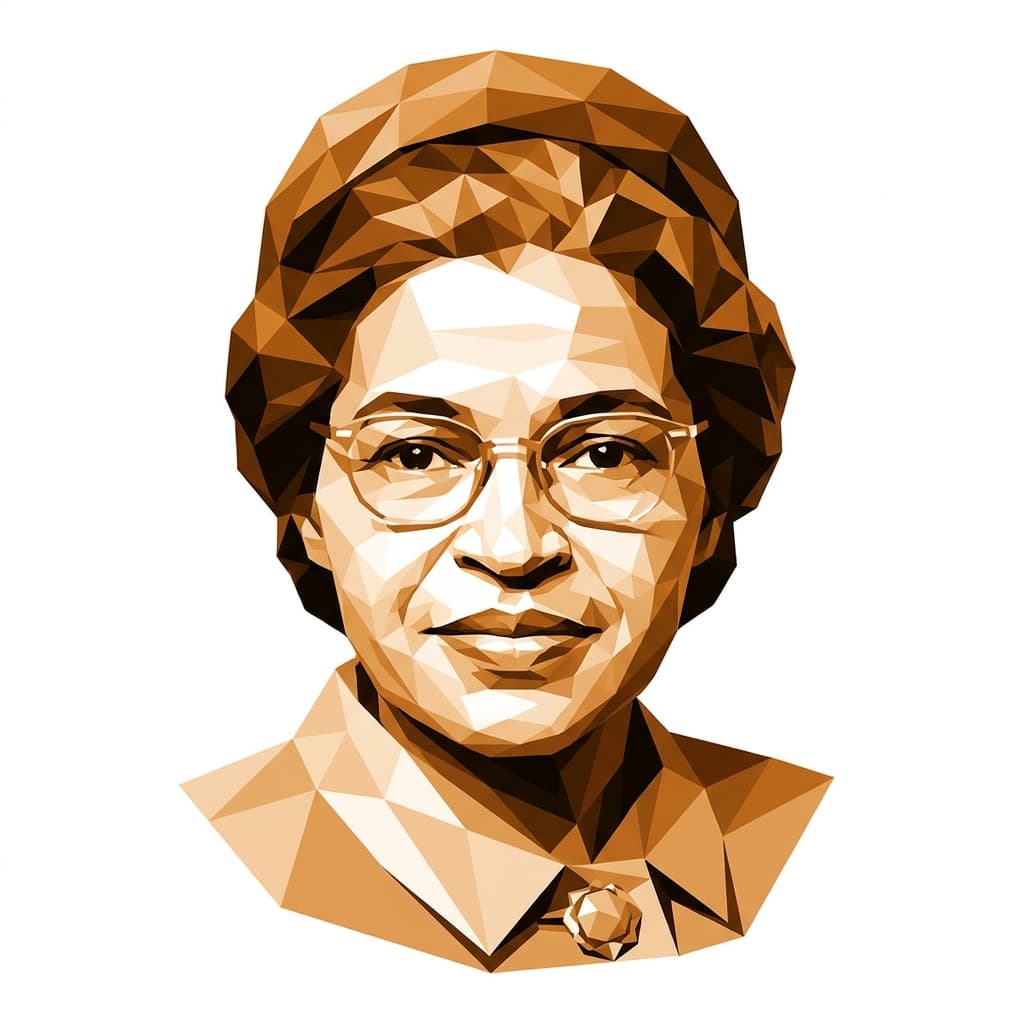
Civil rights activist whose refusal to give up her bus seat ignited the Montgomery Bus Boycott.
Design
- Q1.5
- h2.5
- R14.2
- g21.3
- i48.3
- S9.2
- T26.3
- U1.3
- V26.1
- W20.2
- X60.4
- Y62.6
- Z15.2
Personality
- Q13.2
- h7.2
- R61.6
- g17.1
- i18.1
- S19.2
- T25.4
- U54.4
- V58.4
- W8.3
- X41.3
- Y62.4
- Z12.6
Rosa Parks was a Manifesting Generator — built for sustained, responsive action with a current of quick, decisive power underneath — and the arc of her life makes more sense when you stop treating December 1, 1955 as the whole story. By the time she refused to move from her seat on that Montgomery bus, she had already been secretary of the Montgomery NAACP for over a decade, had investigated the gang rape of Recy Taylor, had trained at the Highlander Folk School, and had spent years quietly documenting the violence done to Black women and men in Alabama. The bus moment wasn't impulse. It was a full-bodied gut yes that didn't need explaining.
She was a 2/5 profile, the hermit who gets cast as the problem-solver — someone who guarded her private life fiercely while the world projected onto her the role of saint, symbol, matriarch. People who knew her described a woman who read, sewed, prayed, and preferred the company of a few trusted friends. Her strategy of waiting, then moving decisively when the moment arrived wasn't passivity; it was the discipline of a lifelong organizer who understood that the right action at the wrong time accomplishes nothing. She had given up her seat before. On that December evening, something was different, and she knew it in her body before her mind caught up.
Her refusal was an act of self-expression stripped down to its essentials, spoken in a voice that carried the weight of knowing exactly when silence stops serving. When the driver, James Blake, told her he'd have her arrested, she answered simply: "You may do that." That short sentence did the work of a speech. It was the kind of present-moment truth-telling that ripples outward — unforced, unornamented, impossible to argue with. The Montgomery Improvement Association formed within days. The boycott lasted 381.
Parks paid for that moment for decades. She and her husband Raymond lost their jobs; death threats drove them north to Detroit in 1957. There she worked in a shirt factory, then for Congressman John Conyers, continuing the quieter organizing she had always done — around housing, around prisoners' rights, around the Black Power movement she supported more openly than her sanitized public image suggested. She carried a deep attunement to what her community actually needed, not what sympathetic white audiences wanted to hear. She met with Malcolm X. She admired Robert F. Williams. The grandmother-in-a-hat framing never quite fit.
Her listener's gift — the ability to hold other people's stories without rushing to fix them made her an unusual kind of leader: one whose authority came from recognition rather than ambition. She led by being asked to lead, and when she wasn't being asked, she went home and read her Bible. In her later years she founded the Rosa and Raymond Parks Institute for Self-Development, directing her quiet drive toward the next generation of young Black people rather than toward preserving her own legend. She died in 2005. The woman who was tired of giving in had never, in fact, been tired at all — just precise about where her energy belonged.
Sources: biography · birth data
What do you and Rosa Parks have in common?
Enter your birth details to find out