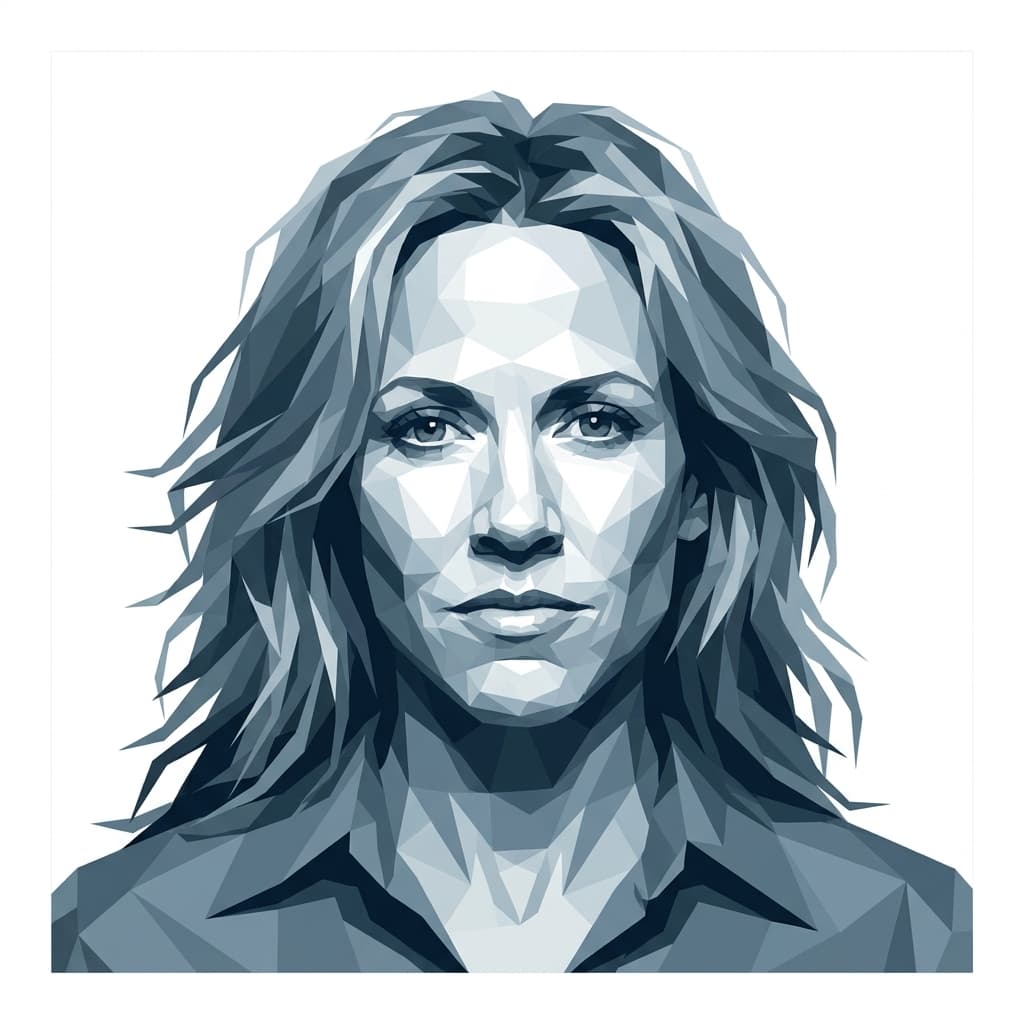
American singer-songwriter behind "All I Wanna Do" and a defining rootsy-rock voice of the 1990s.
Design
- Q43.6
- h23.6
- R63.4
- g4.4
- i49.4
- S44.1
- T28.6
- U34.3
- V60.6
- W61.5
- X59.1
- Y44.5
- Z40.5
Personality
- Q49.4
- h4.4
- R23.4
- g7.6
- i13.6
- S19.3
- T30.2
- U41.6
- V49.2
- W41.3
- X29.5
- Y1.1
- Z40.4
Sheryl Crow is a Projector — someone wired to see the shape of a song, a scene, or a room before most people notice there's a shape at all — and her whole career reads like a study in what happens when a guide learns to hold her own microphone. She grew up in Kennett, Missouri, the daughter of a trumpet-playing lawyer and a piano teacher, and by the time she'd earned a music education degree from Mizzou she was already teaching elementary school by day and singing jingles for McDonald's and Toyota by night. That double life is a very Projector kind of apprenticeship: watching how the machine works before stepping into it.
The invitation that changed everything came in 1987, when she was tapped to sing backup on Michael Jackson's Bad tour. She spent eighteen months next to the biggest star on the planet, learning stagecraft from the wings. It's a story that only makes sense through waiting for the right recognition rather than chasing the spotlight; she didn't push her way to a solo deal, she got seen into one. Her first attempt at a record was shelved — she famously hated it — and instead she fell in with the loose Tuesday Night Music Club collective in Pasadena, where the album that made her name was written around a kitchen table with friends. That circle-of-collaborators origin story is textbook 4/6 profile: the warm, network-driven 4 finding her people, the 6 already sensing she was building toward something more lasting.
"All I Wanna Do" turned her into a household name in 1994, but the follow-up is the more revealing record. She produced Sheryl Crow herself, wrote through the darkness of losing a close collaborator to suicide, and dared radio to keep up with a song about a Walmart selling handguns. Anyone with the kind of decision-making that needs to sleep on the wave recognizes what she was doing there — refusing to release from the sugar high of a debut and instead waiting until the songs felt true from a cooler, clearer place. She has said in interviews that she second-guesses everything for days; that's not indecision, that's her instrument.
The texture of her catalog is restless songwriting that keeps chasing the next feeling braided with a plainspoken way of making complicated feelings land in one line. "Every day is a winding road," "if it makes you happy, it can't be that bad" — she has a gift for distilling a whole worldview into a hook a stranger can sing. Underneath the ease is a fighter's willingness to take on the struggle worth taking on: breast cancer in 2006, a benign brain tumor in 2012, a very public breakup, decades of being condescended to as "the girl with the guitar." She kept touring, kept producing her own records, kept showing up.
What's aged best about her is the community around her — Emmylou, Willie, Stevie Nicks, Keith Richards, the two sons she adopted and moved home to Nashville to raise. She's become the friend other artists call when they need someone who's actually been through it, and a quiet provider inside a scene that rarely takes care of its own. The 6 has landed. The role model is just being herself out loud.
Sources: biography · birth data
What do you and Sheryl Crow have in common?
Enter your birth details to find out