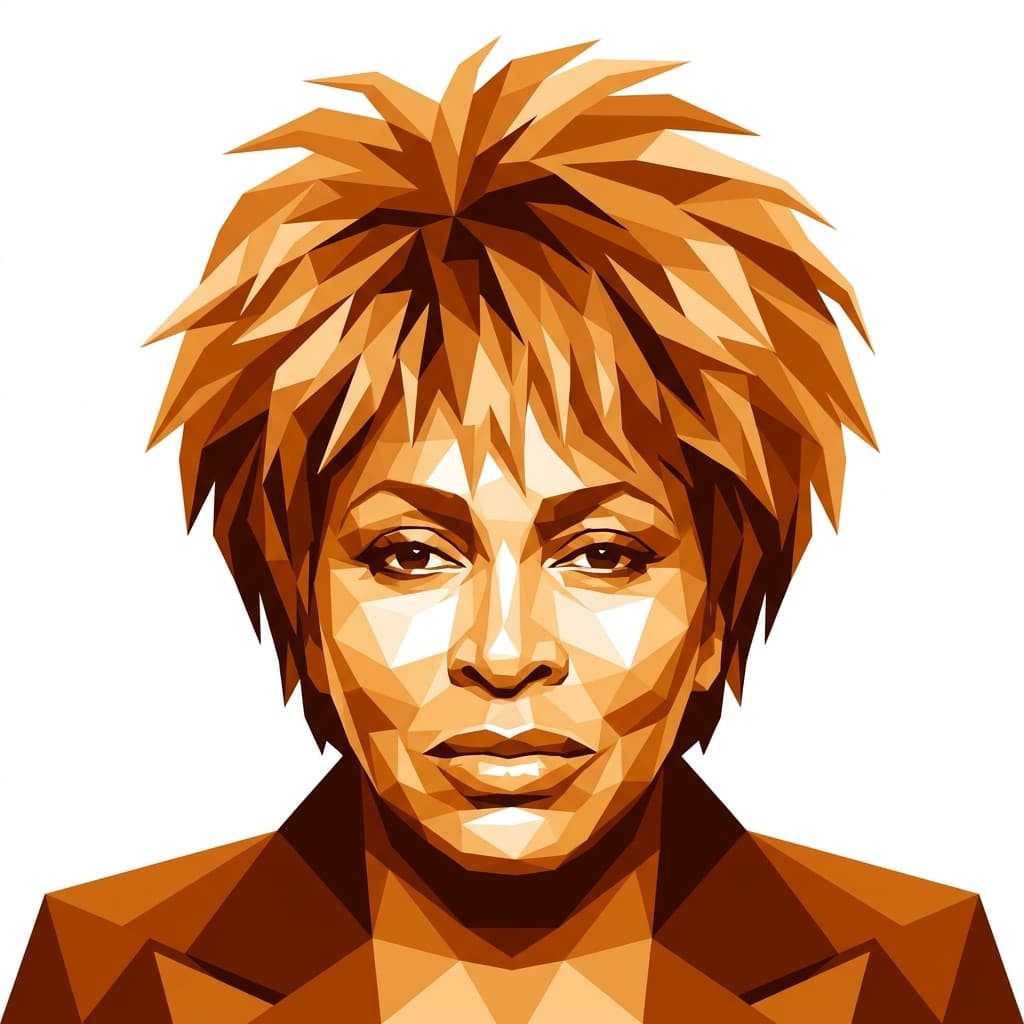
American-born singer who reinvented rock and roll, survived Ike Turner, and became a global solo phenomenon.
Design
- Q40.1
- h37.1
- R37.5
- g50.5
- i3.5
- S7.6
- T59.5
- U61.4
- V17.4
- W3.5
- X23.4
- Y47.6
- Z31.1
Personality
- Q34.5
- h20.5
- R16.2
- g50.3
- i3.3
- S9.3
- T11.3
- U55.5
- V25.1
- W42.5
- X23.1
- Y6.3
- Z31.1
Tina Turner was a Manifesting Generator — built for sustained, high-voltage output and capable of pivoting fast when the work no longer fit. The arc of her life, from a Nutbush cotton farm to selling out stadiums in her sixties, is the arc of someone who kept saying yes to what lit her up and walking away from what didn't, even when walking away cost her everything.
She didn't chase a singing career; she responded to one. The story she told for decades was that she wandered onstage at a St. Louis club in 1957, grabbed a microphone from Ike Turner during intermission, and sang. He hired her on the spot. That moment carries the whole shape of her Wait to Respond wiring — nothing was planned, but when the thing showed up, her body knew. What followed was nearly two decades of the kind of raw, locomotive stage energy that defined Ike & Tina Turner Revue: she could outwork any band, any tour, any expectation.
Underneath the spectacle was a 5/1 profile, the investigator who becomes a problem-solver others lean on. She studied her craft obsessively, drilled the Ikettes on choreography, and built a foundation of skill through sheer repetition. She also carried the projection field that comes with this profile — fans, husbands, labels all wanting her to be their idea of her — and much of her later life was a careful disentanglement from those projections. Her 1986 autobiography I, Tina and the film What's Love Got to Do With It were her insisting, in public, on being seen as who she actually was.
The 1976 departure from Ike — fleeing a Dallas hotel with 36 cents and a Mobil credit card — is one of the most quoted decisions in American music, and it reads exactly like an Emotional Authority decision made correctly: years of feeling into it, riding wave after wave, until the clarity finally landed cool and settled. She filed for divorce and refused alimony, keeping only her stage name. That she then spent eight years grinding through Vegas lounges and cabaret circuits before Private Dancer hit in 1984 is the part most people forget — the patience to close one cycle completely before the next one could begin.
Her Buddhist practice, which she credited with surviving the Ike years, gave her a way to keep her heart open through what should have broken it. She chanted Nam-myoho-renge-kyo daily for the rest of her life. Friends described her as warm and clannish, gathering people around her in her Swiss home, generous with the inner circle and explicit about what she would and wouldn't give — no more performing on demand, no more touring past her own appetite for it.
She retired on her own timing in 2009, married Erwin Bach, became a Swiss citizen, and refused most comeback offers. Her late voice — on Tina: The Musical, on the 2021 HBO documentary — carried the unmistakable quality of someone done explaining herself. She had survived, mastered her craft, and was finally allowed to simply be Tina.
Sources: biography · birth data
What do you and Tina Turner have in common?
Enter your birth details to find out