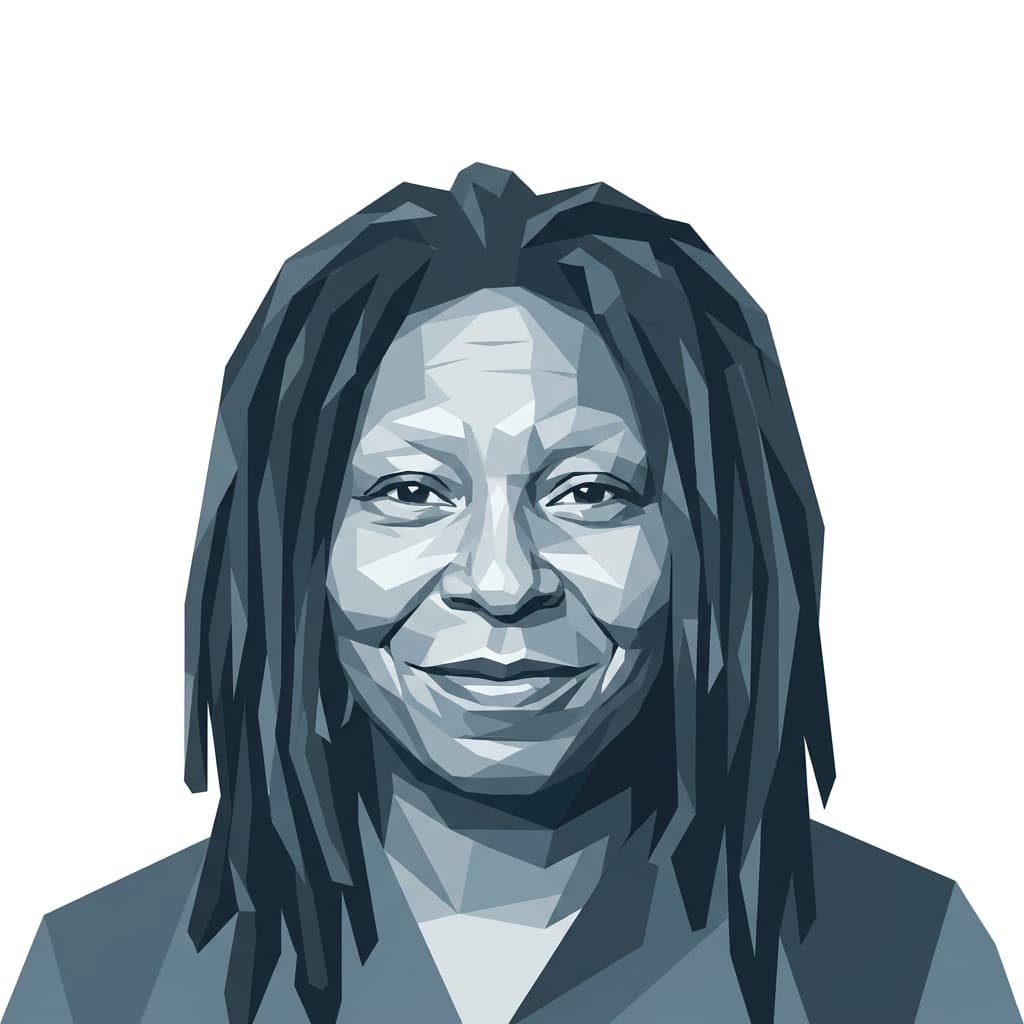
EGOT-winning actor, comedian, and View co-host whose voice has shaped American culture for four decades.
Design
- Q4.4
- h49.4
- R56.5
- g11.3
- i12.3
- S59.4
- T7.6
- U4.5
- V7.1
- W1.3
- X56.4
- Y32.6
- Z29.2
Personality
- Q43.2
- h23.2
- R44.5
- g26.1
- i45.1
- S44.2
- T9.5
- U57.6
- V29.6
- W43.5
- X31.1
- Y50.3
- Z29.5
Whoopi Goldberg is a Projector — built to see people clearly, steward their energy, and guide through perspective rather than pure output — and her entire career has been an exercise in being recognized for exactly that. Born Caryn Elaine Johnson in a Chelsea housing project in 1955, she dropped out of high school, did time in the chorus of Hair and Pippin, raised a daughter alone, and went on welfare in San Diego before anyone outside small experimental theaters had heard of her. The breakthrough wasn't hustle. It was Mike Nichols seeing her one-woman show The Spook Show in 1983 and inviting her to Broadway — a textbook instance of waiting for the right invitation to land before everything changes.
That show, and the film career that followed, depended on a particular kind of voice — one that could inhabit a junkie, a nine-year-old Black girl who wanted to be Whoopi-with-blonde-hair, a disabled woman, a surfer dude — and find the human underneath. It's the gift of distilling complicated truths into something an audience can actually hear, paired with a storyteller's instinct for turning lived experience into something that lands. The Color Purple in 1985 — her first film — got her an Oscar nomination. Ghost in 1990 won her the second Oscar ever awarded to a Black woman. She didn't audition like other actors. She got invited in.
Her 2/4 profile — the hermit who needs community — explains a lot about how she's always operated. She's famously private, lives quietly, has said in countless interviews that she doesn't go to parties and doesn't socialize with Hollywood. But her opportunities have almost always come through relationships: Nichols, Spielberg, Patrick Stewart inviting her onto Star Trek, Barbara Walters bringing her to The View. She works from instinct, the kind of yes or no that arrives instantly and doesn't explain itself, which is why her comedy timing has always felt unteachable and why she's been willing to take jobs — Sister Act, game show host, Broadway producer — that other "serious" actors wouldn't touch.
On The View, where she's moderated since 2007, you can watch the natural guide steering a room of strong personalities toward something the audience can actually use. She'll let co-hosts run, then cut in with a single line delivered exactly when the moment is ripe and reset the entire conversation. She's also unmistakably the voice that takes on causes — AIDS activism with Comic Relief, the homeless, civil rights — because the principles aren't negotiable. She co-founded Comic Relief USA with Billy Crystal and Robin Williams in 1986 and it raised tens of millions for the unhoused.
She became the first Black woman to win the EGOT, and she did it by following through on commitments most people would have walked away from — sticking with The View through years of co-host turnover, returning to Broadway as a producer, doing the unglamorous work. The original, unmistakable self-expression — the dreadlocks she's worn since the 1980s, the refusal to use her birth name, the insistence on being exactly one person on camera and off — is the whole point. She was never trying to fit in. She was waiting to be seen, and then she was.
Sources: biography · birth data
What do you and Whoopi Goldberg have in common?
Enter your birth details to find out