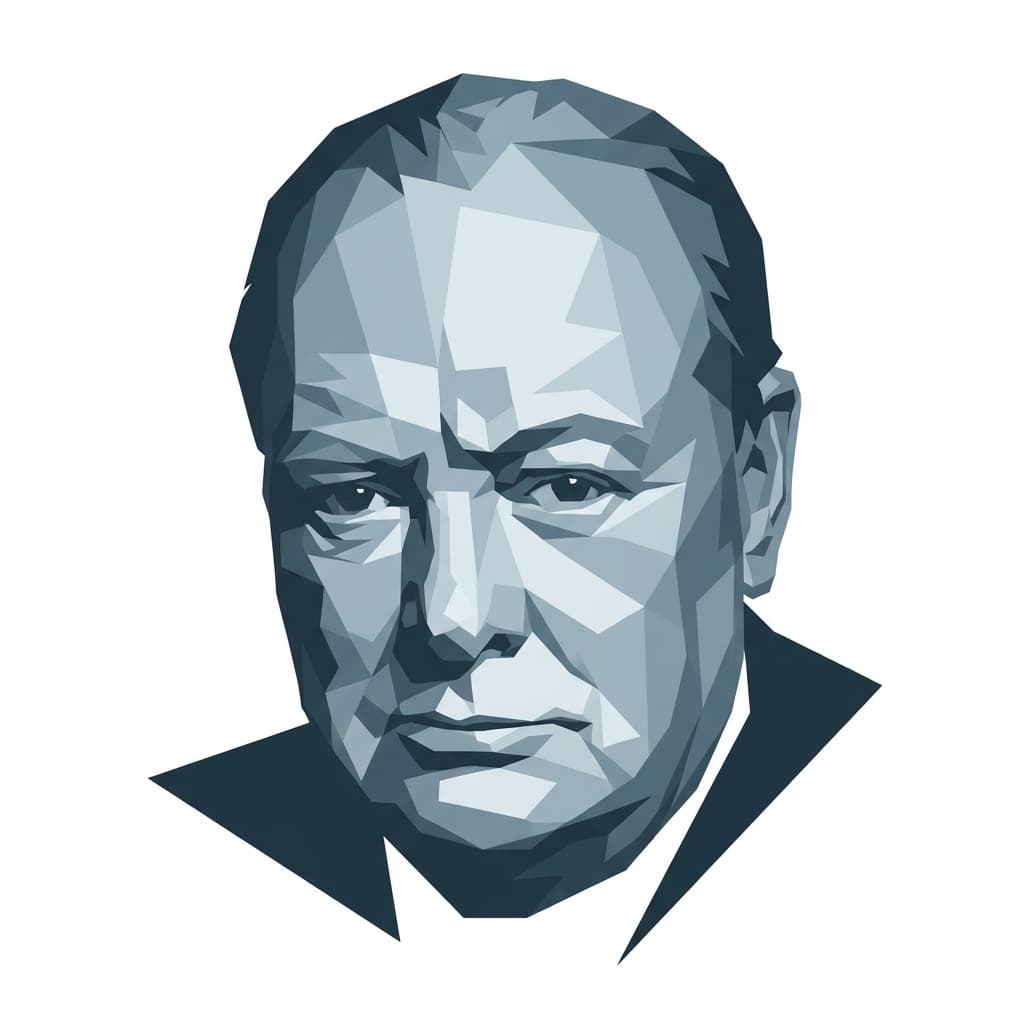
British statesman, wartime Prime Minister, orator, and author who led Britain through World War II.
Design
- Q40.5
- h37.5
- R8.6
- g3.2
- i50.2
- S59.5
- T32.4
- U4.3
- V18.2
- W19.2
- X33.6
- Y3.5
- Z23.5
Personality
- Q9.3
- h16.3
- R29.6
- g42.6
- i32.6
- S1.5
- T26.6
- U57.2
- V32.4
- W19.3
- X7.3
- Y3.3
- Z23.3
Winston Churchill was a Projector — built not for relentless output but for seeing things others couldn't, and then being called upon at the exact moment that vision was needed. For most of the 1930s, he was a man in the political wilderness, mocked in the Commons, passed over for office, shouting warnings about Hitler that nobody wanted to hear. Then in May 1940, the invitation finally came. He was sixty-five years old.
The wilderness years are the Churchill story that explains the rest of him. His 3/5 profile, the experimenter who eventually becomes a crisis leader, fits a career strewn with spectacular failures — Gallipoli in 1915, the return to the Gold Standard in 1925, his bitter opposition to Indian self-rule — each one teaching him something he later drew on. He'd been a soldier in Sudan, a war correspondent in South Africa, a cabinet minister at thirty-three, and a backbencher at sixty. He kept pioneering through chaos and getting things wrong first, which is why, when actual chaos arrived, he was the only man in Britain who already knew its shape.
His instrument was his voice. Churchill wrote his speeches in cadenced lines like poetry, pacing his study at Chartwell, dictating to secretaries late into the night. He had a gift for finding the one phrase the whole country could carry — "blood, toil, tears and sweat," "we shall fight on the beaches," "their finest hour." Behind the rhetoric was decades of obsessive craft: he'd published a million words of history and journalism before becoming Prime Minister, and the discipline of practicing a craft until it became him was inseparable from who he was. He once spent an afternoon rewriting a single paragraph.
Decisions came slowly, often after wild swings. He called his depressions "the black dog," and the pattern of riding emotional waves before landing on a course shaped his war cabinet style: long, rambling late-night meetings, brandy and cigars, ideas thrown out and abandoned, generals exhausted, until clarity emerged sometime around 2 a.m. He had an instinct for which men and projects were worth the investment — he championed radar, code-breaking at Bletchley, the unconventional commandos — and was equally certain about what wasn't, sometimes catastrophically so. His critics called it megalomania. His staff, who adored him, called it Winston.
He led with the kind of authority that has to be recognized to work, which is why 1940 mattered so much. Without the invitation from King and country, his particular gifts would have looked like the ravings of a washed-up imperialist. With it, he became the man who stewarded a nation's energy toward a shared survival. He was also a relentless critic of inefficiency and bad ideas, firing off "Action This Day" memos that terrified Whitehall, and a persuader who could sell a vision of British endurance to a wary Roosevelt across the Atlantic.
Voters threw him out in July 1945, weeks after victory in Europe — a reminder that recognition is conditional and Projectors don't get to keep it. He returned as Prime Minister in 1951, wrote a six-volume history of the war, won the Nobel Prize for Literature, painted landscapes, and died in 1965 having lived almost exactly as long as the century he'd shaped.
Sources: biography · birth data
What do you and Winston Churchill have in common?
Enter your birth details to find out