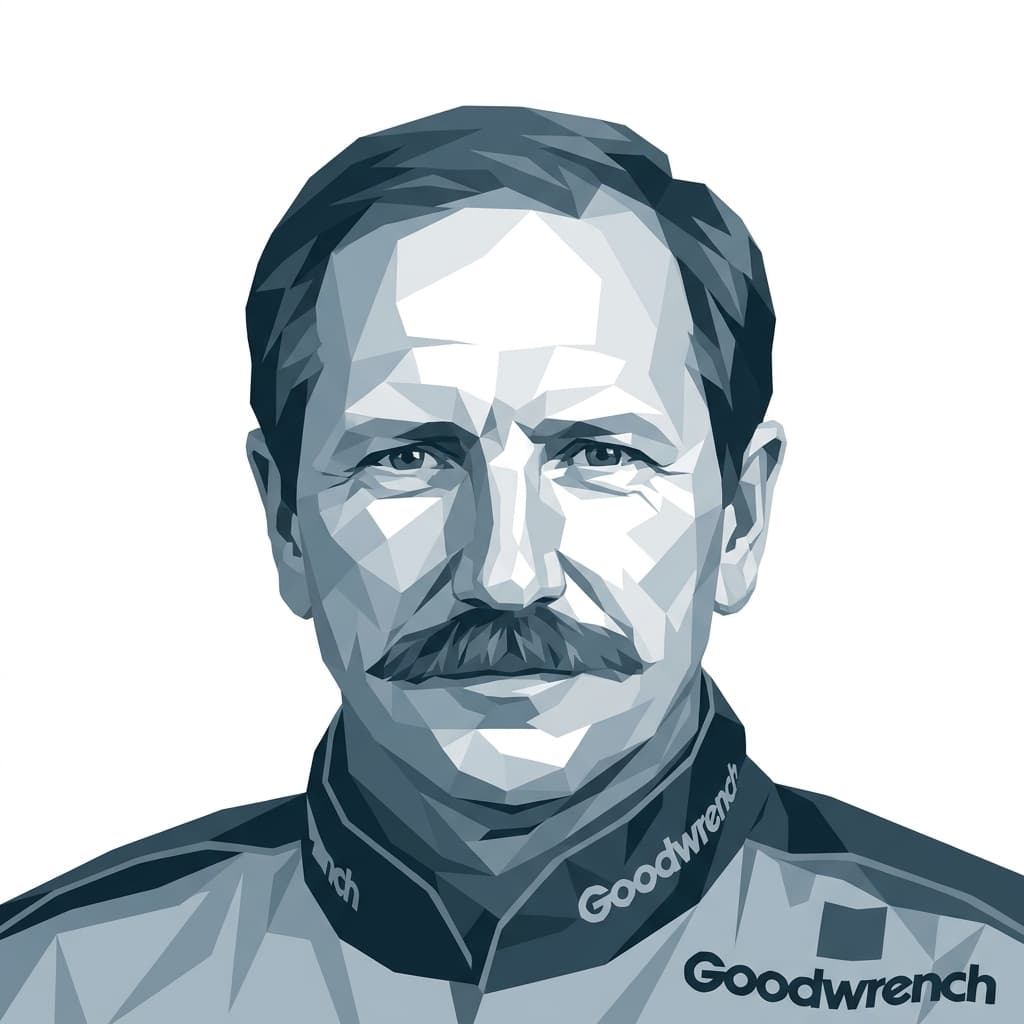
Seven-time NASCAR Cup Series champion known as "The Intimidator," widely regarded as stock car racing's greatest driver.
Design
- Q19.4
- h33.4
- R1.6
- g22.3
- i47.3
- S54.3
- T30.6
- U37.2
- V37.6
- W46.5
- X52.3
- Y57.5
- Z7.6
Personality
- Q24.2
- h44.2
- R49.6
- g22.1
- i47.1
- S3.6
- T35.6
- U2.2
- V25.4
- W6.4
- X52.3
- Y57.3
- Z7.5
Dale Earnhardt was a Projector — the type designed to read a system so deeply that they can steer it from a position most people don't even notice. In his case, the system was a stock car at 190 miles an hour, and the reading happened in real time, through the steering wheel, the tires, and the tiny air currents coming off the car in front of him. He didn't outwork the field. He out-saw it.
He grew up in Kannapolis, North Carolina, the son of short-track legend Ralph Earnhardt, and he dropped out of school in the eighth grade to work on cars. That decision haunted him — he later called it his single biggest regret — but it fit the pattern of a 2/4 profile, someone who develops his craft in near-total privacy and then emerges into a tight community that already knows him. The garages of the Carolina short-track circuit were that community. By the time he reached Winston Cup in the late 1970s, he'd been quietly mastering the car for years, studying in solitude what he'd later share with the whole sport.
On the track he became "The Intimidator," and the nickname captured something real: he had instincts for pattern and consequence that let him predict a wreck three cars ahead, and a body-level knowing about when to commit and when to lift that no telemetry could teach. The famous 1998 Daytona 500 win, after twenty years of trying, came from exactly this — he'd studied every previous failure and finally read the draft correctly on the last lap. His authority was Emotional, which showed up in a career-long refusal to make hot decisions; teammates described him as maddeningly quiet after a bad race, going home to the farm to let the feeling settle before saying anything about it.
The other side of the Projector wiring was that he was a natural guide who waited to be recognized before extending himself. He didn't campaign for Richard Childress; Childress came to him, and the partnership that produced six championships was built on an invitation Earnhardt honored for the rest of his life. With younger drivers — Jeff Gordon, his own son Dale Jr., Michael Waltrip — he was famously prickly until they asked, and then he'd tell them everything, the reluctant leader whose counsel carried real weight precisely because it was never volunteered.
Away from the track he was different than the black-hat persona suggested. He was deeply loyal to a small circle of family and crew, preferred the quiet of his farm, his tractors, his chickens, and the deer he wouldn't let anyone hunt to any celebrity appearance, and turned down endless invitations to be somewhere other than home. The mustache and the sunglasses did the talking so he wouldn't have to. He was an original who never tried to fit anyone else's mold of what a champion should look like.
He died on the last lap of the 2001 Daytona 500, blocking for his son and Waltrip so they could finish 1-2. The move was in character — a warrior's instinct, a final act of stewarding other people's success. NASCAR overhauled its safety standards in the years that followed. His seven championships still stand tied for the all-time record.
Sources: biography · birth data
What do you and Dale Earnhardt have in common?
Enter your birth details to find out