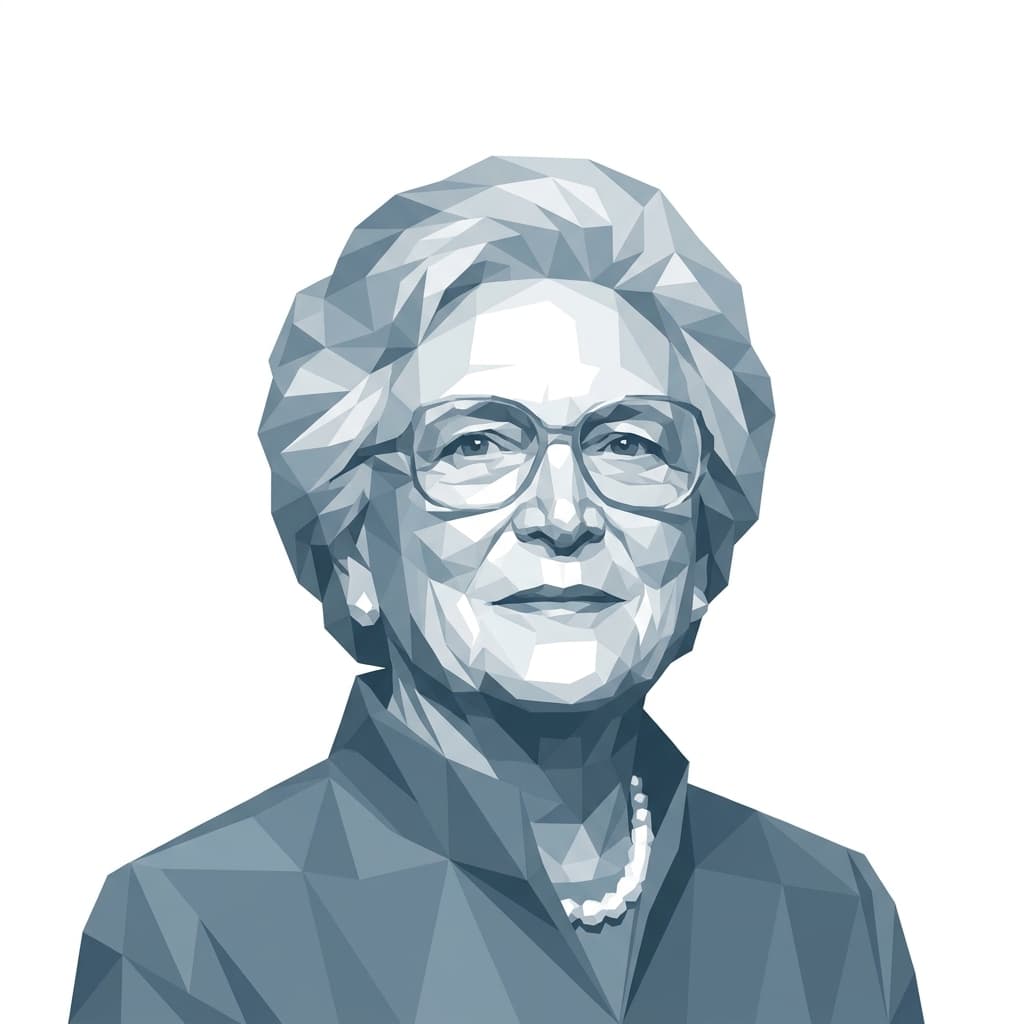
First Lady of the United States, matriarch of a political dynasty, and literacy advocate.
Design
- Q22.3
- h47.3
- R47.4
- g7.1
- i13.1
- S36.2
- T37.3
- U23.3
- V54.3
- W1.1
- X22.5
- Y4.2
- Z39.3
Personality
- Q45.1
- h26.1
- R54.2
- g31.4
- i41.4
- S20.5
- T15.2
- U53.5
- V61.1
- W44.1
- X36.3
- Y4.2
- Z39.4
Barbara Bush was a Projector — designed less to do everything herself than to see people clearly and steward the energy around her — and her decades in American public life read exactly that way. She was the wife of one president and the mother of another, but the role she carved out was neither ornamental nor executive. It was observational, sharp, and unmistakably her own.
Born Barbara Pierce in 1925 to a Rye, New York publishing family, she met George H.W. Bush at a Christmas dance when she was sixteen, and by all accounts made up her mind about him almost immediately. That kind of instant, uncomplicated knowing — the quiet certainty that doesn't need reasons — was a hallmark of how she operated her whole life. She dropped out of Smith College to marry him in 1945, then followed him from Texas oil fields to Washington to Beijing to the CIA, moving twenty-nine times in forty-four years. She raised six children, lost her three-year-old daughter Robin to leukemia, and turned prematurely white in her twenties from the grief.
As Second Lady and then First Lady, she made literacy her signature cause, founding the Barbara Bush Foundation for Family Literacy in 1989. It was a 1/3 investigator's project — rooted in her own experience of reading to Robin during her illness, then tested and refined through years of school visits, prison classrooms, and reading programs. She wanted to know how the problem actually worked before she'd talk about it, and then she wanted to put the answer in language anyone could grasp.
She was famous, and sometimes infamous, for saying exactly what she thought. Her 1990 Wellesley commencement address — delivered over student protests about her being defined by her husband — became a landmark of graceful pushback. She called Geraldine Ferraro a word that "rhymes with rich" and then apologized without quite taking it back. She had the timing of someone who knew when a room needed shaking, and she used it. Reporters loved her because she was quotable; her husband's staff feared her because she remembered everything and everyone. She kept a mental ledger of who had been loyal, who had crossed the family, and who deserved the kind of loyalty that gets returned in kind.
Behind the pearls and the white hair — which she'd stopped dyeing decades earlier, refusing to pretend — she was the household's real center of gravity. She managed the family's public face, edited her husband's instincts, and offered guidance the family actually asked for rather than pushing herself into the spotlight. When her son Jeb ran for president in 2016, she initially said publicly that the country had "had enough Bushes" — a piece of truth-telling in real time that no political consultant would have approved.
She died in 2018 at 92, having refused further medical intervention and chosen "comfort care" at home in Houston. It was a final act of knowing exactly when something was complete — clear-eyed, unsentimental, and entirely on her own terms.
Sources: biography · birth data
What do you and Barbara Bush have in common?
Enter your birth details to find out