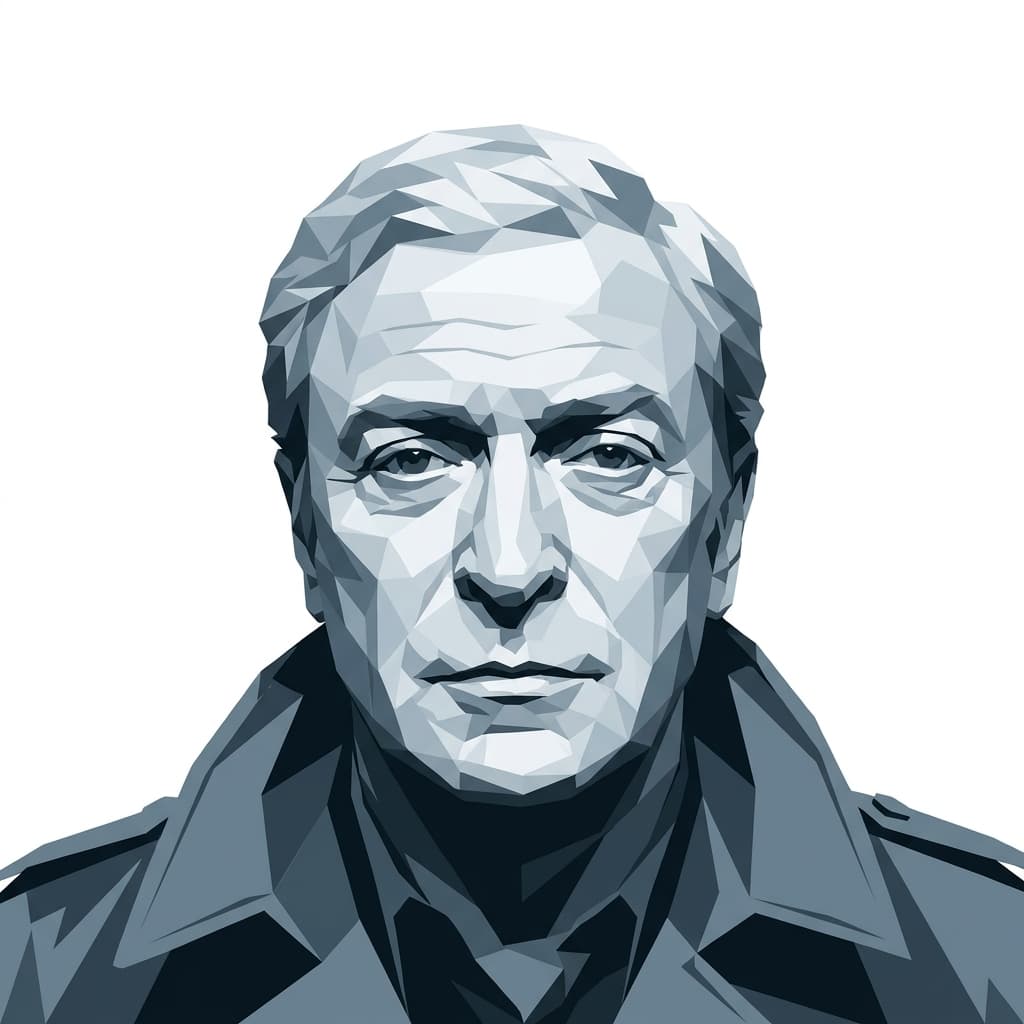
British actor whose seven-decade career turned Cockney charm into Oscar-winning craft and quiet authority.
Design
- Q11.3
- h12.3
- R7.3
- g37.6
- i40.6
- S34.6
- T14.1
- U64.3
- V47.6
- W41.1
- X51.5
- Y40.5
- Z62.3
Personality
- Q36.1
- h6.1
- R32.4
- g37.3
- i40.3
- S17.4
- T63.3
- U40.1
- V47.1
- W19.6
- X42.1
- Y40.3
- Z62.1
Michael Caine is a Projector — built not to grind through roles but to study people, distill what he sees, and deliver it with a precision that looks easy from the outside. Born Maurice Micklewhite in a Rotherhithe tenement, he spent his early twenties in repertory theatres and bit parts, watching working actors the way a mechanic watches engines. He has said in interviews that he learned the craft mostly by being broke and paying attention — the long apprenticeship of someone who needs to know how the thing actually works before he'll trust himself to do it on camera.
His breakout in Zulu came at 30, after a decade of rejection, and Alfie and The Ipcress File arrived almost immediately after. That pattern — long obscurity, then sudden recognition — is the 1/3 profile in miniature: deep foundational study followed by a series of public experiments, some glorious (Get Carter, Sleuth, The Man Who Would Be King) and some he cheerfully calls disasters (Jaws: The Revenge, The Swarm). He has been famously unembarrassed about the bad ones, treating each as tuition paid toward the next role, and his memoirs return again and again to what he learned from the flops.
Caine waited for the work to come to him in a way that looks like luck but is closer to strategy. He turned down very little once an offer arrived — he is candid about taking jobs for the paycheque and the location — but he didn't chase, didn't campaign, didn't audition once he was established. The Caine method instead was readiness: knowing his lines, knowing the other actor's lines, arriving on set with the homework already done so that when Huston or Mankiewicz or Nolan called, he could simply step in and deliver.
He is a famously emotional man underneath the unflappable exterior — capable of welling up in interviews about his mother decades after her death, still tearful describing the moment he met his wife Shakira on a Maxwell House coffee advert in 1971. He has talked openly about the slow-burn certainty of that marriage: he saw her on television, found her, and waited. More than fifty years later they still live together in Surrey. The same patience shows up in how he talks about money and class — a working-class boy's instinct for what is worth keeping and what is wasteful spectacle.
On screen his gift is restraint. The famous Caine performances — Jack Carter, Frank in Educating Rita, Alfred Pennyworth — work because he holds back where lesser actors would push. He understood early that the camera reads thought, and that knowing exactly when to speak and when to let the silence do it is most of film acting. He has taught masterclasses on this for the BBC, and the advice is always specific: don't blink, use the other actor's eye-line, the small precise thing instead of the big general one.
In his eighties he announced retirement, unretired, and quietly retired again — a man who, having been recognised more than enough, finally allowed himself the rest he'd earned but rarely taken. The cockney kid from the Elephant became a knight of the realm and seems, by all accounts, genuinely surprised it worked out.
Sources: biography · birth data
What do you and Michael Caine have in common?
Enter your birth details to find out