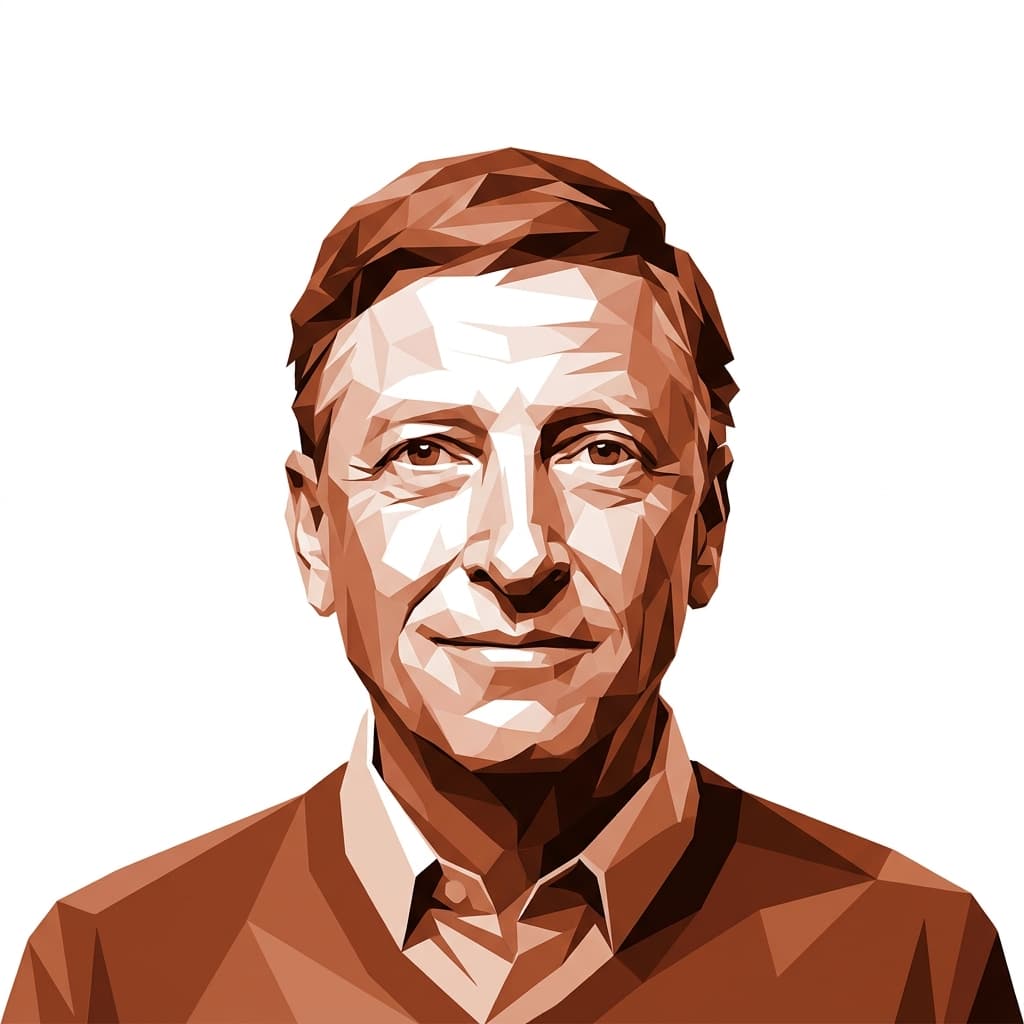
Microsoft co-founder turned philanthropist who reshaped personal computing and global health funding.
Design
- Q31.6
- h41.6
- R11.3
- g11.4
- i12.4
- S56.5
- T56.2
- U33.6
- V33.3
- W1.2
- X56.3
- Y32.6
- Z29.2
Personality
- Q28.4
- h27.4
- R17.5
- g26.2
- i45.2
- S57.2
- T43.2
- U48.1
- V29.4
- W43.3
- X31.1
- Y50.2
- Z29.5
Bill Gates is a Generator — built for deep, sustained engagement with work that lights him up, and his life reads like a case study in what that stamina can build when it's pointed at a single field. He famously spent his teenage years locked in a University of Washington computer room until the early hours of the morning, and decades later described reading textbooks cover-to-cover on vacation as a form of pleasure. That's not discipline in the willpower sense; it's the gut pull toward the thing that actually satisfies, running on a very long battery.
The Microsoft origin story is a wait-to-respond story more than a Manifestor one. Gates didn't invent the microcomputer; he read the January 1975 Popular Electronics cover about the Altair 8800, called MITS, and offered them a BASIC interpreter that didn't quite exist yet. Then he and Paul Allen built it in eight weeks. The pattern repeats: IBM comes looking for an operating system, Gates responds, licenses QDOS, and turns it into MS-DOS. He was extraordinarily good at seeing which opportunities were worth the whole company's weight and which weren't.
Inside the company he was famous for opinions ground into shape through logic and evidence, and famously willing to tell engineers their code was the stupidest thing he'd ever seen. Colleagues describe a mind that ran on ideas arriving faster than most rooms could keep up with, paired with a persuasive edge that turned technical bets into industry defaults. The 1998 antitrust deposition — hunched, evasive, litigating the meaning of "concern" — was that same energy without the room reading it charitably. He could win an argument and lose the audience in the same breath.
His 4/6 profile frames the whole arc almost too neatly. The first phase was experimentation and combat: dropping out of Harvard, the browser wars, the deposition years, a personal life he mostly kept private. The transition came in stages — stepping down as CEO in 2000, then as chairman, then leaving day-to-day work entirely. What emerged was the role model on the roof: a man in a sweater on a TED stage talking about mosquitoes, malaria nets, and toilet design, sharing wisdom from a life that had actually been through the mess.
The Gates Foundation is the second act, and it's where his instinct to steward large resources toward collective outcomes finally has a clean expression. He reads roughly fifty books a year, writes long annual letters, and applies the same depth-first, until-the-problem-yields approach to polio eradication and agricultural yields that he once applied to shipping Windows 95. He picks a domain, disappears into it, and re-emerges with a plan and a check.
The public Gates in 2024 is a somewhat lonelier figure — divorced, entangled in reputational fallout from the Epstein association, publicly criticized by his ex-wife and daughter. But he still shows up in the same posture: committed to problems that take twenty years to move, reading, arguing, funding, and treating the long, hard fight as the point rather than the cost.
Sources: biography · birth data
What do you and Bill Gates have in common?
Enter your birth details to find out