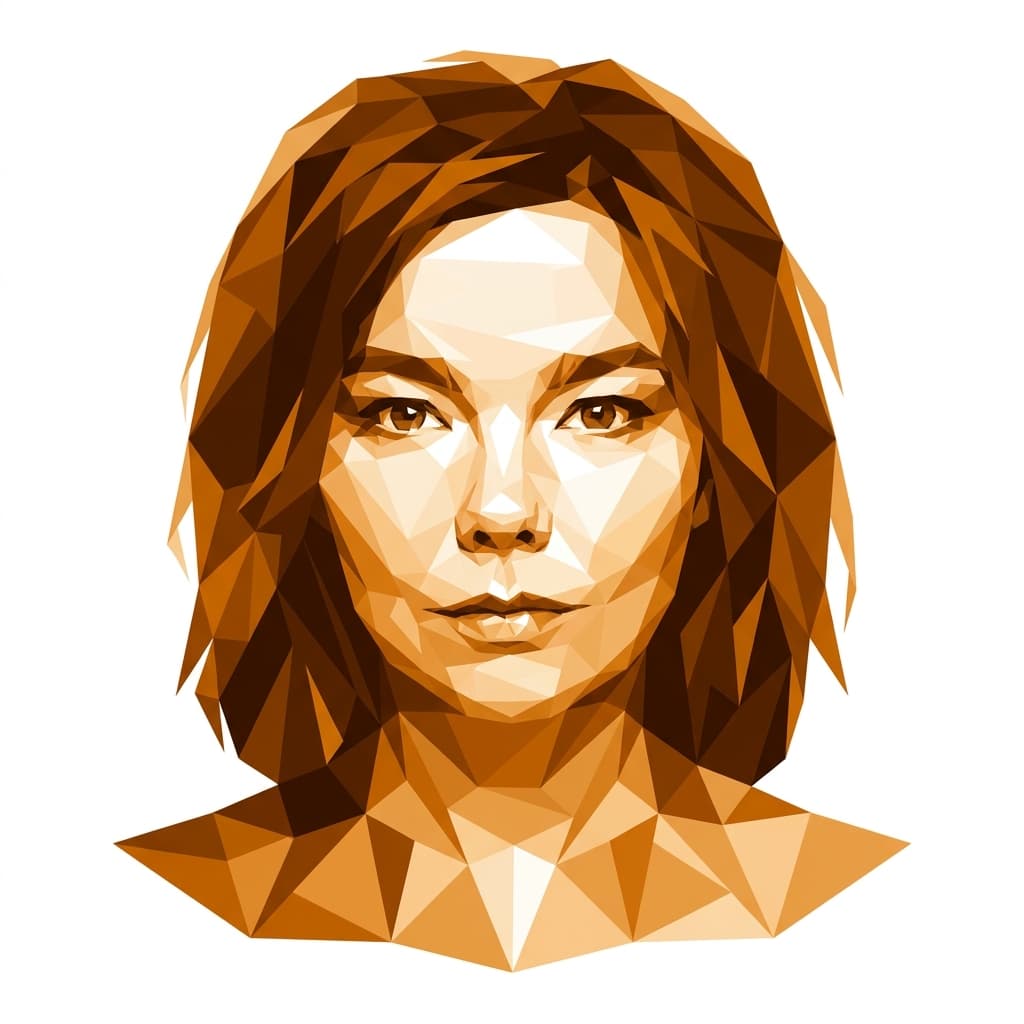
Icelandic singer, composer, and producer whose genre-defying work fuses avant-garde electronics, orchestral scores, and primal voice.
Design
- Q59.1
- h55.1
- R62.4
- g16.5
- i9.5
- S7.5
- T18.2
- U28.1
- V12.5
- W63.4
- X64.4
- Y1.5
- Z64.5
Personality
- Q14.5
- h8.5
- R28.5
- g20.5
- i34.5
- S26.2
- T54.1
- U58.2
- V15.2
- W37.6
- X47.3
- Y43.2
- Z47.2
Björk Guðmundsdóttir is a Manifesting Generator — wired to chase several passions at once without picking just one — and her career is a forty-year demonstration of exactly that. She released her first album at eleven, fronted the punk band Kukl, then the Sugarcubes, then dissolved both to build a solo body of work that treats each album as a wholly different instrument: Debut's club-jazz, Homogenic's string-and-beat architecture, Medúlla's all-vocal cathedral, Biophilia's app-driven pedagogy. She doesn't so much change direction as follow whatever her gut lights up next, and she informs the world after the fact.
Her 5/1 profile — the investigator who becomes an authority — shows up in how she works. Before Biophilia she spent years reading about musicology, neurology, and Tesla coils; before Vulnicura she wrote pages of harmonic analysis with Arca. She retreats to Iceland, disappears into research, and returns with something nobody asked for but that turns out to be the solution to a problem the culture didn't know it had. When she agrees to a collaboration, it's with the full-body yes that doesn't need to be explained — and when she declines, as she famously did to countless Hollywood offers after Dancer in the Dark, the no is just as absolute.
The texture of her catalog is a study in pure originality as a way of being — swan dresses, throat-sung ballads, an album distributed as an iPad app. She has a natural instinct for spotting the strange new thing before anyone else notices it, which is why Arca, FKA twigs, Serpentwithfeet, and Rabit all appeared in her orbit before the wider world caught on. Her whole practice runs on an appetite for the extremes most artists avoid — grief albums, ecology albums, a record made entirely from mouths — and she trusts that the wisdom she brings back from those edges is the point.
The voice itself is a Gate 12 instrument: emotion released at the exact moment it becomes unbearable to hold, whether it's the whispered restraint of "Unravel" or the shattered howl of "Black Lake." She works from emotional highs and lows treated as raw creative material rather than problems to smooth over — Vulnicura mapped her divorce in real chronological time, and Utopia mapped the reconstruction afterward. Even her most abstract records are diaries.
She has always been the reluctant leader others project onto, pushed into being the face of Icelandic music, of art-pop, of women in electronic production — roles she accepts on her own terms and abandons when they stop fitting. Her drive toward mastery through obsessive repetition means she'll spend two years learning a new software before releasing a note made with it, and her instinct for what in the system needs fixing has made her an outspoken critic of aluminum smelters in Iceland, of the music industry's treatment of women, of the way streaming flattens albums into playlists.
At sixty, she is still recording, still touring elaborate stagings, still refusing to niche down. The through-line isn't a sound; it's a person doing what genuinely lights her up, at her own speed, and letting the culture catch up when it can.
Sources: biography · birth data
What do you and Björk have in common?
Enter your birth details to find out