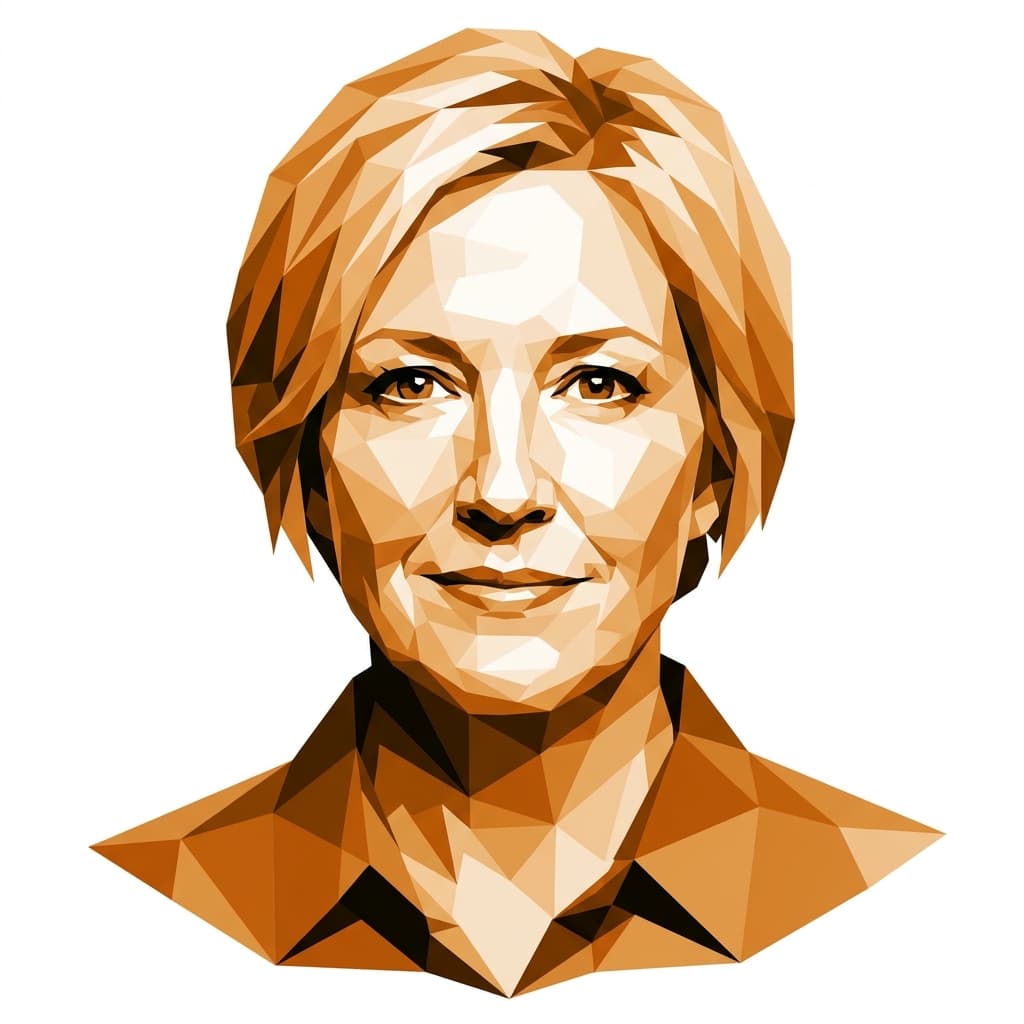
Research professor and storyteller whose work on vulnerability, shame, and courage reshaped modern leadership conversations.
Design
- Q29.4
- h30.4
- R35.2
- g16.6
- i9.6
- S7.6
- T46.5
- U50.5
- V12.4
- W63.4
- X64.3
- Y1.5
- Z64.5
Personality
- Q14.2
- h8.2
- R46.1
- g20.5
- i34.5
- S26.1
- T38.4
- U10.6
- V15.2
- W37.6
- X47.3
- Y43.2
- Z47.2
Brené Brown is a Manifesting Generator — built to chase several threads at once and braid them into something useful — and her career is the proof. She is at once a tenured research professor at the University of Houston, a qualitative methodologist running grounded theory studies on shame, a bestselling author, a podcaster, a Netflix special headliner, and an advisor to Fortune 500 leadership teams. None of that was the plan. She spent years collecting thousands of interview transcripts before her 2010 TEDxHouston talk on vulnerability quietly became one of the most-watched TED talks of all time, and the speed at which she pivoted from academic to public voice after that — without abandoning the academic part — is exactly the non-linear path of someone who refuses to niche down.
Her 2/4 profile — the hermit who also happens to be the connector — explains a lot of the contradictions people notice in her. She has built one of the most public careers imaginable around an inner life that requires enormous amounts of solitude to recharge and write, and she is candid about needing to retreat to her Houston home and her family before she can show up again. The opportunities, though, have always come through community: a local TEDx invite, a friend who put her in front of Oprah, the small Houston congregation of researchers and clinicians who first took her shame work seriously. She tends to credit the people around her with seeing what she couldn't yet see in the gifts that came easiest to her.
What people respond to in her work is the gut-level certainty underneath the data. She'll cite Theodore Roosevelt and a regression analysis in the same breath, but the through-line is a full-bodied yes from somewhere deeper than her notes. She has talked openly about the 2007 "breakdown spiritual awakening" when her own research findings — that wholehearted people practice vulnerability — collided with her preference for armor, and the only honest move was to follow the body before the mind caught up.
Her gates show up most clearly in the language she uses. The Daring Greatly framework is a fight worth having on behalf of people daring to show up. The work on shame resilience is built from pattern-recognition across thousands of stories of past pain, then translated into the aha moments that make people exhale in their cars. When she names something — "vulnerability hangover," "the arena," "clear is kind" — she's doing what natural truth-tellers do when the timing is finally right, giving language to what people already felt but couldn't say.
She is, underneath the platform, a deeply community-rooted Texan loyal to her people — her sisters, her husband Steve, her kids, her research team, her dogs — and she has been protective of that inner circle in a way that reads as both discernment about what's worth her energy and self-love that refuses to perform a version of her that isn't real. The empire grew because she wouldn't shrink the human at the center of it.
Sources: biography · birth data
What do you and Brené Brown have in common?
Enter your birth details to find out