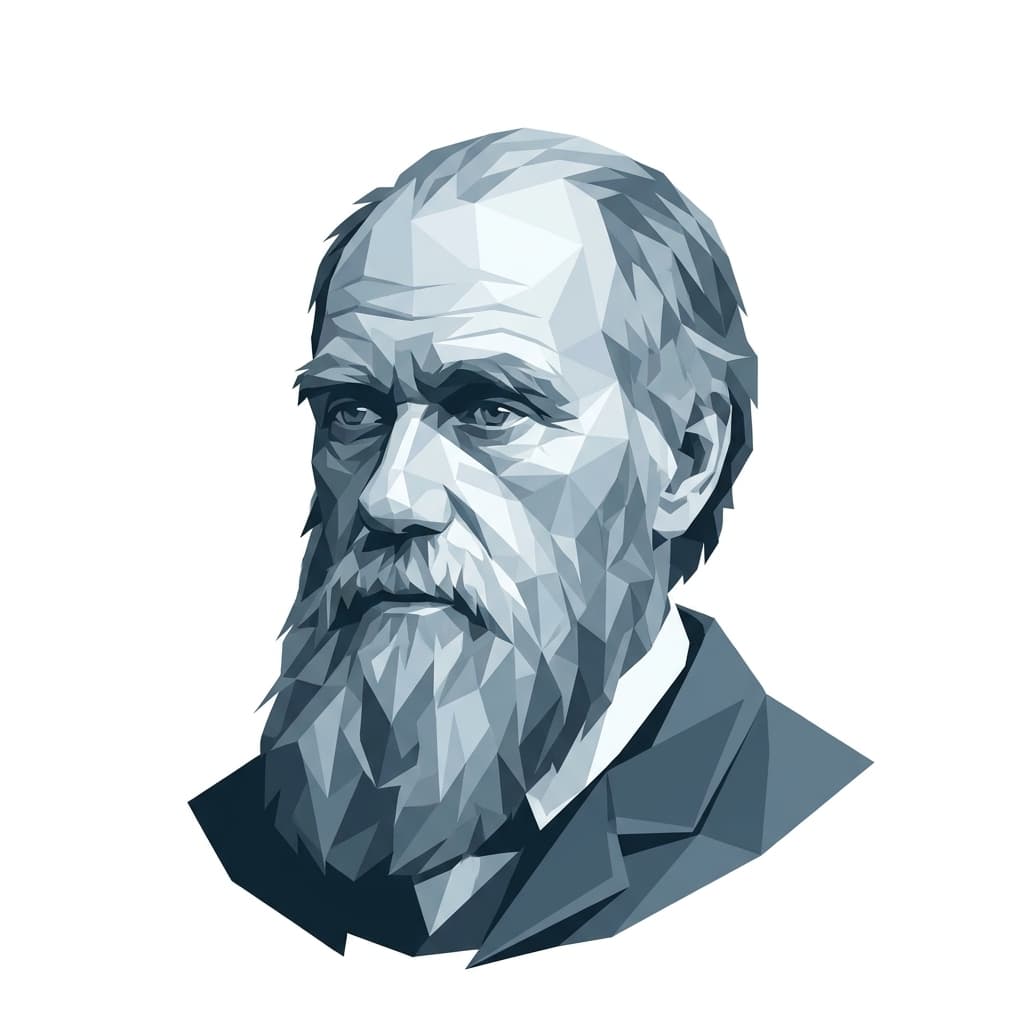
English naturalist whose theory of evolution by natural selection transformed biology and human self-understanding.
Design
- Q14.1
- h8.1
- R1.4
- g44.6
- i24.6
- S14.3
- T26.6
- U47.2
- V37.3
- W14.1
- X28.5
- Y34.5
- Z63.2
Personality
- Q49.5
- h4.5
- R61.1
- g28.5
- i27.5
- S37.5
- T17.4
- U32.5
- V22.6
- W34.4
- X44.3
- Y9.1
- Z63.3
Charles Darwin was a Projector — built to observe rather than produce, to see patterns in the natural world that no one else was quite looking for. He spent five years on HMS Beagle not doing much in the conventional sense: collecting beetles, sketching finches, watching tortoises, filling notebooks. Then he came home and spent another twenty-two years mostly sitting in a study at Down House, letting the observations settle into a theory. The pace was not a failure of ambition. It was the shape of how his mind actually worked.
The Beagle voyage itself arrived as exactly the kind of invitation his Strategy required: Captain FitzRoy wanted a gentleman companion, and Darwin's Cambridge mentor John Henslow recommended him. He had not applied, campaigned, or angled for it. When the offer came, something quiet and immediate said yes, even as his father initially refused permission. That instinctive knowing — the split-second recognition that this was the thing — is the signature move of a life that otherwise looked cautious and slow.
His 5/1 profile — the investigator who eventually offers the world a solution — describes the entire twenty-two-year gap between returning to England in 1836 and publishing On the Origin of Species in 1859. He was building the foundation. He wrote a four-volume monograph on barnacles first, spending eight years concentrating on tiny anatomical details most naturalists found tedious, because he refused to speak on species before he had earned the right to. His notebooks are full of the compulsion to understand the mechanism, not just describe the phenomenon — how, exactly, does a finch's beak change shape across generations?
The theory itself was born from relentless questioning of what everyone else took as given: why are Galápagos species so similar to South American ones but subtly distinct? Why do embryos of different species look nearly identical? He was alert to patterns across vast time, reading Malthus on population and instantly recognizing the missing piece — the struggle for existence that gives selection something to work on. He famously delayed publication until Alfred Russel Wallace sent him a paper outlining the same idea, forcing the joint 1858 presentation to the Linnean Society. Even then, Darwin's public self-expression was cautious, private, almost reluctant.
He was not a public brawler. Thomas Huxley — "Darwin's bulldog" — did the fighting for him at Oxford in 1860. Darwin stayed home, chronically ill, tending his garden, caring meticulously for his ten children and his wife Emma, whose religious grief over his ideas he took seriously his whole life. He kept experimenting: earthworms, orchids, climbing plants, the expression of emotion in humans and animals. Each late book was another patient investigation, another framework offered to a world that had finally learned to listen.
What he left behind wasn't just a theory but a way of looking — the habit of watching long enough for the pattern to reveal itself, and the humility to publish only what the evidence could actually carry.
Sources: biography · birth data
What do you and Charles Darwin have in common?
Enter your birth details to find out