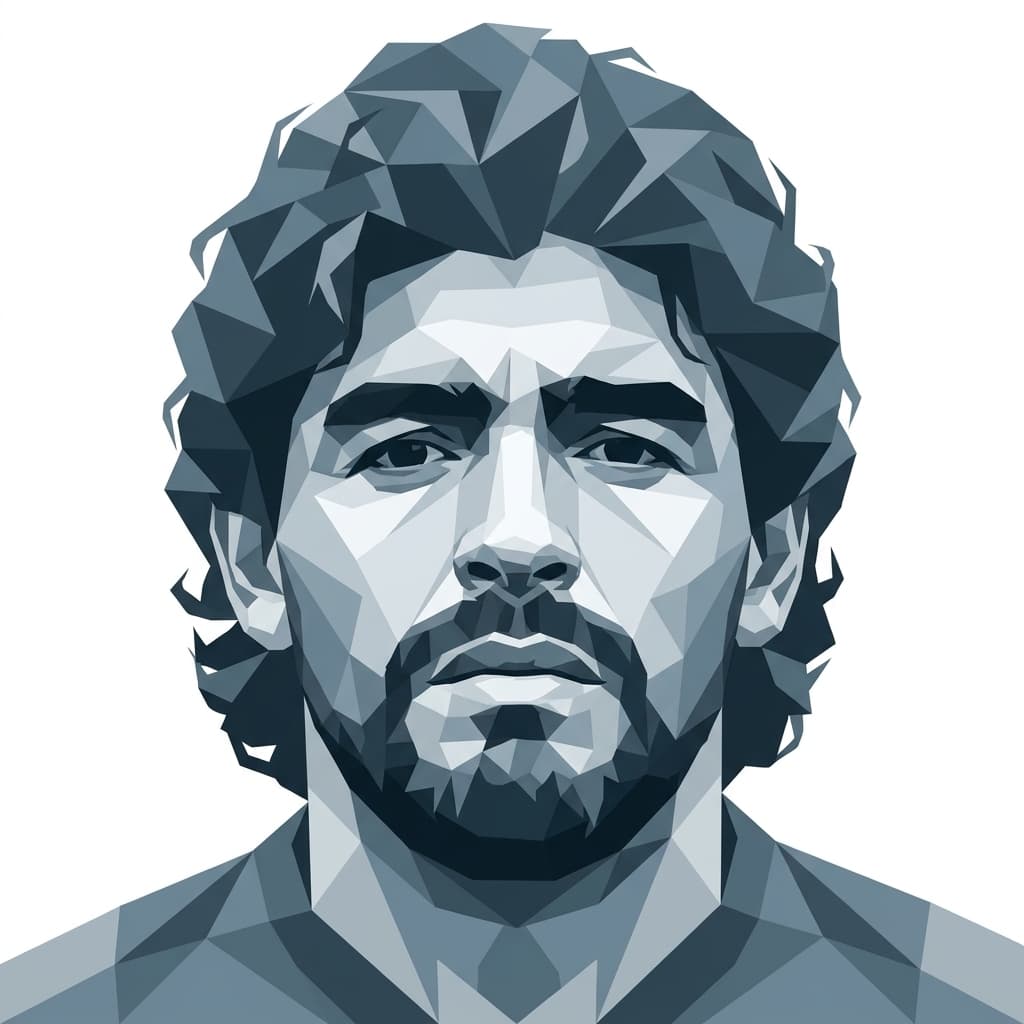
Argentine footballer widely considered the greatest of all time, captain of the 1986 World Cup winners.
Design
- Q33.2
- h19.2
- R1.6
- g64.6
- i63.6
- S62.1
- T4.2
- U8.6
- V11.2
- W38.5
- X4.2
- Y28.5
- Z59.6
Personality
- Q28.6
- h27.6
- R63.6
- g64.4
- i63.4
- S43.5
- T9.6
- U53.1
- V10.3
- W38.5
- X29.1
- Y44.2
- Z40.3
Diego Armando Maradona was a Projector — not the endless-motor athlete the sport usually canonizes, but a rarer thing: a seer with a left foot, someone whose genius was in how he read the field rather than how much ground he covered. He grew up in Villa Fiorito, the muddy outskirts of Buenos Aires, juggling an orange because he didn't own a proper ball, and from the beginning what set him apart wasn't stamina but a kind of instantaneous perception — seeing three passes before anyone else saw one.
His breakthrough at Argentinos Juniors came at fifteen, and Boca followed, but it was the invitation to Barcelona and then Napoli that revealed the pattern of his career: he needed a club, a city, a people to summon him before his gift fully arrived. Napoli in 1984 was a broke, mocked southern club, and Maradona chose it precisely because he could feel the recognition waiting there — a whole city that needed a hero. He gave them two Serie A titles and, in doing so, became something closer to a saint than a footballer, carrying the pride of a place that had none.
The 1986 World Cup in Mexico was the 6/2 profile delivering its promise early — a role model crowned at 25, in a tournament he essentially won by himself. The two goals against England, four minutes apart, are the whole man in miniature: the Hand of God, an instinctive, unexplainable act done in a split second, followed by the slalom through half the English team, which he later said he'd rehearsed against Cesarini's youth team as a boy. He was an original whose creativity refused to look like anyone else's, a left foot that seemed to have its own theology.
He fought constantly — with referees, with FIFA, with the English, with the Italian tax office, eventually with his own body. Gate 38's instinct to stand up against whoever was biggest in the room drove him into causes most players wouldn't touch: he backed Fidel, embraced Chávez, decorated his arm with Che. It also drove him into the darker fights that weren't really worth fighting — the cocaine years in Naples, the ban after Ephedrine at USA '94, the wilderness decade of weight, illness, and public collapse. He committed to everything the way he committed to a match: saying yes with his whole body until there was nothing left.
The retreat years — Cuba, rehab, the long recovery — were the 6/2's mandatory withdrawal, and he emerged transformed into a coach, a television personality, and finally, improbably, the manager who took Argentina to the 2010 World Cup quarterfinals. He was never a tactician; he was a presence, a pattern-reader who could see which player had it that day and which didn't. When he died in November 2020, Argentina stopped for three days. The boy from Fiorito had done what Projectors do at their most extreme: he had let an entire people recognize themselves through him.
Sources: biography · birth data
What do you and Diego Maradona have in common?
Enter your birth details to find out