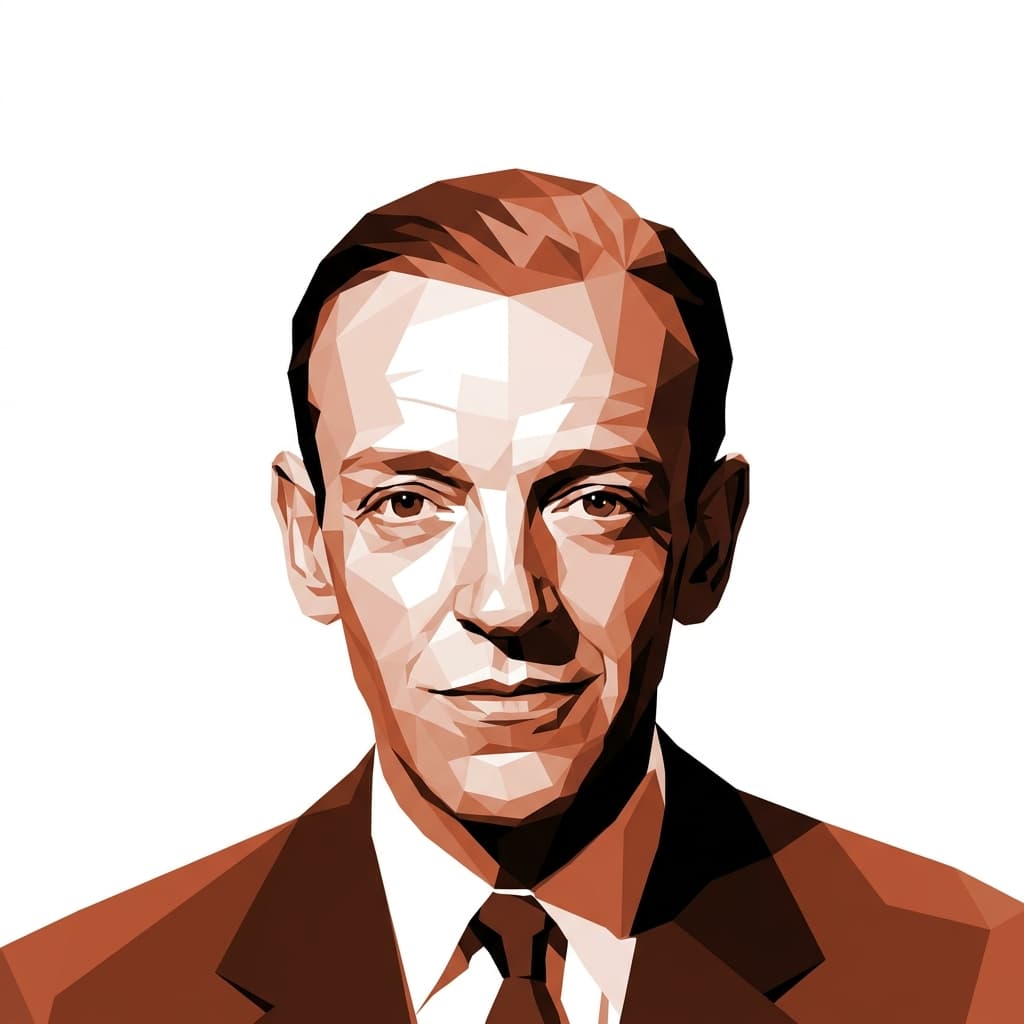
American dancer, singer, and actor who redefined film musicals with elegance, precision, and relentless rehearsal.
Design
- Q49.4
- h4.4
- R55.3
- g58.5
- i52.5
- S19.3
- T58.2
- U62.1
- V44.3
- W26.5
- X9.3
- Y45.6
- Z35.3
Personality
- Q23.2
- h43.2
- R16.2
- g10.2
- i15.2
- S42.4
- T51.2
- U33.4
- V28.2
- W26.6
- X9.2
- Y12.1
- Z35.4
Fred Astaire was a Generator — built for the long, satisfying grind of doing one thing over and over until it looked like breathing. His entire career was a monument to that stamina: a small, unshowy man from Omaha who outworked everyone in Hollywood and made the labor invisible.
He and his sister Adele toured vaudeville from childhood, then conquered Broadway and the West End through the 1920s. When Adele married into the British aristocracy and retired in 1932, Fred was thirty-three and suddenly solo — a moment of forced completion that reads exactly like the closing of one cycle to make room for the next. His famous RKO screen test allegedly earned the note "Can't act. Slightly bald. Can dance a little." He signed anyway, and the response he'd been waiting for the right thing to say yes to arrived in the form of Ginger Rogers.
The rehearsal habits became legend. Astaire would work a single routine for weeks, drilling six, eight, ten hours a day with choreographer Hermes Pan, refining a shoulder angle or a hat toss until it disappeared into ease. This was mastery built through obsessive, unglamorous repetition, fused with the kind of focused stillness that lets a body find one exact answer. He insisted on full-figure camera framing and long unbroken takes, so the audience would see the dance was real. That refusal to let editors fake the work was a quiet insistence on doing things the right way, his way.
His 2/4 profile fit him almost too well. Astaire was famously private, uncomfortable with publicity, happier on a rehearsal floor or at the racetrack than at parties — the natural talent who genuinely didn't understand what all the fuss was about. Yet the opportunities came through the network: the Gershwins wrote for him, Kern and Berlin wrote for him, Ginger was placed opposite him by studio friends who saw what he couldn't quite see in himself. He was the hermit whose gifts kept getting pulled into the world by the people around him.
He was also a quiet perfectionist about small things — the tilt of a tie, the drape of a jacket, the exact tempo of a Cole Porter verse. He'd fret a phrase for days before recording it, which is how someone with an ear for when a lyric wants to land and when it wants to wait sings "Night and Day" with that particular held-breath restraint. Composers loved writing for him because he treated a song as something to be refined toward its best possible shape, never oversold. His singing voice, thin and unshowy, worked because he never pushed it past what it could truthfully do.
Astaire kept working into his seventies — dramatic roles, television specials, a late second act as a character actor — and refused for decades to sit for a proper biography, processing his own life mostly in private before releasing anything to the public. When he died in 1987, he left a body of work that still teaches dancers a specific lesson: the answer is almost always one more rehearsal.
Sources: biography · birth data
What do you and Fred Astaire have in common?
Enter your birth details to find out