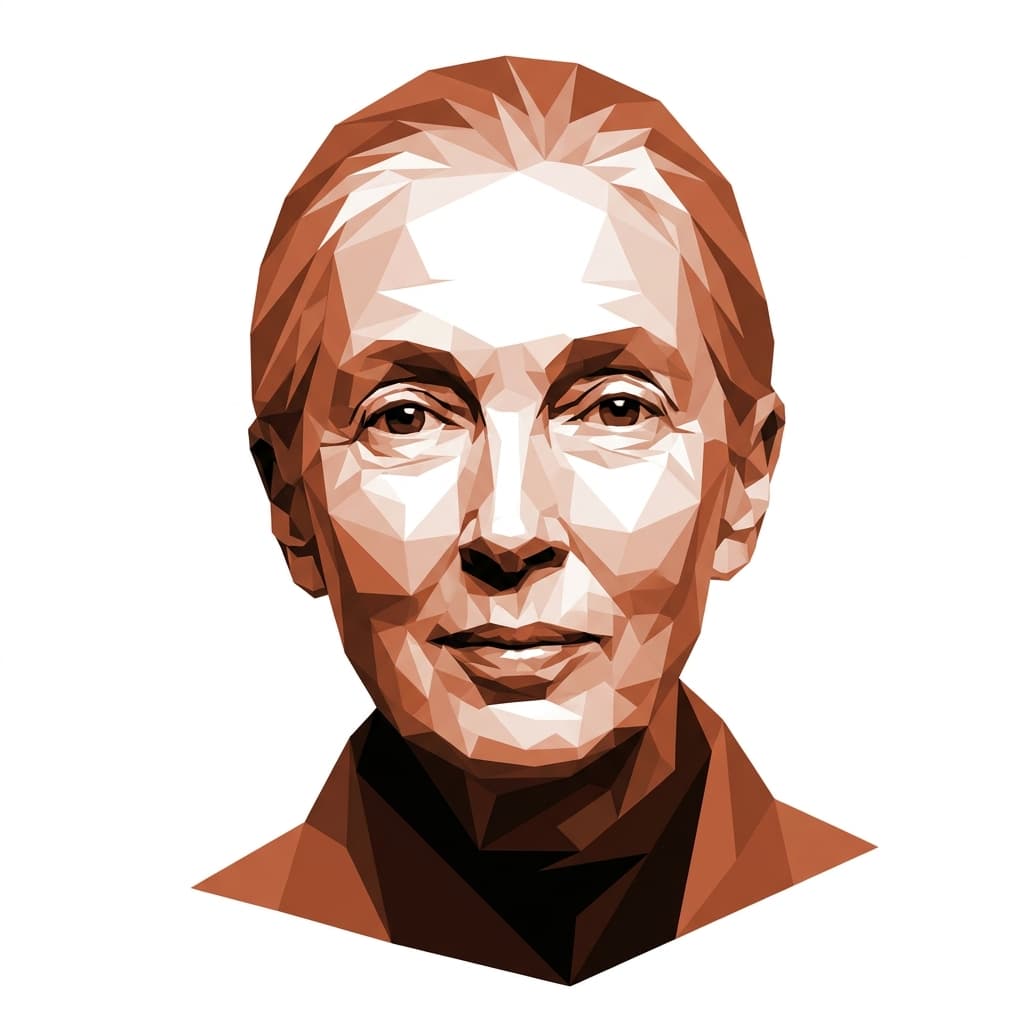
English primatologist whose decades-long study of wild chimpanzees transformed our understanding of animal behavior.
Design
- Q54.1
- h53.1
- R47.1
- g49.1
- i4.1
- S58.4
- T49.4
- U41.6
- V32.1
- W13.2
- X42.3
- Y64.1
- Z62.4
Personality
- Q21.5
- h48.5
- R34.4
- g13.5
- i7.5
- S63.5
- T30.4
- U51.1
- V57.5
- W30.1
- X3.1
- Y40.5
- Z62.2
Jane Goodall is a Generator — built for the long, patient, deeply absorbing work that mastery actually requires, and the arc of her life is a study in what happens when one person stays with a question for sixty years. She arrived at Gombe Stream in 1960 with no degree, a notebook, and her mother as a chaperone, sent by Louis Leakey because he wanted someone whose mind hadn't been narrowed by academic training. What she had instead was stamina, curiosity, and a willingness to sit in one place until something happened.
She sat for months before the chimpanzees stopped fleeing. Then she watched David Greybeard strip leaves from a twig and use it to fish termites from a mound — the observation that famously made Leakey cable back, "Now we must redefine tool, redefine Man, or accept chimpanzees as humans." The discovery is often told as a stroke of luck, but it was really the payoff of the kind of sustained attention that only comes from genuine fascination, of waiting until the forest itself offered something back. She named the chimps — Flo, Fifi, Frodo, Goliath — over the objections of a scientific establishment that wanted them numbered, and refused to budge.
Her 5/1 profile — the investigator who eventually becomes a public authority — describes the shape of her career almost too neatly. For two decades she was a field researcher, building a foundation in the patient cataloguing of small daily observations and letting patterns surface slowly from years of fragmented impressions. Then, after a 1986 conference in Chicago where she saw footage of chimps in medical labs and habitat destruction across Africa, she walked out of the field. She has said she went to sleep a scientist and woke up an activist. As an Emotional Authority, she sat with that shift; when she emerged, she didn't go back.
Since then she has traveled roughly 300 days a year, well into her late eighties, speaking in school gymnasiums and at the United Nations with the same soft, unhurried voice. The Jane Goodall Institute and Roots & Shoots — her youth program, now in more than sixty countries — are the structures she built to bring order to a problem that initially looked like pure chaos. She rarely raises her voice. She tells stories about individual animals and individual children, drawing wisdom from decades of watching and listening rather than from statistics. Audiences lean forward.
She is also, by temperament, a quiet revolutionary: someone who fights for those who cannot speak for themselves and who has spent her life seeing potential where others saw only what needed fixing. She still travels with Mr. H, a stuffed monkey given to her by a blind magician, and opens lectures by hooting in pant-greeting like a chimpanzee. The gesture is disarming on purpose. It carries the courage to break the frame of what a scientist is supposed to sound like, and it has never stopped working.
She likes to say that every individual matters, every individual has a role to play, every individual makes a difference. It sounds like a slogan until you remember she means it about a single chimpanzee fishing for termites in 1960, and about whoever happens to be sitting in the back row.
Sources: biography · birth data
What do you and Jane Goodall have in common?
Enter your birth details to find out