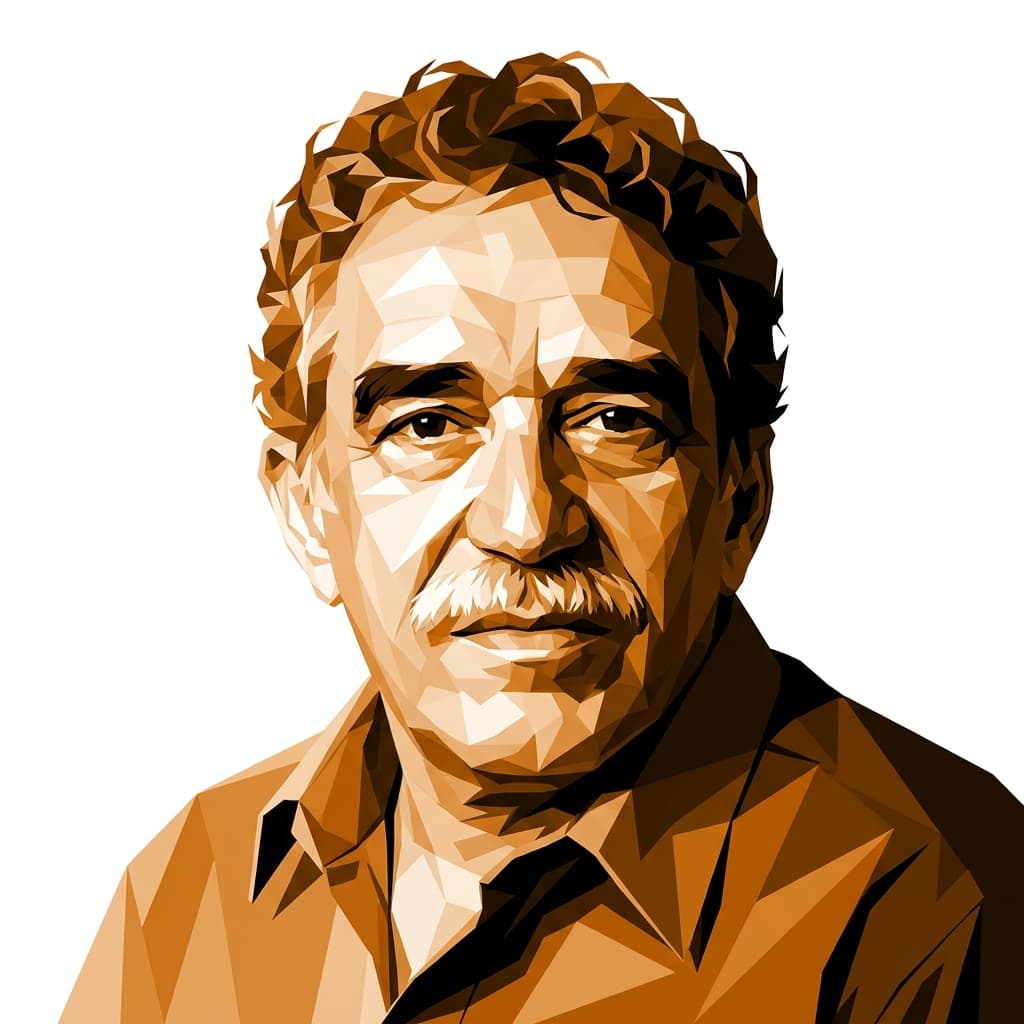
Colombian novelist and Nobel laureate who pioneered magical realism with One Hundred Years of Solitude.
Design
- Q26.1
- h45.1
- R13.2
- g52.4
- i58.4
- S14.3
- T26.5
- U27.3
- V49.4
- W34.1
- X36.4
- Y29.3
- Z53.1
Personality
- Q63.4
- h64.4
- R42.4
- g52.1
- i58.1
- S36.5
- T21.1
- U16.1
- V37.6
- W9.2
- X25.1
- Y29.1
- Z39.5
Gabriel García Márquez was a Manifesting Generator — wired to chase several vocations at once, and the shape of his life reflects it. He was a working journalist, a screenwriter, a political operator, a friend to presidents and guerrillas, and, somewhere in the middle of all that, the novelist who rewrote what Latin American fiction could do. He rarely sat still in one lane. Cartagena, Barranquilla, Bogotá, Paris, Caracas, Mexico City, Havana — the addresses kept changing, and so did the projects, but the underlying energy stayed the same: pursue what lit him up, and pursue several of them at once.
He grew up in Aracataca, raised largely by his grandparents in a house crowded with aunts and ghost stories, and this early absorption became the foundation of everything he later wrote. As a 4/1 profile, he worked through community and depth at once — his closest friends from the Barranquilla Group (Cepeda, Vargas, Fuenmayor) were both his readers and his running mates, while his private hours went to the slow, obsessive investigation of a single subject until he understood it from the inside. He read Faulkner and Kafka the way a mechanic takes apart an engine. When he finally began Cien años de soledad in 1965, he had been circling the material for nearly two decades.
The famous story of that book — eighteen months locked in his Mexico City study, Mercedes pawning the household appliances to keep him writing — is really a story about commitment once the gut has said yes. He knew. He turned down other work, burned through savings, and saw the cycle through to its natural end because stopping wasn't an option once the voice of the novel arrived. That kind of follow-through is the discipline of someone who only says yes when he means it, and it produced a manuscript he mailed to Buenos Aires in two halves because he couldn't afford the full postage.
As a journalist he had already spent years refining a craft through repetition — the crónica, the reportage, the interview — and he never really stopped being a reporter. His fiction reads like eyewitness testimony to impossible events precisely because the sentences are built with a newspaperman's discipline. He kept a lifelong fascination with other people's stories and how to hold them, collecting anecdotes from taxi drivers, dictators, and old women in equal measure, then returning them to the page transformed.
His politics ran through the same channel. He was close to Fidel Castro for decades — a friendship that cost him readers and won him others — and he used his fame to push at systems he believed were unjust, mediating between the Colombian government and the FARC, founding a film school in Cuba, funding journalism scholarships across the continent. He followed his Wait to Respond instinct here too: he showed up when asked, when the moment presented itself, rather than manufacturing causes.
In his later years, memory itself became the subject. Living to Tell the Tale is a long act of looking backward and finding the pattern — the boy in Aracataca, the grandmother's voice, the banana company massacre — assembled at last into a shape only age could see. He died in Mexico City in 2014, having done, more or less, exactly what he came to do.
Sources: biography · birth data
What do you and Gabriel García Márquez have in common?
Enter your birth details to find out