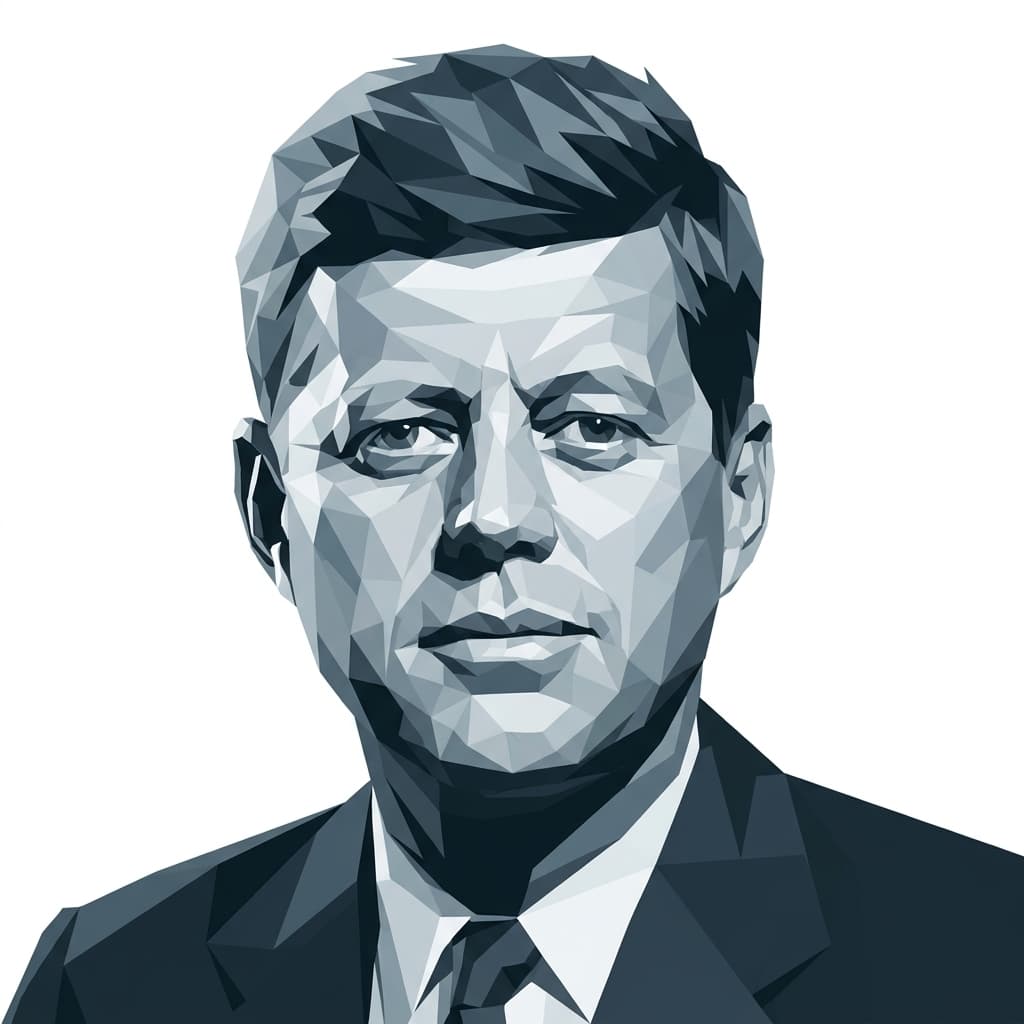
35th President of the United States, Cold War-era icon whose brief presidency reshaped American political imagination.
Design
- Q37.5
- h40.5
- R35.3
- g54.4
- i53.4
- S13.6
- T30.2
- U37.5
- V27.1
- W62.4
- X49.3
- Y31.1
- Z15.5
Personality
- Q16.3
- h9.3
- R47.1
- g38.2
- i39.2
- S23.2
- T35.6
- U2.6
- V23.5
- W56.1
- X49.6
- Y31.1
- Z15.6
John Fitzgerald Kennedy was a Projector — built less for relentless output than for seeing situations clearly and steering others through them, which is exactly how he governed. Behind the famous vitality was a man who spent enormous stretches of his life in bed: Addison's disease, a wrecked back from PT-109, colitis. He read voraciously during those recoveries, and the presidency he eventually ran was less the work of a tireless campaigner than of someone who had learned to conserve energy for the moments that actually mattered, letting his brother Bobby and an unusually capable staff carry the operational weight.
His 3/5 profile — the experimenter who becomes a crisis leader — fits the arc almost too neatly. He bumbled through Choate as a mediocre student, drifted through early Navy assignments, lost his first congressional speech notes and improvised, then turned PT-109's disaster into a campaign asset. By the time he faced Khrushchev over Cuba, he had already learned through failure (the Bay of Pigs, eighteen months earlier) that taking generals at their word was a mistake. The thirteen days of the missile crisis were him refusing to act from the heat of the moment, insisting on more meetings, more options, more time — the naval quarantine instead of the airstrike his Joint Chiefs demanded.
Kennedy's public voice carried the unmistakable signature of putting a complicated idea into language anyone could repeat. "Ask not what your country can do for you." "We choose to go to the Moon." Ted Sorensen drafted, but Jack edited mercilessly, stripping clauses until the line snapped. He paired this with a storyteller's instinct for making policy feel like a personal stake — the New Frontier wasn't a program so much as an invitation into a narrative. Press conferences, televised and unscripted, were him reading the room and pulling its emotional temperature toward him.
He had a hunger for new experience that bordered on reckless — the women, the speedboats, the amphetamines from Dr. Feelgood, the cortisone, the cruises. Some of this was the Kennedy clan's appetite for variety and edges that Joe Sr. had bred into all of them; some of it was a man who had been told since childhood he wouldn't live long, chasing intensity because flatness felt like dying. Jackie tolerated more than she should have; Bobby cleaned up after him; the press, in that era, looked away.
What made him effective was a vision for where the country needed to point that he could articulate without needing to know every step. The Peace Corps, the moonshot, the Alliance for Progress — he picked directions and trusted the apparatus to fill in the path. His civil rights conversion was a slow trial-and-error reckoning, pushed by Bobby and by the brutality in Birmingham, ending in the June 1963 address that finally called segregation a moral issue. He had the kind of unforced gravity that made people want to know what he thought about everything — what he ate, what he read, how he tied his tie — and he wielded it like a tool.
Dallas cut the experiment short at forty-six, and the country has been arguing ever since about what the rest would have looked like. The mythology that grew up around him — Camelot, the eternal flame — was Jackie's careful curation of the story he didn't live to tell, turning a thousand days into something Americans could keep recognizing themselves in.
Sources: biography · birth data
What do you and John F. Kennedy have in common?
Enter your birth details to find out