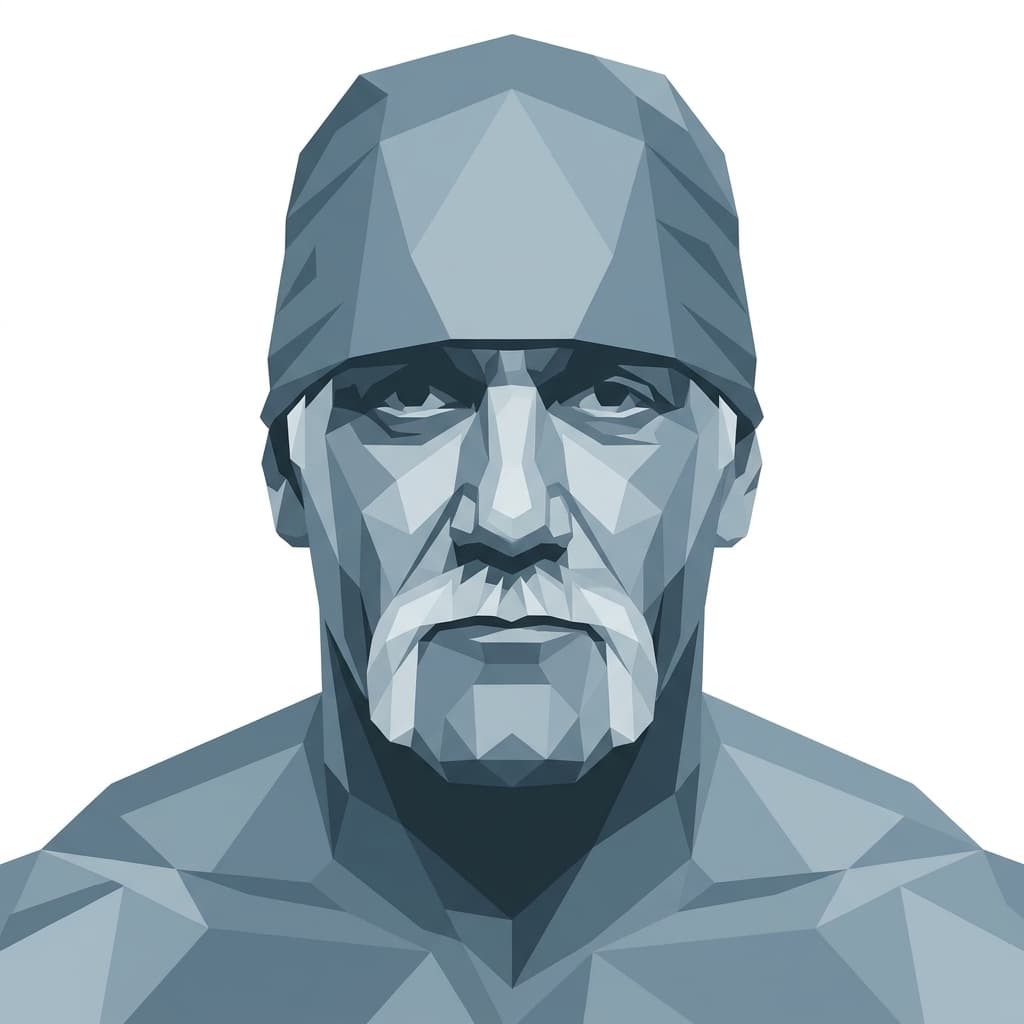
American professional wrestler whose showmanship and charisma turned WWE into a global cultural phenomenon in the 1980s.
Design
- Q23.2
- h43.2
- R3.1
- g41.5
- i31.5
- S27.5
- T51.1
- U16.2
- V20.1
- W32.2
- X53.1
- Y32.2
- Z4.3
Personality
- Q7.6
- h13.6
- R40.3
- g41.2
- i31.2
- S56.4
- T52.5
- U33.1
- V45.4
- W32.2
- X53.6
- Y32.1
- Z4.5
Hulk Hogan — born Terry Bollea — was a Projector built like nobody's idea of one: 6'7", 300 pounds, tanned and bleached and shouting into a microphone. But strip away the physique and the archetype fits. He wasn't the most technically gifted wrestler of his era, and by his own admission he wasn't the strongest. What he had was a preternatural read on a crowd, an ability to see exactly what a live audience needed and give it to them at the precise decibel. Vince McMahon didn't hire Hogan to wrestle. He hired him to guide the whole enterprise somewhere new, and Hogan did.
Hulkamania was, in many ways, a 6/2 profile arriving right on schedule. Bollea's twenties were the messy experimental phase — bass player in Florida bar bands, bouncer, a false-start wrestling career under half a dozen names, a small role in Rocky III that changed everything. By the time he body-slammed André the Giant at WrestleMania III in 1987, he was in his mid-thirties and had already lived several lives. That trial-and-error stretch became the raw material for the character. He knew what worked in a bar, in a locker room, in a movie set, in an arena — and he could distill it into three or four simple lines a nine-year-old could chant back.
His genius was promo work, and promo work is Self-Projected Authority turned up to eleven. Hogan talked his way into clarity. Given a microphone and a camera, he'd find the exact phrase — "whatcha gonna do, brother" — by saying it out loud until it landed right in his own chest. He was also a masterful reader of the room, responding to the crowd in real time with a timing that couldn't be coached. When he ripped the shirt, when he cupped the ear, when he pointed at the heel — those were beats he heard, not beats he planned.
The heel turn at Bash at the Beach 1996, when he joined the nWo in WCW, was the clearest expression of his willingness to shock the audience out of its comfort. Nobody thought Hogan would go bad. He'd been red-and-yellow for thirteen years. Dyeing the beard black and telling the fans to stick it wasn't just a storyline flip — it was a professional bet that the whole business needed disruption, and he was the only one big enough to deliver it. It worked. WCW briefly buried WWE in the ratings, and wrestling as a whole mutated into something darker and more knowing.
The later chapters have been harder to watch — the reality show, the leaked tape, the racist rant that got him fired and eventually reinstated, the courtroom battle with Gawker, the political appearances. A Projector who never quite learned to rest or be selective about invitations tends to keep saying yes past the point of dignity. Still, when he stepped back to reflect on what he'd built, even critics conceded the scale of it. He didn't invent professional wrestling. He just began the era that made everyone else's version possible.
Sources: biography · birth data
What do you and Hulk Hogan have in common?
Enter your birth details to find out