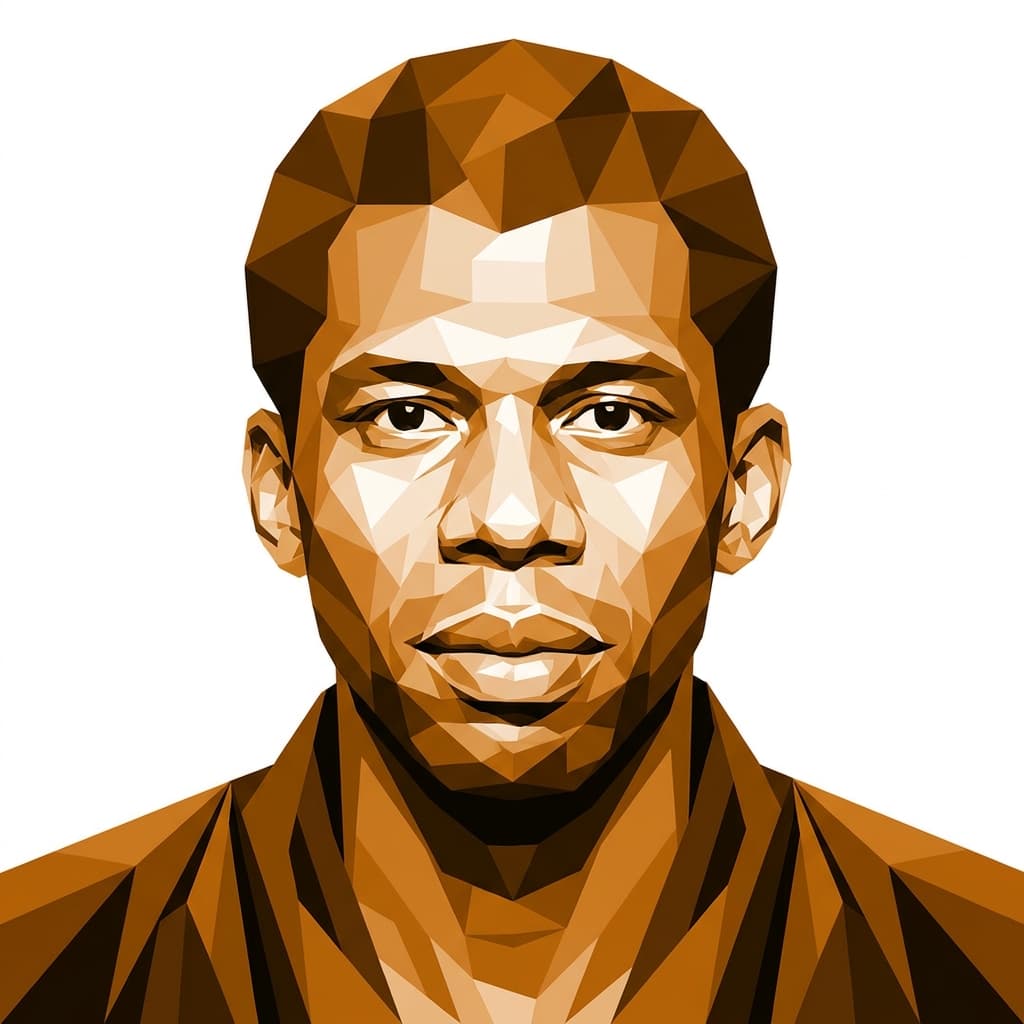
NBA's all-time scoring legend turned essayist, historian, and cultural critic with a singular skyhook signature.
Design
- Q60.2
- h56.2
- R26.6
- g16.6
- i9.6
- S61.5
- T5.1
- U61.5
- V43.5
- W31.5
- X45.2
- Y48.2
- Z33.6
Personality
- Q42.6
- h32.6
- R55.5
- g20.4
- i34.4
- S25.4
- T22.4
- U17.1
- V14.2
- W31.1
- X45.2
- Y18.6
- Z33.4
Kareem Abdul-Jabbar is a Manifesting Generator — wired to chase several mastery paths at once and refuse to be reduced to any single one. The arc proves it: six-time NBA MVP, six-time champion, all-time leading scorer for nearly four decades, and then a second career as a columnist, novelist, and historian who writes about jazz, Sherlock Holmes, the Harlem Renaissance, and American race politics with the same precision he once brought to footwork in the low post.
Born Ferdinand Lewis Alcindor Jr. in Harlem in 1947, he was 7'2" by college and already wary of being treated as a body rather than a mind. At UCLA under John Wooden he won three straight national titles and perfected the skyhook through thousands of identical repetitions — a shot nobody could block because nobody else was willing to drill it that long. That patience for the long process, the quiet refinement of one impossible thing until it became automatic, is the through-line of his entire life. He converted to Islam in 1971 and changed his name, a decision he made from a place that didn't require anyone else's approval and which cost him commercial opportunities he never seemed to mourn.
On the court he was famously reserved, sometimes mistaken for aloof. The 6/2 profile — the role-model-hermit, the wise guide who needs solitude to recharge — fits him almost too neatly. Teammates described a man who would read on team flights, retreat to his hotel room, and emerge for tip-off with the kind of focus that locked out the entire arena. His strategy of responding rather than initiating showed up in how he played: he rarely forced shots, rarely barked, let the offense come to him and then delivered the skyhook with a calm that bordered on ceremony.
The post-playing life is where the 6/2 really opened up. He turned out to be a natural storyteller who could braid memoir, history, and argument into long-form essays for TIME, The Guardian, and his own Substack. His books on the Harlem Rens, on Black inventors, on his coach Wooden, all carry the critic's instinct for what the culture has gotten wrong and how to fix it. He writes about jazz the way he played basketball — patient, attentive to interior detail, reaching for the deeper why beneath the surface.
He has also been a public conscience, willing to say the true thing whether the moment welcomed it or not — on Muhammad Ali, on Colin Kaepernick, on antisemitism inside movements he otherwise supports. He survived leukemia, a heart bypass, prostate cancer, and the loss of his Hollywood Hills home and his entire jazz archive in a 1983 fire, absorbing each shock without losing the open-hearted curiosity that drives the writing. Now in his late seventies, he keeps publishing, keeps refining, keeps investing his attention only in work he genuinely believes in — a Manifesting Generator who finally got the second, third, and fourth careers his energy always wanted.
Sources: biography · birth data
What do you and Kareem Abdul-Jabbar have in common?
Enter your birth details to find out