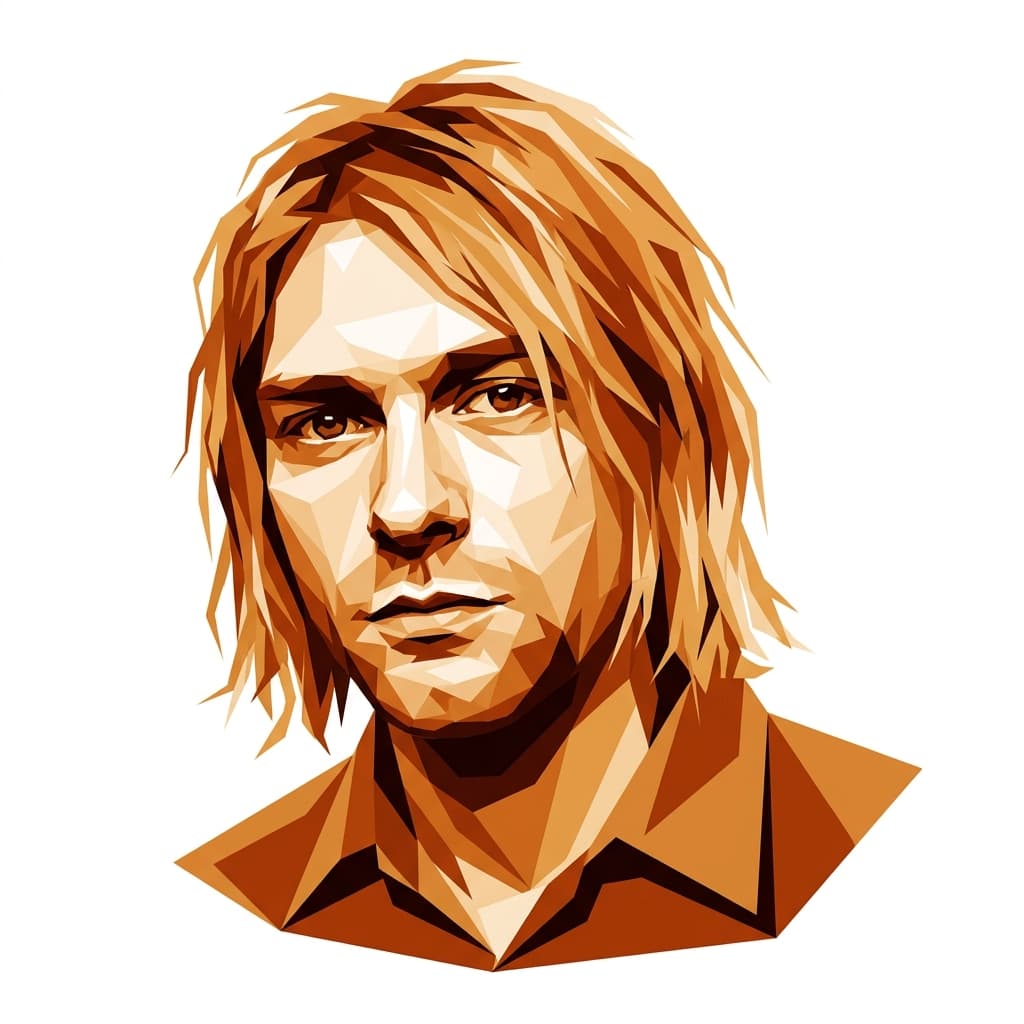
Nirvana frontman whose raw songwriting defined 1990s alternative rock and reshaped mainstream music.
Design
- Q34.4
- h20.4
- R2.3
- g2.4
- i1.4
- S1.5
- T9.3
- U6.4
- V31.3
- W36.1
- X6.2
- Y43.4
- Z47.4
Personality
- Q55.2
- h59.2
- R39.5
- g24.3
- i44.3
- S22.2
- T36.5
- U50.6
- V62.6
- W25.1
- X6.1
- Y43.6
- Z47.3
Kurt Cobain was a Manifesting Generator — wired for fast, non-linear bursts of creative output and allergic to the slow, obedient pace the music industry wanted him to keep. He learned guitar as a left-handed kid in a logging town, drew constantly, wrote in journals obsessively, and by his early twenties had built a band that would knock Michael Jackson off the top of the Billboard charts. He never quite made peace with getting what he'd asked for.
He had a 2/4 profile, the hermit-opportunist — someone who needed long stretches alone to develop what came naturally, then relied on a tight circle of friends to carry the work outward. Nirvana's rise fits that pattern almost too neatly: songs written in isolation in Olympia and Aberdeen apartments, then handed to Krist Novoselic, Dave Grohl, and Sub Pop's small network of allies who recognized what he had before he could. His discomfort with fame was partly a 2/4's resistance to being pulled out of solitude once the community had done its job too well.
His songwriting lived in the pure electricity of self-expression — original, restless, unwilling to repeat a formula, which is why Nevermind and In Utero sound like two different bands making a point of not being the same. Underneath the noise was an insight-based mind that arrived at things all at once, which is how "Smells Like Teen Spirit" got written in an afternoon and how the acoustic Unplugged setlist reordered his entire catalog into something devotional. He was also carrying Gate 39's provocateur energy — the guy who wore a dress on national television, who titled a record Rape Me's parent album In Utero, who could not stop poking at what everyone else was pretending not to see.
He had Emotional Authority, meaning clarity for him only ever arrived after riding a wave — days, sometimes weeks — and the decisions he made in the middle of a spike were almost always the ones he regretted. Interviews from 1992 and 1993 show him contradicting himself constantly: quitting the band, un-quitting, hating fame, courting it. The shape of an emotional wave was the shape of his life. Paired with the deep-water intensity of Gate 36 and Gate 55's musician's fullness and flatness, he lived closer to the extremes than most people can sustainably manage, and he wrote from inside that weather.
His voice — the thing that actually did the work — carried a real-time truth-telling quality, unfiltered and present, which is why the screams on "Territorial Pissings" or the whisper opening of "Something in the Way" both feel like they cost something. He had a heart that stayed strangely open through everything: the letters to fans, the championing of the Meat Puppets and the Vaselines, the way he'd credit obscure bands in interviews when he could have just talked about himself. He also had strong, protective values around who and what deserved his loyalty — his marriage, his daughter Frances Bean, the underground scene he came from — and a mounting sense that he was failing all of them.
He died in Seattle in April 1994. He was 27. What he left behind is less a discography than a document of someone trying, in real time and in public, to feel the whole thing.
Sources: biography · birth data
What do you and Kurt Cobain have in common?
Enter your birth details to find out