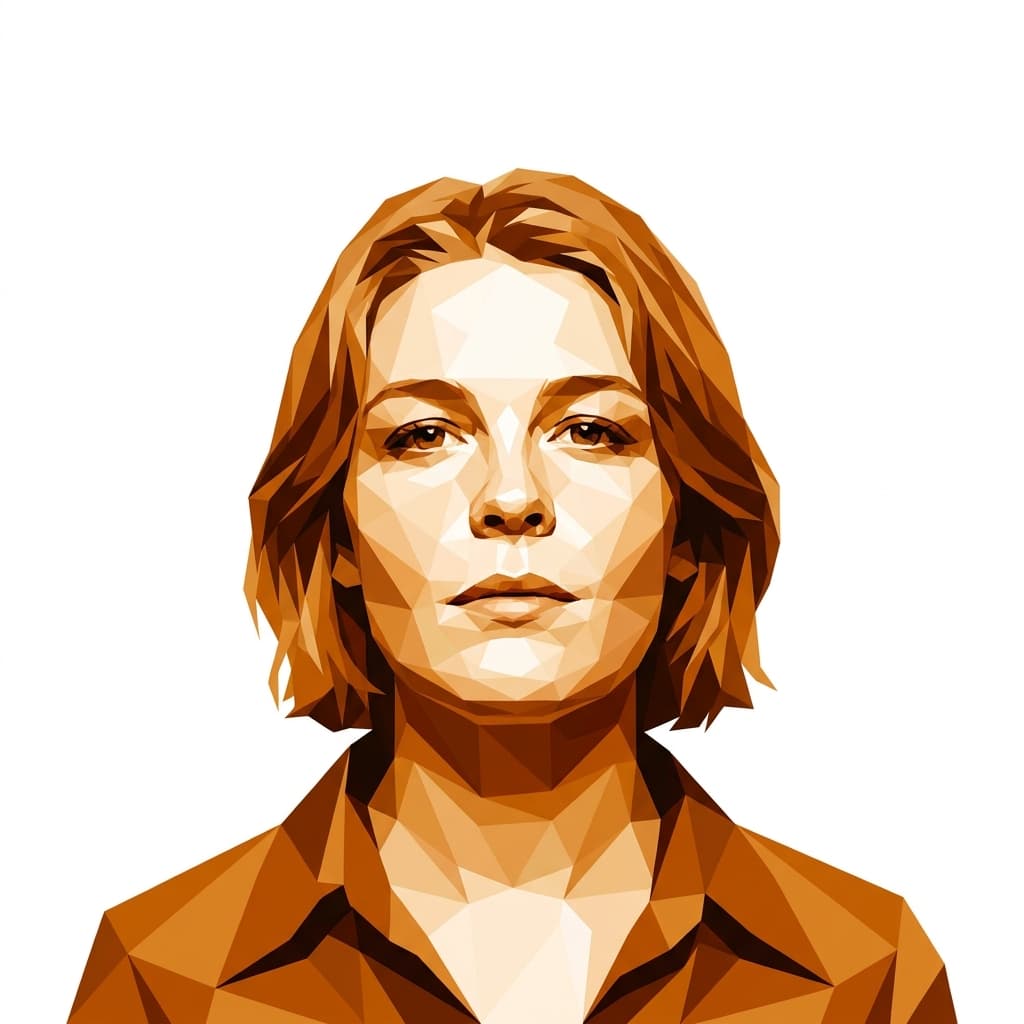
American singer-songwriter who went viral at NYU and built a career on felt, physical music.
Design
- Q41.6
- h31.6
- R31.2
- g34.1
- i20.1
- S49.4
- T19.2
- U60.4
- V44.6
- W30.6
- X61.3
- Y61.1
- Z14.4
Personality
- Q27.4
- h28.4
- R50.5
- g43.6
- i23.6
- S3.4
- T8.5
- U17.5
- V44.3
- W37.5
- X61.6
- Y61.3
- Z14.3
Maggie Rogers is a Manifesting Generator — wired to chase several things at once, master them fast, and move on when the energy shifts — and the shape of her career has that signature non-linear sprint built right in. She grew up on Maryland's Eastern Shore playing harp and banjo, taught herself production at summer camp, released a folk record in high school, and by the time she got to NYU's Clive Davis Institute she was already restructuring her sound around dance music she'd discovered hiking alone in Berlin. The through-line isn't a genre; it's a gut pulled toward whatever lights her up next.
The famous moment — Pharrell Williams hearing "Alaska" in a 2016 masterclass and visibly tearing up — is a near-perfect illustration of her 4/6 profile stepping into visibility after years of quieter experimentation. She didn't pitch him. The song showed up, he responded, and the video spread because people could see something real happening on both sides of the table. She'd been making music for a decade by then; the "overnight" framing never fit, and she's said so, repeatedly and clearly, in interviews that read like someone protecting a wisdom she earned the long way.
Her writing voice is unusually plain-spoken for pop — direct, bodily, unafraid of a flat declarative line. "Light On," "Alaska," "That's Where I Am" all work by distilling something complicated into a phrase you can actually sing back, and she tends to describe songs in terms of weather, hiking, dancing, the physical fact of being in a body. There's a tastemaker's ear for what deserves attention running underneath — she curates her own radio show, writes long newsletters, and talks about other artists' records with the specificity of someone who's been listening carefully her whole life.
In 2020, mid-pandemic, she enrolled at Harvard Divinity School to study the religion of public gatherings — specifically what happens at concerts. It's the kind of move that reads as odd from the outside and completely consistent from inside her chart: a restless pull toward the next real experience, paired with a mind that wants to sit with the big questions rather than answer them tidily. She's talked about touring as a form of communal ritual, and about needing the work to mean something beyond the metrics — a frame most pop artists her age don't bother articulating.
Onstage she dances hard, often alone at the front of a wide empty stage, and the shows have the feel of someone channeling raw physical energy she can't quite contain. But she's also protective of her timing — she took most of a year off after her debut, writes about burnout honestly, and has pushed back against industry pressure to release on anyone's schedule but her own. The Emotional Authority shows up as a visible willingness to sit with a decision, say no to the obvious opportunity, and come back when the feeling has settled.
What she's building, record by record, is less a brand than a model of how to do this work without hollowing yourself out — generous with her community, specific about her values, and unembarrassed to keep learning in public.
Sources: biography · birth data
What do you and Maggie Rogers have in common?
Enter your birth details to find out