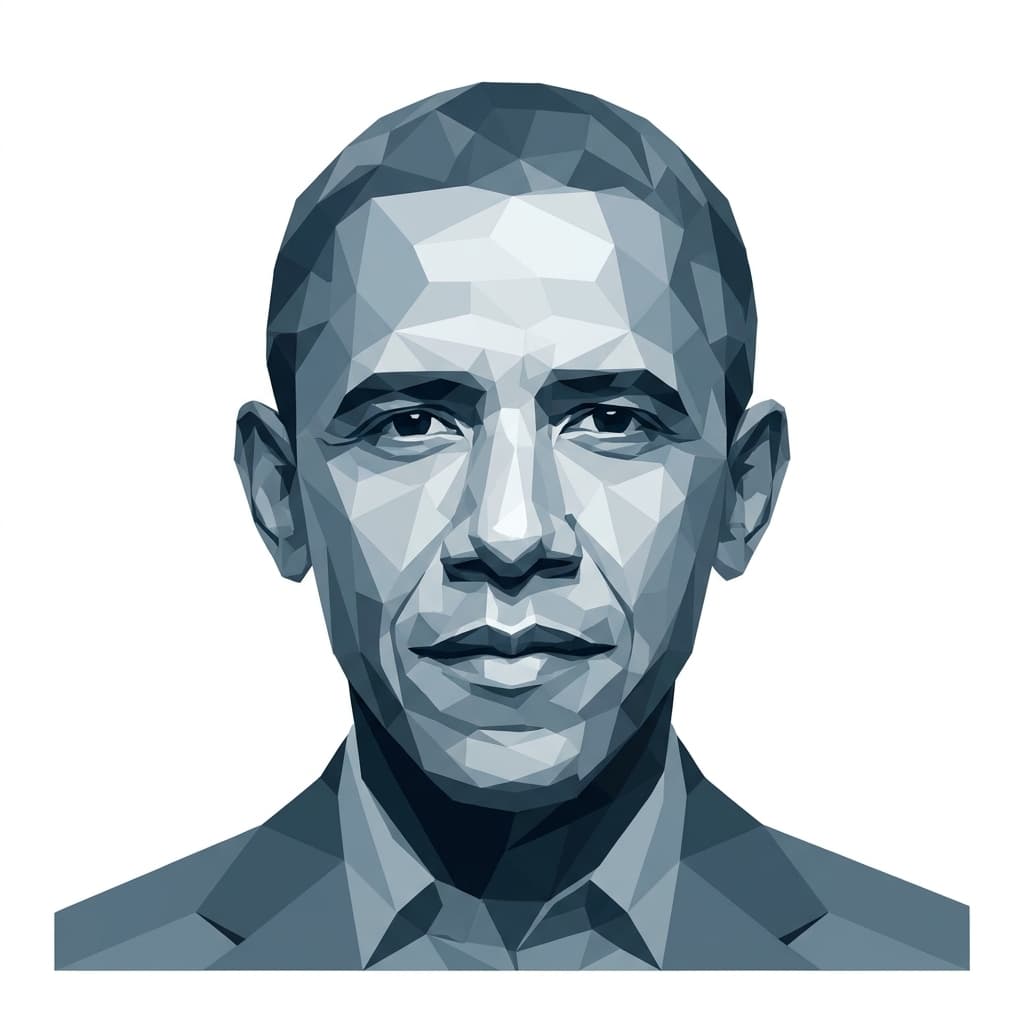
44th President of the United States, constitutional lawyer, community organizer, and two-term Democratic leader.
Design
- Q2.2
- h1.2
- R38.5
- g59.4
- i55.4
- S2.6
- T21.4
- U56.4
- V41.5
- W60.4
- X4.3
- Y44.3
- Z59.6
Personality
- Q33.6
- h19.6
- R20.4
- g29.3
- i30.3
- S31.1
- T15.4
- U47.6
- V60.5
- W61.5
- X29.1
- Y44.2
- Z40.2
Barack Obama is a Projector — the type wired to see systems and people clearly, then guide from that seeing rather than muscle through by sheer output. His entire political rise makes sense through that lens: a community organizer in Chicago's South Side who spent years studying how neighborhoods actually worked before he ever ran for office, a state senator known for reading the room and finding the bill nobody else could pass, then a first-term U.S. senator who somehow ended up giving the 2004 convention keynote that made him a household name overnight. He didn't hustle his way into that speech. He was invited.
That waiting-to-be-recognized rhythm shaped the whole arc. He didn't announce in 2004 when the frenzy started; he waited until early 2007, and the campaign itself became a kind of national invitation — Iowa first, then everywhere. His 6/2 profile, the role model who needs long stretches of solitude, tracks with a man who reads on vacation, golfs alone with three friends, and disappears into the residence after state dinners. Michelle has said he's happiest with a book and a quiet room. The wisdom of that profile — that the messy earlier chapters were building something — reads clearly in the Dreams from My Father years: Indonesia, Hawaii, Occidental, Columbia, Chicago, Kenya. He was gathering material.
His decision-making was famously deliberate, sometimes maddeningly so to aides who wanted a call before lunch. That was Emotional Authority doing its work — sleeping on it, running it past the wave, waiting for the cool clarity underneath. The bin Laden raid took months of quiet weighing. The Affordable Care Act survived a year of vote-counting and revision because he refused to be rushed. He was mocked for being "no-drama Obama," but that flatness was the point: decisions made from the calm settled place, not the emotional peak.
The texture of his leadership shows up in specific gates. His speeches — Grant Park, Selma, the Charleston eulogy where he sang "Amazing Grace" — carried the storyteller's gift of turning lived experience into meaning for a room. His constitutional-law mind ran on needing to understand the why beneath every argument, which is why his press conferences sometimes felt like seminars. And his political identity was built on seeing where the country could go before most people could — "the audacity of hope" wasn't a slogan so much as a felt sense of direction he trusted before the data caught up.
There was also a fighter's spine under the composure, visible when he went after birthers at the 2011 Correspondents' Dinner hours before ordering the Abbottabad raid, or when he pushed the ACA through against every prediction. And there was the pull toward extremes of experience — a biracial kid raised across continents who ended up being the first Black president, a range most political careers can't hold. Post-presidency, the pursuit of belonging and craft in solitude — memoirs, a production company, quiet mentorship — looks like a Projector finally letting himself rest into the role of elder guide he was always headed toward.
Sources: biography · birth data
What do you and Barack Obama have in common?
Enter your birth details to find out