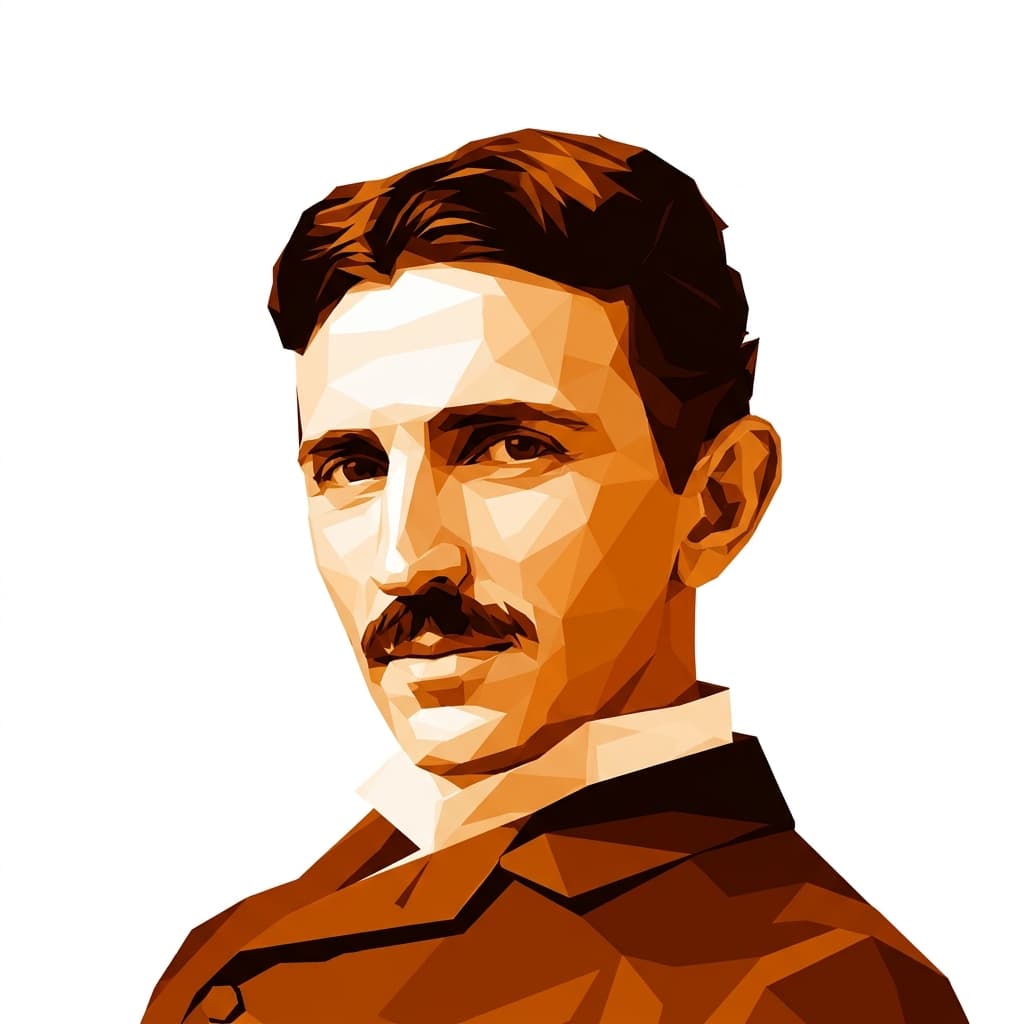
Serbian-American inventor and electrical engineer whose alternating current systems electrified the modern world.
Design
- Q51.6
- h57.6
- R15.2
- g42.4
- i32.4
- S17.1
- T36.2
- U48.1
- V36.2
- W12.3
- X23.1
- Y22.3
- Z27.2
Personality
- Q53.4
- h54.4
- R32.6
- g51.6
- i57.6
- S15.1
- T53.1
- U57.5
- V17.6
- W52.2
- X23.6
- Y22.4
- Z27.4
Nikola Tesla was a Manifesting Generator — wired to chase several passions at once and skip the steps most engineers consider mandatory, which is exactly how a Serbian-born immigrant ended up rewriting how the world is powered. He arrived in New York in 1884 with four cents, a book of poems, and sketches for a motor that would eventually make Niagara Falls into a power plant. He worked for Edison briefly, fell out with him over money and over direct current, and walked away to dig ditches for a year before investors finally recognized what he'd been seeing all along.
His method was famously non-linear. He claimed to design entire machines in his head, running them mentally for weeks before building anything, and then assembling them on the first try. That's a 4/6 profile at full extension — the experimental young role-model who learns by lived trial and then becomes the living example others study. He cycled through electric motors, radio, remote control, neon lighting, X-ray imaging, and wireless power transmission, moving fast and pivoting whenever the energy shifted, often before a previous invention was commercially settled.
Tesla had famous emotional waves and made some of his worst decisions inside them — tearing up the royalty contract with Westinghouse in a moment of loyalty, pouring everything into Wardenclyffe Tower without the patience to let the emotional charge settle before committing. His best work came when he could wait for the right invitation and the right backer — the Westinghouse offer that launched alternating current, the Niagara Falls commission, the lecture circuit that made him a celebrity in the 1890s. When he initiated from grandiosity instead, the projects collapsed.
The texture of the man lived in the extremes. He worked obscene hours, slept two, ate on rigid schedules, walked exactly the same blocks, and then would vanish into intense, theatrical demonstrations — sitting in a chair while a million volts arced around his body in front of reporters. He had a showman's instinct for exactly when to pull back the curtain, staging public spectacles that made electricity itself feel like magic. He could also sit with a single problem in absolute focused stillness for days, the kind of concentration that produced the rotating magnetic field while he was walking in a Budapest park reciting Goethe.
He was a natural shocker of inherited systems, happy to tell Lord Kelvin he was wrong, happy to wage the War of the Currents against the most powerful industrialist in America. But he had no instinct for protecting the value of what he built. He let patents lapse, gave away royalties, and trusted handshake deals. The nose for what was worth preserving versus what to let go — the discernment that might have made him wealthy — was the one piece of equipment he never built for himself.
He died alone in a New York hotel room in 1943, owing money, feeding pigeons, and still sketching. The community he'd influenced was vast and largely invisible to him; the role-model arc completed posthumously, as it often does for a 6th line. Every time a motor turns on, he is the lived example still being studied.
Sources: biography · birth data
What do you and Nikola Tesla have in common?
Enter your birth details to find out