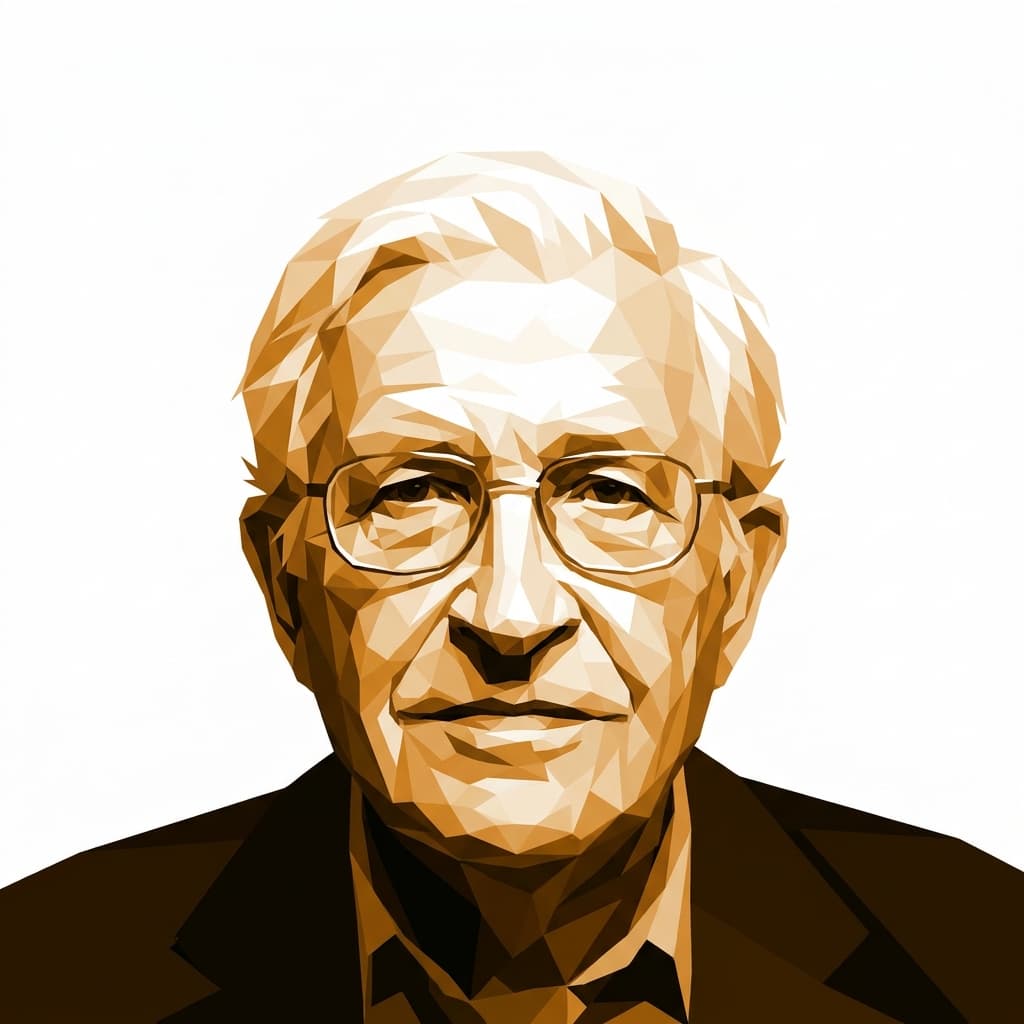
American linguist, cognitive scientist, and political critic who reshaped modern understanding of language and power.
Design
- Q47.1
- h22.1
- R56.3
- g20.5
- i34.5
- S18.4
- T18.3
- U45.3
- V24.3
- W5.2
- X17.3
- Y29.6
- Z53.4
Personality
- Q5.5
- h35.5
- R32.4
- g20.1
- i34.1
- S9.4
- T61.5
- U52.1
- V3.5
- W26.5
- X25.6
- Y59.2
- Z53.3
Noam Chomsky is a Manifesting Generator — built to run two full careers in parallel without ever choosing between them, and his life is exactly that: a linguistics revolution on one desk, a decades-long political critique on the other, both sustained at a pace that has exhausted every colleague who tried to keep up. Born in Philadelphia in 1928 to a Hebrew scholar father, he was reading proofs of his father's medieval Hebrew grammar as a child, an early apprenticeship in spotting the pattern others missed.
His 1957 book Syntactic Structures dismantled the behaviorist orthodoxy of American linguistics almost overnight. He argued that language wasn't learned through stimulus and response but generated by an innate grammar built into the human mind — a claim that overturned a discipline and helped launch the cognitive revolution. This is the 5/1 profile at full power: years of quiet foundation-building at Penn and Harvard, then a decisive step into the field as the person with a solution, bringing order to a chaotic discipline whose old paradigm couldn't survive contact with his framework.
Then, in 1967, he published "The Responsibility of Intellectuals" in the New York Review of Books and became something else entirely: America's most persistent critic of American foreign policy. Vietnam, East Timor, Central America, Israel-Palestine, the Iraq wars — he treated each with the same instinct for what needed correcting and the same refusal to be quieted by institutional pressure. Manufacturing Consent, written with Edward Herman in 1988, laid out a propaganda model of the mass media with the kind of logical framework designed to withstand any challenge, footnoted to the point of tedium because he assumed — correctly — that everything he wrote would be attacked.
The output is almost comic in volume: over 150 books, thousands of articles, an answered-email habit that MIT students spoke about with awe. He would respond to a graduate student's question and a hostile journalist's baiting with the same flat, patient prose within the same hour. This is the raw engine that doesn't run down paired with saying yes to nearly everyone who asks — a combination that would break most people and which he has somehow metabolized into routine. Colleagues describe a man who protects his working hours with monastic rhythm: office, home, family, repeat, for sixty years.
His speaking voice is famously affectless — no rhetorical flourishes, no jokes, no raised voice even when describing atrocity. He simply states, cites, moves on. It's the truth-telling delivered without decoration, and it lands harder for the flatness. Admirers and enemies alike have called him cold; he has said, repeatedly, that outrage without evidence changes nothing, and evidence with outrage attached looks like propaganda.
Now in his mid-nineties, having moved from MIT to the University of Arizona, he continues to publish. What holds the whole edifice together is a Sacral yes that never required his mind's permission and a strategy of responding to whatever the world put in front of him — a war, a linguistic puzzle, a student's question, an interview request. He didn't chase a career. He answered what showed up, for seventy years, and the answers accumulated into one of the most consequential intellectual lives of the twentieth century.
Sources: biography · birth data
What do you and Noam Chomsky have in common?
Enter your birth details to find out