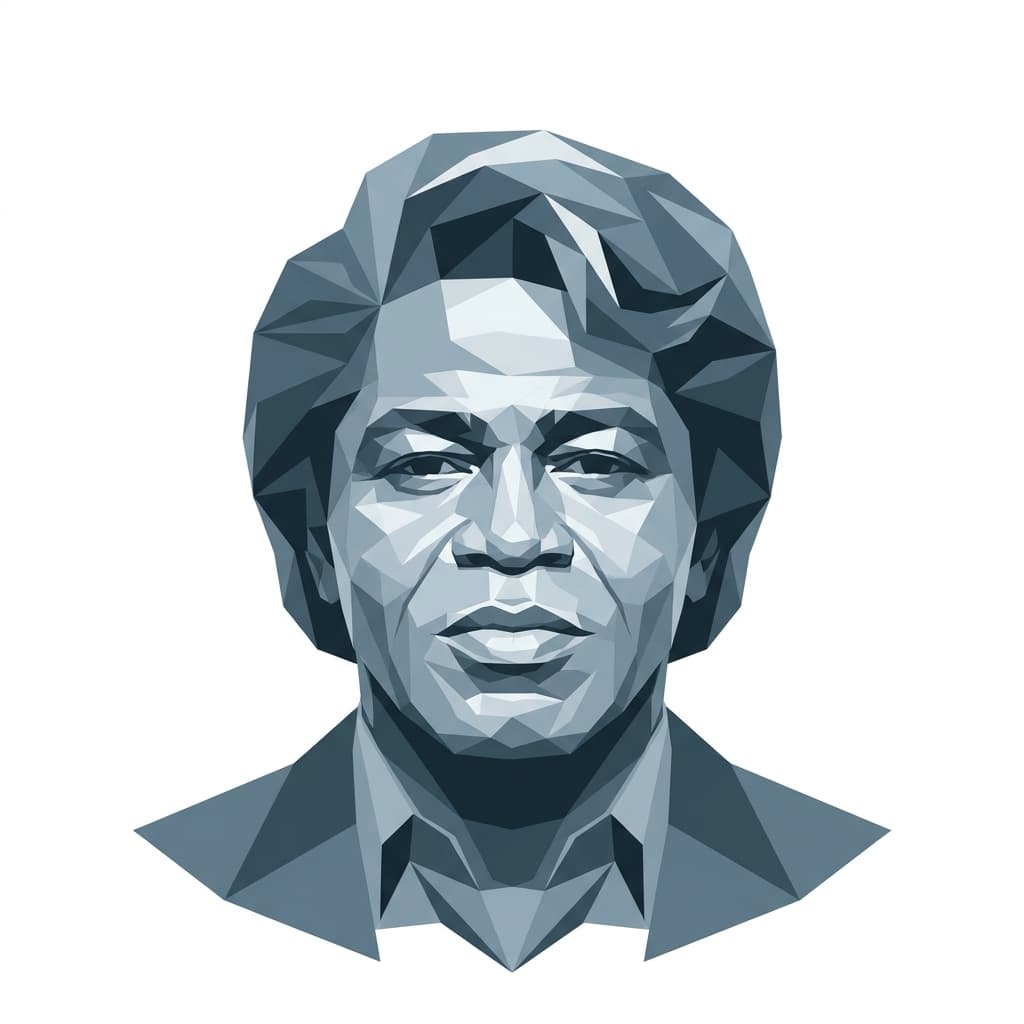
American consumer advocate, lawyer, and political activist who transformed auto safety and corporate accountability.
Design
- Q9.5
- h16.5
- R45.1
- g49.4
- i4.4
- S43.2
- T60.1
- U38.1
- V57.3
- W19.5
- X42.4
- Y64.2
- Z62.4
Personality
- Q37.3
- h40.3
- R7.3
- g49.1
- i4.1
- S22.4
- T19.1
- U22.2
- V32.2
- W49.3
- X42.5
- Y40.6
- Z62.3
Ralph Nader is a Projector — a guide wired to see structural rot others miss and to steward reform from the margins rather than from any driver's seat. That's the shape of his career: a lone lawyer from Winsted, Connecticut, who read the fine print on things nobody else was reading, and then made the country read it too.
In 1965 he published Unsafe at Any Speed, a book that took apart the Chevrolet Corvair and, with it, the entire assumption that traffic deaths were driver error rather than engineering choice. That work required the kind of sustained, granular attention that spots what everyone else has scrolled past — accident reports, suspension geometries, internal GM memos. When General Motors hired private detectives to tail him and dig for dirt, Nader didn't retreat. He sued, won, and used the settlement to seed the consumer movement. That episode set the template: a fighter drawn to the causes that felt genuinely worth the fight, rarely to the ones that were merely convenient.
What followed was a decade of legislative breakthroughs — seatbelt mandates, the National Traffic and Motor Vehicle Safety Act, OSHA, the EPA, the Freedom of Information Act reforms — most of them traceable, at least in part, to Nader's testimony, his young researchers (the "Nader's Raiders"), or the organizations he founded. He built Public Citizen, the Center for Auto Safety, and a constellation of others, operating as a reluctant authority over how collective resources get spent and who gets protected. His method was almost always the same: organize the facts so precisely that the argument became unanswerable, then hand the material to a reporter, a senator, or a jury.
He lives, famously, without a car, without a family, without much visible interest in the ordinary comforts. The self-reliance is the whole point — he's said he doesn't want to owe anyone anything that might compromise the work. Colleagues describe long stretches of solitude, spartan hotel rooms, a legal pad always going. That austerity is part of what has made him effective and also part of what has isolated him: an activist whose principles admit very little negotiation, which is a strength when you're taking on Detroit and a liability when you're trying to hold a coalition together.
His 3/5 profile — the experimenter who becomes a crisis-time problem-solver — is legible across the arc. He learned by doing, took the hits, and became the person others summoned when a system was clearly failing. The 5 in that profile also draws heavy projection, and no episode illustrates that more than his 2000 Green Party run, when he was cast alternately as savior and saboteur depending on who was talking. His characteristic pattern of finishing what he starts, even past the point most would let go, kept him running for president well into his seventies.
Nader's decisions have always taken their time — worked over, sat with, revisited from a calmer state before the commitment lands. At ninety, he's still writing columns, still filing petitions, still waiting to be called in by the people and institutions that actually want the guidance — and quietly furious when they don't.
Sources: biography · birth data

What do you and Ralph Nader have in common?
Enter your birth details to find out