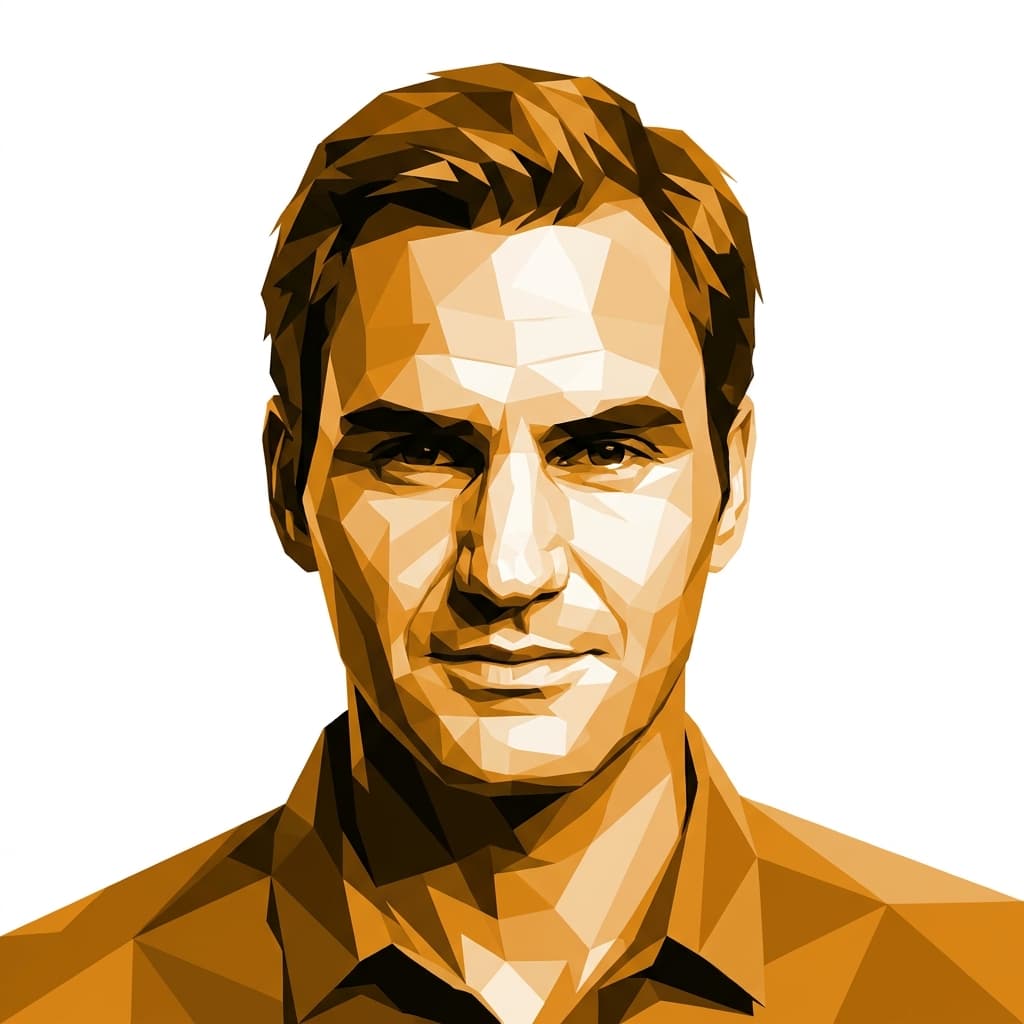
Swiss tennis maestro whose fluid grace and 20 Grand Slam titles redefined the modern game.
Design
- Q2.5
- h1.5
- R39.6
- g31.4
- i41.4
- S8.6
- T8.2
- U24.3
- V46.3
- W46.6
- X14.5
- Y11.2
- Z32.2
Personality
- Q7.3
- h13.3
- R43.2
- g56.6
- i60.6
- S7.1
- T47.1
- U39.5
- V18.4
- W18.3
- X14.2
- Y26.6
- Z32.2
Roger Federer is a Manifesting Generator — built for both explosive speed and sustainable energy, which is exactly what a 24-year professional career at the top of tennis required. He was the temperamental Swiss junior who threw rackets and cursed at himself into his late teens, and then, seemingly overnight after his coach Peter Carter's death in 2002, he became the composed shot-maker the world came to know. That pivot — from prodigy in progress to fully-formed champion — is the trial-and-error learner who eventually leads through hard-won wisdom in action.
His decision to sack coach Peter Lundgren at the end of 2003, right after winning his first Wimbledon, was pure in-the-moment gut clarity that didn't require a committee. He coached himself for years afterward, a move nearly unheard of in the sport. Federer rarely explained these choices with elaborate reasoning; he simply knew when a relationship, a racket size, or a service motion had run its course. When he finally added Stefan Edberg, Ivan Ljubičić, and later Severin Lüthi to his team, it was always in response to something specific showing up — a plateau, an injury, a shift in the game — rather than a preemptive plan.
On court, his tennis was a study in pure creative self-expression, an original voice in a sport of grinders. The tweener, the SABR, the between-the-legs winners at the U.S. Open — these weren't gimmicks but the natural overflow of a mind that couldn't stop generating fresh ideas about what a tennis point could be. Commentators reached for the word "artist" because the attention his shot-making attracted genuinely felt like watching someone paint. He made an inefficient one-handed backhand into the most photographed stroke in the sport.
Off court, Federer's influence operated through a different register. He was the reluctant leader players kept electing as ATP Player Council president, and his voice on tour matters — scheduling, prize money, the Laver Cup — carried weight precisely because he waited to be asked. His vision for a Ryder Cup-style team event became the Laver Cup, launched in 2017, which he built patiently with Tony Godsick over years of quiet groundwork. The same instinct for what would last versus what was a passing fad showed up in his brand choices: a two-decade Nike relationship walked away from for On, a Swiss startup he took equity in rather than a fatter check elsewhere.
The 2017 Australian Open comeback — beating Nadal in five sets at 35, after six months off with a knee injury — was the breakthrough that arrived from nowhere after everyone had written the ending. He'd retooled the backhand in exile, finding an entirely new solution inside the constraint of an aging body. He'd trusted the body to tell him when it was ready rather than the calendar. The final chapter — Laver Cup 2022, doubles alongside Nadal, both men crying — was Federer choosing his own goodbye, pulling emotional truth out of a room full of rivals who had spent two decades trying to beat him. Even his retirement was choreographed with the taste of someone who had always known exactly what the moment called for.
Sources: biography · birth data
What do you and Roger Federer have in common?
Enter your birth details to find out