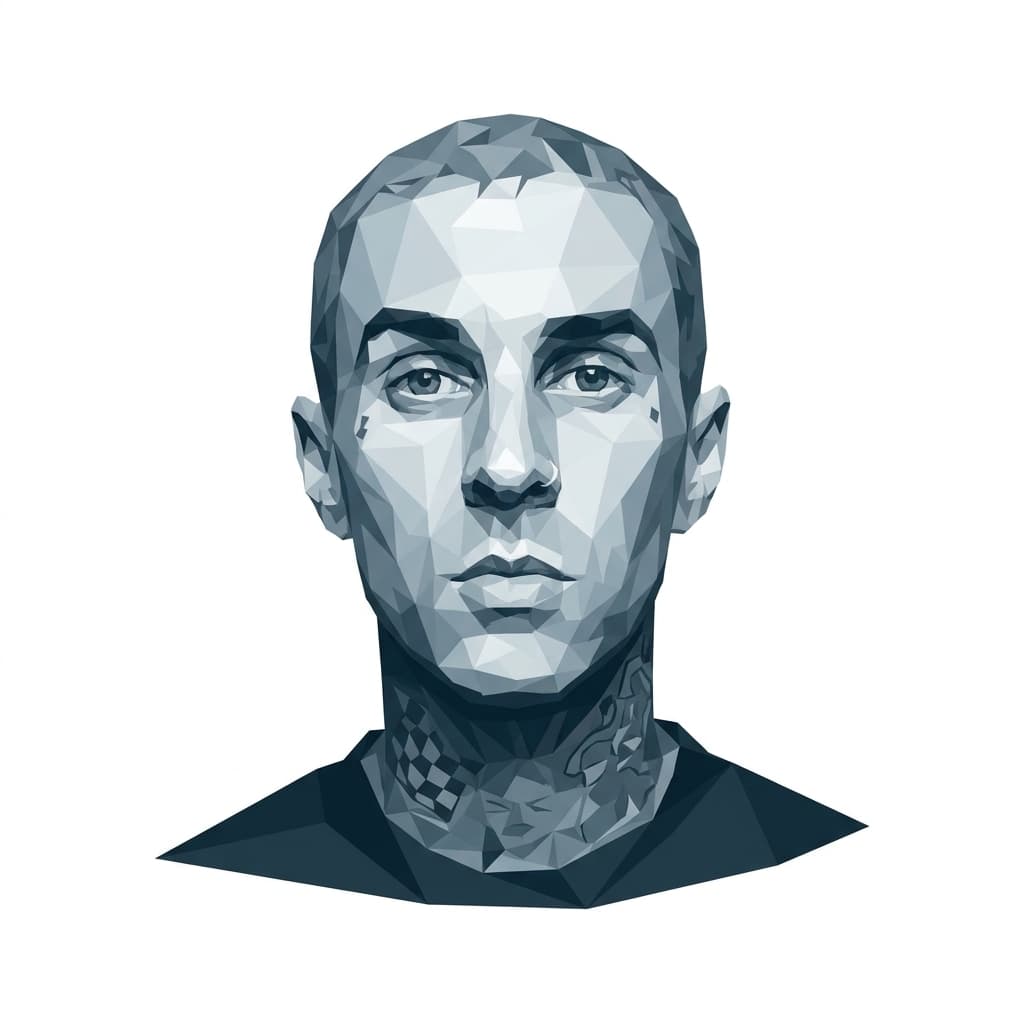
Blink-182 drummer, plane-crash survivor, and prolific collaborator who reshaped punk drumming and pop-punk's second life.
Design
- Q4.6
- h49.6
- R58.5
- g14.3
- i8.3
- S40.5
- T40.4
- U20.2
- V42.5
- W56.1
- X50.3
- Y9.4
- Z18.4
Personality
- Q43.4
- h23.4
- R21.2
- g43.4
- i23.4
- S1.2
- T18.3
- U15.5
- V51.1
- W31.2
- X28.3
- Y9.6
- Z48.2
Travis Barker is a Projector — built to see and steward other people's talent rather than grind out energy on his own — which is a strange thing to say about a drummer known for four-limb machine-gun precision. But watch how his career actually works: he's the guy other artists want in the room, the one who elevates whatever's happening around him, whether that's Blink-182, a Machine Gun Kelly record, a Rihanna performance, or a Kanye session. His power is recognition. He hears what a song wants to become and drums it into being.
His 4/6 profile — the young experimenter who eventually becomes the role model — reads clean across his life. The early years in Fontana, the ska-punk grind with The Aquabats, the messy, loud, visible chaos of Blink's late-'90s peak: all training ground. By his forties he'd become the person younger artists text when they want to make something real, a trusted guide inside a very specific community of musicians who want to blur punk, hip-hop, and pop without apologizing for any of it.
The 2008 Learjet crash that killed four people and left him with burns over most of his body is the hinge of the story. He didn't fly again for over a decade. What he did do was survive with a splenic knowing about what was worth continuing and what wasn't — the quiet, in-the-moment intuition that tells you this collaborator, not that one; this project, not that one. His post-crash output is a study in fighting only the battles that carried real meaning, a man who'd literally walked out of fire and refused to spend the rest of his life on empty struggle.
As a drummer he's pure self-expression made physical, the tastemaker who spots what deserves attention before the rest of the industry catches up — signing Machine Gun Kelly to a pop-punk pivot when everyone else said the genre was dead, producing records for artists across half a dozen scenes. His playing itself is concentration turned into a discipline: the hours in the practice room, the metronome work, the willingness to sit with one groove until it's exactly right. He's also famously drawn to extremes and variety, which is why one week he's on a metal record and the next he's drumming behind a country singer at the CMAs.
He runs businesses the same way he runs sessions — independently, with tight control over what he provides and what he doesn't. DTA Records, Famous Stars and Straps, the vegan restaurant Crossroads, the Barker Wellness line. Each one is a resource he directs personally rather than delegates away, and each one reflects a strong internal compass about what he'll put his name on. He's talked openly about sobriety, about veganism, about the therapy work after the crash — correcting old patterns instead of pretending they weren't there.
The tattoos, the tabloid marriage to Kourtney Kardashian, the reunited Blink tour — all of it lands because he only steps forward when genuinely invited into the room. He's spent a career learning that his sharpest work happens when someone specifically asks for him, not just for a drummer. That's when the breakthrough ideas arrive without warning and the take everyone remembers gets printed on the first pass.
Sources: biography · birth data
What do you and Travis Barker have in common?
Enter your birth details to find out