16th U.S. President who preserved the Union and ended slavery through the Civil War.
Design
- Q14.2
- h8.2
- R43.5
- g44.6
- i24.6
- S14.2
- T11.1
- U47.2
- V37.3
- W14.1
- X28.5
- Y34.5
- Z63.2
Personality
- Q49.5
- h4.5
- R60.1
- g28.5
- i27.5
- S37.5
- T17.4
- U32.6
- V22.6
- W34.4
- X44.3
- Y9.2
- Z63.3
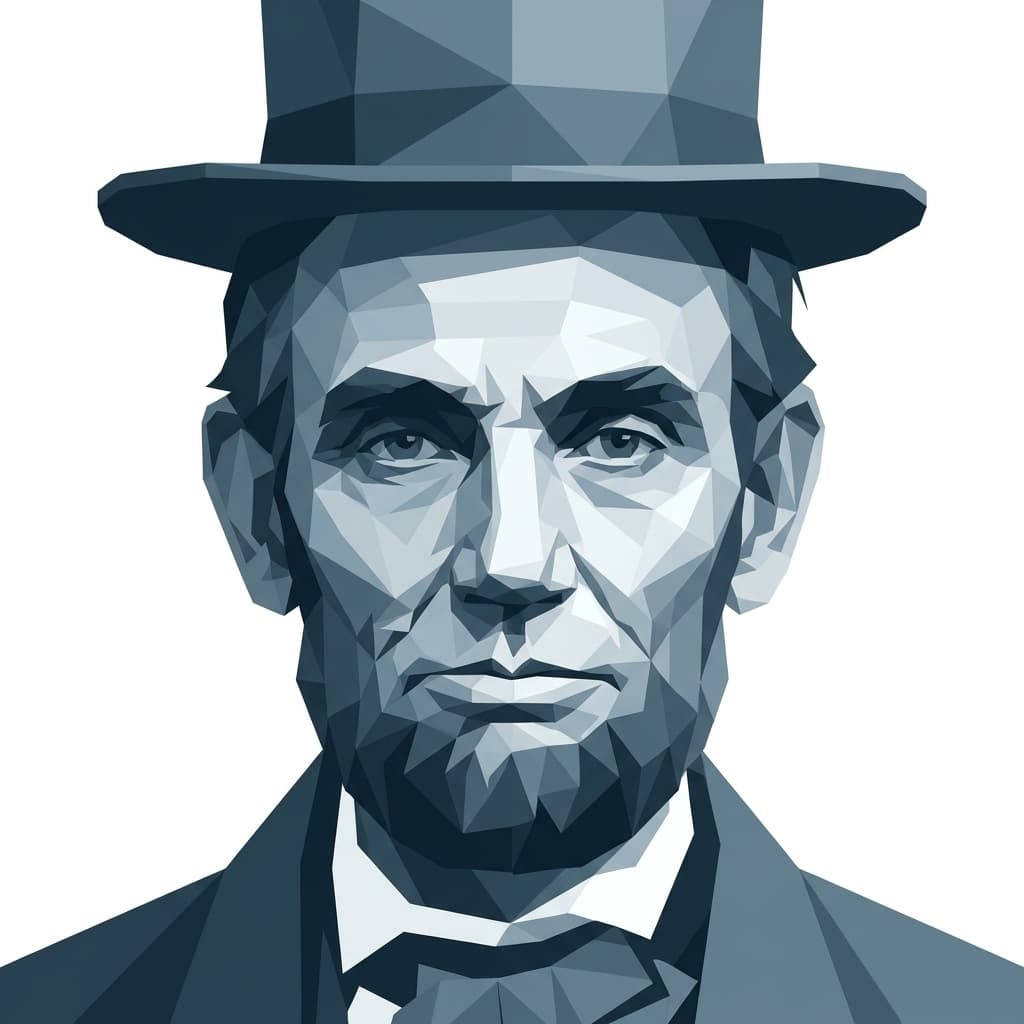
Abraham Lincoln was a Projector — the kind of leader whose power lived in perspective rather than output, in seeing what others couldn't see and waiting until the country was ready to hear it. He lost more elections than he won before 1860, and each loss looked like failure until, one day, it looked like preparation. The presidency came to him as an invitation the country didn't quite realize it was extending, and he took it exactly when the recognition finally arrived.
He was largely self-taught — the frontier boy who read Blackstone by firelight and taught himself geometry in his forties to sharpen his reasoning. That was his 5/2 profile at work: the reluctant heretic with a natural talent he barely counted as a gift, retreating into books and long walks before emerging with something the country needed. His law partner William Herndon described him as moody and remote for hours, then suddenly present — the kind of mind that needed solitude before it could serve. Colleagues learned not to interrupt those silences.
Lincoln decided by talking. He would corner a cabinet secretary, a stranger on a train, a soldier outside the White House, and think aloud until he heard his own clarity emerge in his own voice. The famous "Team of Rivals" cabinet — Seward, Chase, Stanton, men who had wanted his job — was partly this: he needed people who would argue back, not agree. He also told stories compulsively, folksy anecdotes that frustrated generals who wanted decisions, but the stories were the process. He was structuring his opinions in public, testing the logic against the room, refining until something felt sound.
His mind was relentlessly analytical. He picked apart the Dred Scott decision line by line in the 1858 debates, and questioned every assumption the pro-slavery argument rested on until its foundations showed. The Cooper Union address that made him a national figure was a work of forensic patience — months of research into what the Founders actually believed, delivered as logical patterns others had missed entirely. He understood that a house divided could not stand not as slogan but as syllogism.
The melancholy was real and lifelong. He carried the deaths of his mother, his sister, his fiancée Ann Rutledge, and his son Willie, and he spoke openly of despair in ways nineteenth-century men usually didn't. He was acoustically attuned to grief, his own and the nation's — the Gettysburg Address is 272 words of exactly that attunement, a eulogy that reframed the war. His sense of what the Union was worth fighting for sharpened as the casualties climbed; he refused peace terms that would have ended the killing but preserved slavery, because the struggle had to mean something.
The Emancipation Proclamation was timed with a strategist's patience — he waited through Antietam, through cabinet objections, through his own doubts, until the moment for transformation had actually arrived. He believed, with the stubbornness of a man who had thought it through alone, that some principles were worth the whole apparatus of the state. Five days after Appomattox, at Ford's Theatre, the invitation ended.
Sources: biography · birth data
What do you and Abraham Lincoln have in common?
Enter your birth details to find out