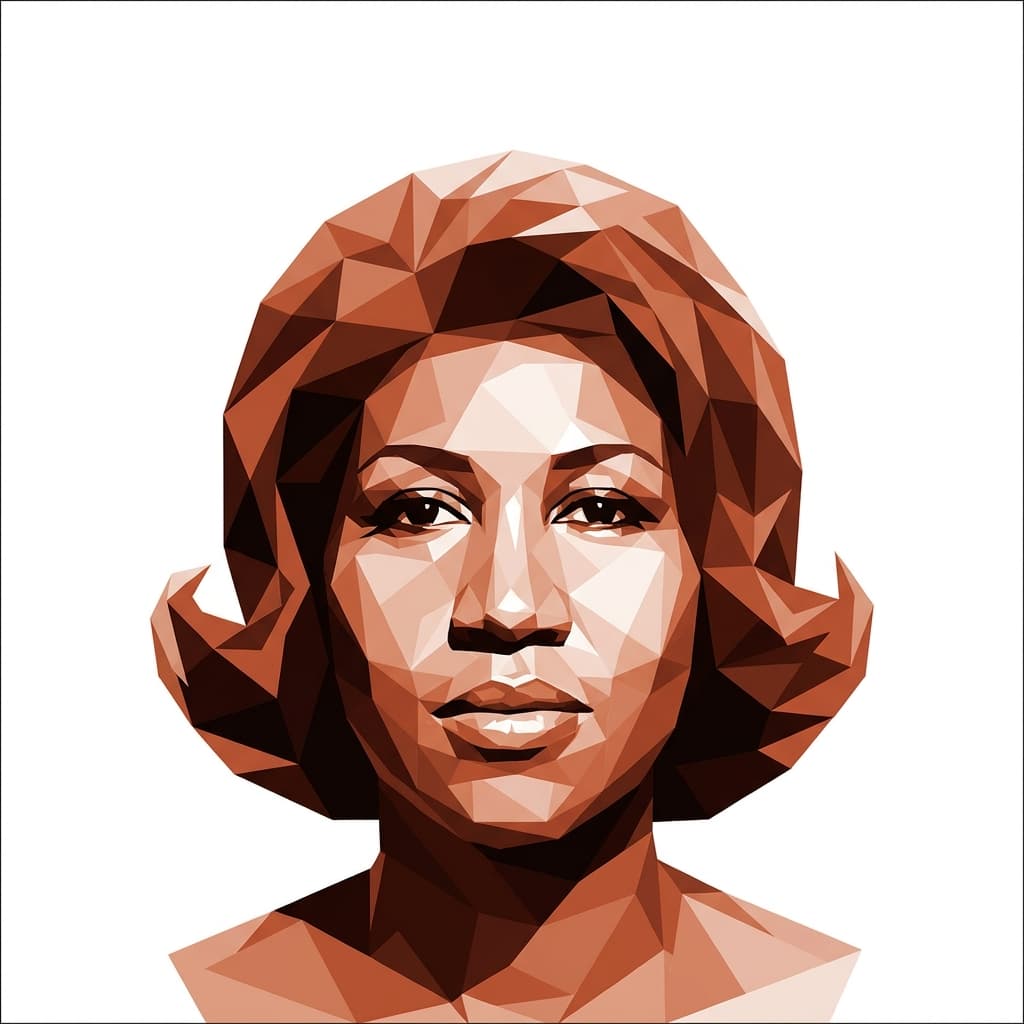
The Queen of Soul whose voice defined gospel, R&B, and civil rights-era American music.
Design
- Q58.4
- h52.4
- R2.3
- g64.6
- i63.6
- S38.2
- T13.5
- U42.3
- V35.3
- W23.4
- X8.3
- Y46.2
- Z31.4
Personality
- Q17.2
- h18.2
- R53.3
- g64.2
- i63.2
- S63.2
- T49.2
- U16.6
- V35.4
- W8.1
- X8.4
- Y46.1
- Z31.2
Aretha Franklin was a Generator — built with deep, renewable stamina for the one thing that lit her up completely, which was singing, and she poured that stamina into a six-decade career without ever really running dry. Born in Memphis and raised in Detroit inside her father C.L. Franklin's New Bethel Baptist Church, she was performing gospel solos by age ten and cutting her first record at fourteen. The voice was there from the start; what took time was learning where to point it.
Her early Columbia years, under John Hammond, are famous now mostly as a cautionary tale. Producers dressed her in supper-club standards and show tunes, chasing a sound that wasn't hers. She was waiting for something to actually light up her gut, and none of it did. When Jerry Wexler signed her to Atlantic in 1966 and sent her to Muscle Shoals to sit at her own piano, the response came instantly — "I Never Loved a Man" was cut in a single afternoon. That was the full-body yes she'd been listening for.
Aretha was famously private, guarded with the press, uncomfortable with fame's demands — a 2/4 profile who needed long stretches of solitude to recharge and let her gifts develop, then re-emerged through the tight community of musicians, family, and church people who'd known her forever. She rarely toured heavily, feared flying for decades, and preferred cooking at home to Hollywood parties. But when her people called — Mavis Staples, Smokey Robinson, her sisters Carolyn and Erma singing backup — she showed up with everything.
The recordings themselves carry the specifics of her chart. "Respect" became a civil rights and feminist anthem because she stood up for what genuinely mattered to her and rearranged Otis Redding's song around that stance, adding the R-E-S-P-E-C-T spellout and the "sock it to me" bridge her sisters worked out at the piano. Her Muscle Shoals sessions show a mastery built through endless repetition at the keyboard; she arranged from the piano bench, and every horn chart bent to what her left hand was doing. In 1972 she recorded Amazing Grace live at New Temple Missionary Baptist in Los Angeles, returning to the gospel tradition that had shaped her earliest listening, and it remains the best-selling live gospel album ever made.
She sang at Martin Luther King Jr.'s funeral, at Jimmy Carter's inauguration, at Barack Obama's inauguration in a bow-tied hat that became its own icon. Her conviction about what was just and worth working toward ran through the benefit concerts, the bail money she quietly posted for Angela Davis, the way she stayed with Detroit when others left. At the 1998 Grammys she stepped in for an ill Pavarotti with twenty minutes' notice and sang "Nessun Dorma" in his key — a beginning grabbed the moment it appeared, delivered with the kind of focused stillness that stops a room cold.
She was working almost to the end, planning albums and appearances until pancreatic cancer took her in August 2018. What she left is voluminous and specific: not a style so much as a way of distilling everything — gospel, blues, jazz, standards — down to its essential emotional truth.
Sources: biography · birth data
What do you and Aretha Franklin have in common?
Enter your birth details to find out