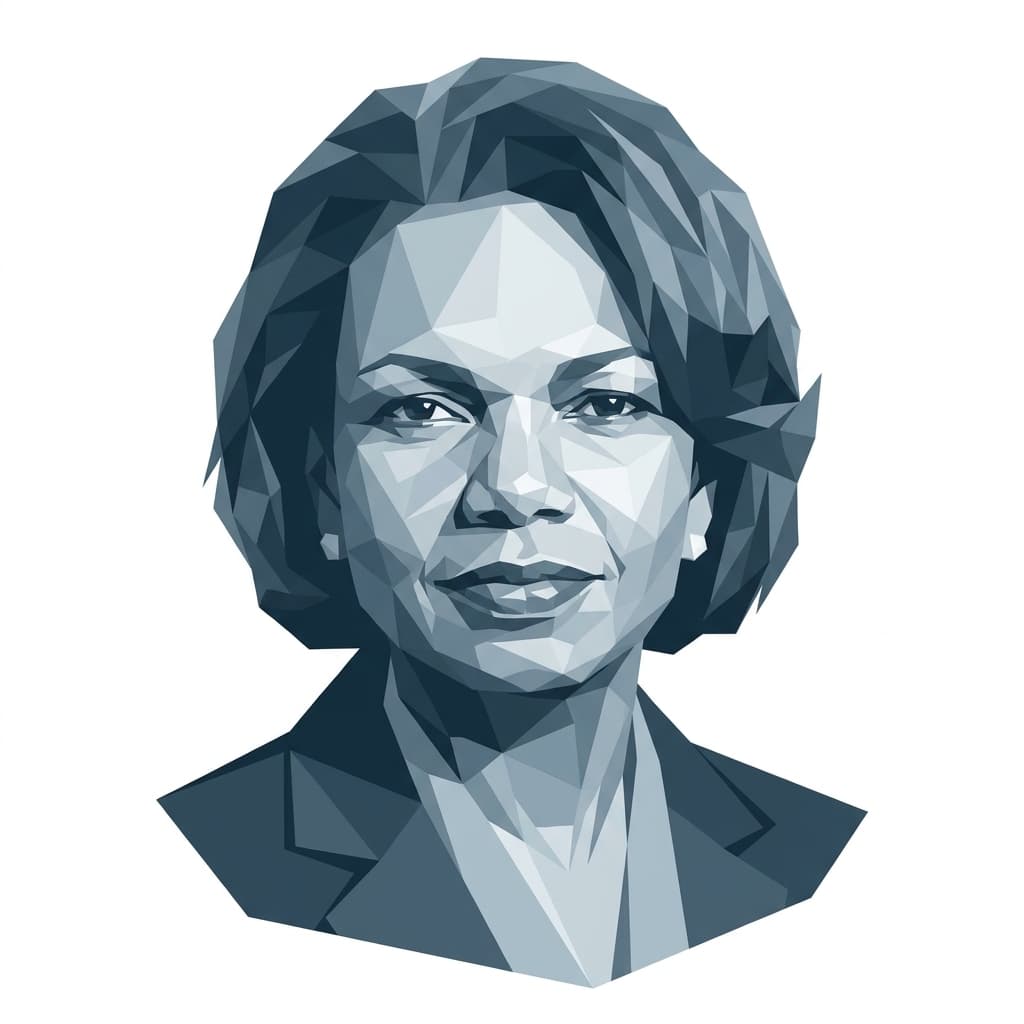
American diplomat and scholar who served as U.S. Secretary of State and National Security Advisor.
Design
- Q4.6
- h49.6
- R25.3
- g38.5
- i39.5
- S4.1
- T18.6
- U11.6
- V53.4
- W28.3
- X62.5
- Y32.4
- Z29.1
Personality
- Q43.4
- h23.4
- R53.4
- g58.3
- i52.3
- S28.1
- T43.5
- U13.4
- V56.4
- W44.6
- X56.2
- Y50.1
- Z29.3
Condoleezza Rice is a Projector — designed less to grind out work than to see systems clearly and steward the energy of powerful people, which is essentially the job description of a National Security Advisor. She grew up in segregated Birmingham, the only child of a Presbyterian minister and a music teacher, and by the time she reached Stanford as a Soviet specialist in her twenties she was already doing what Projectors do best: watching a complex system, mapping it, and being invited into rooms where her read of it mattered.
Her rise inside the George H.W. Bush administration and then as Provost of Stanford was less a career ladder than a series of invitations she was ready for. Brent Scowcroft noticed her at a dinner and pulled her onto the NSC; George W. Bush met her at the Bushes' Kennebunkport house and, by his own account, decided within a weekend that she would tutor him on foreign policy. That's the 4/6 profile at work — the influential role model whose big opportunities come through the network of people who already know and trust her, not through cold applications.
Her mind is unmistakably wired for understanding why systems behave the way they do, and she built an entire academic career organizing the fine-grained facts of Soviet military structure into arguments other people could use. Colleagues from Stanford and the NSC describe the same thing: she could take a tangle of intelligence and render it in language a president could actually act on. It's an unusual combination — the precision of a policy technician with the clarity of a translator.
The harder chapters — the Iraq War, the 9/11 Commission testimony, the "mushroom cloud" line on CNN — showed the shadow side of a chart built to stand up hard for what she believed was principled and to commit fully once she'd said yes. Once inside the Bush administration's worldview she defended it with a warrior's steadiness, treating loyalty as a fight worth having even as the ground shifted underneath. Critics read this as rigidity; friends read it as the same discipline that got a Black girl from Jim Crow Alabama to the seventh floor of the State Department.
What often gets missed is the private Rice — the concert pianist who still plays Brahms with Yo-Yo Ma, the football obsessive who genuinely wanted to be NFL commissioner, the woman who seems to make big calls on a quick inner read rather than long deliberation. Her memoirs are full of moments where she just knew: knew Gorbachev was serious, knew a meeting was going sideways, knew when to leave Washington. That instinct, more than any doctrine, is the through-line.
Back at Stanford's Hoover Institution as its director, she's stepped into the role a 4/6 profile tends to grow into — the elder who mentors from lived experience, drawing younger scholars and diplomats into her orbit and speaking from the long view rather than the daily fight. It's a quieter posture than the podium at Foggy Bottom, and it appears to suit her.
Sources: biography · birth data
What do you and Condoleezza Rice have in common?
Enter your birth details to find out