American jazz trumpeter and vocalist whose fragile lyricism defined West Coast cool, shadowed by lifelong addiction.
Design
- Q46.6
- h25.6
- R52.6
- g24.6
- i44.6
- S32.3
- T59.2
- U32.3
- V35.6
- W11.3
- X21.1
- Y59.3
- Z53.5
Personality
- Q10.3
- h15.3
- R46.6
- g24.4
- i44.4
- S54.1
- T26.4
- U11.3
- V16.4
- W10.5
- X17.4
- Y59.4
- Z53.5
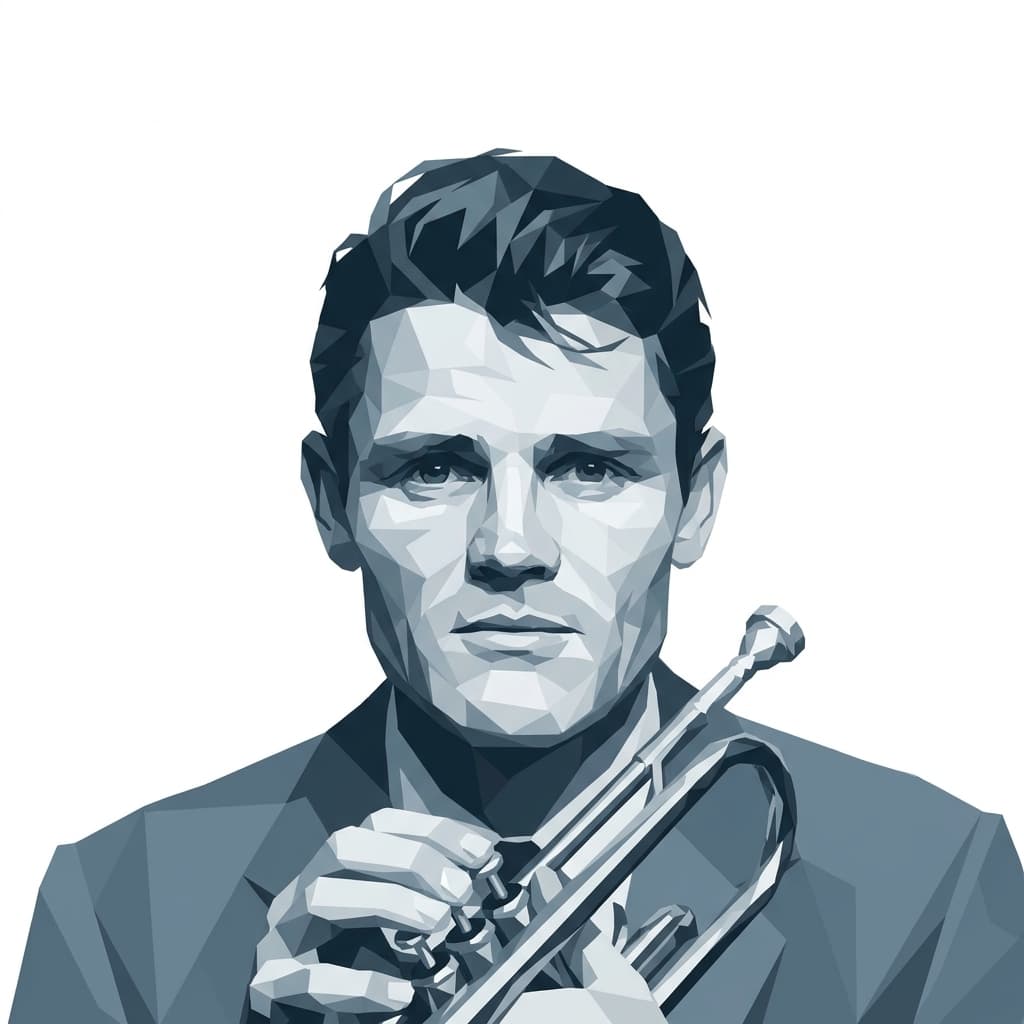
Chet Baker was a Projector — not built to blow the walls down like the bebop titans he admired, but wired to be seen, invited in, and to say a great deal with very little air. When Charlie Parker plucked him out of a Los Angeles audition in 1952, it was exactly the kind of recognition his whole career depended on. Bird told the East Coast players there was a kid on the coast who would eat them alive. Chet stepped into that opening and, within two years, was outpolling Miles Davis in DownBeat.
His tone was the whole argument. Where others crowded the horn with notes, Baker played only what needed to be said, and nothing more, a sound so private it felt eavesdropped on. That sparseness came naturally to a 3/6 profile — years of trial-and-error club work in the early fifties, followed by the elevated, almost sage-like remove of the later recordings. He learned by doing, failed loudly and often, and eventually became the melancholic wise man of his own myth. He also sang, in a voice that startled everyone including him: androgynous, unadorned, carrying the emotional weight of experiences he'd only half-processed.
The decisions that defined his life were rarely deliberated. Baker moved on instinct, the quiet in-the-moment knowing that never bothered to explain itself — which is how he ended up in Europe, in prison in Lucca, deported from Germany, back in New York, back in California, and eventually dead in Amsterdam. He picked up heroin in the mid-fifties and it stayed with him, a pull toward extremes that most players wouldn't have survived a decade of. He survived nearly four.
The chart's darker corners show up in the biography plainly. There's a restlessness that couldn't tolerate the same room twice — new bands, new cities, new marriages, new dealers, always beginning again. There's the ambition to be the best on the instrument, refined through relentless practice in his early years, and then the long collapse when a 1966 beating in San Francisco cost him most of his front teeth and he had to relearn the embouchure from scratch. He did relearn it. That was the 3/6 stubbornness: get knocked down, get dirty, come back with something quieter and stranger than before.
He was chronically broke, chronically charming, and could talk almost anyone into fronting him money, a session, a bed. Producers who swore they'd never work with him again worked with him again. The late records — Chet Baker Sings Again, the Paris and Tokyo dates, the duets with Paul Bley — have the hard-won recognition of an old man who'd seen every pattern before and stopped pretending otherwise. On May 13, 1988, he fell from a second-floor window of the Prins Hendrik Hotel in Amsterdam. Heroin and cocaine were in his system. He was 58, and had been playing, more or less, since he was thirteen.
Sources: biography · birth data
What do you and Chet Baker have in common?
Enter your birth details to find out