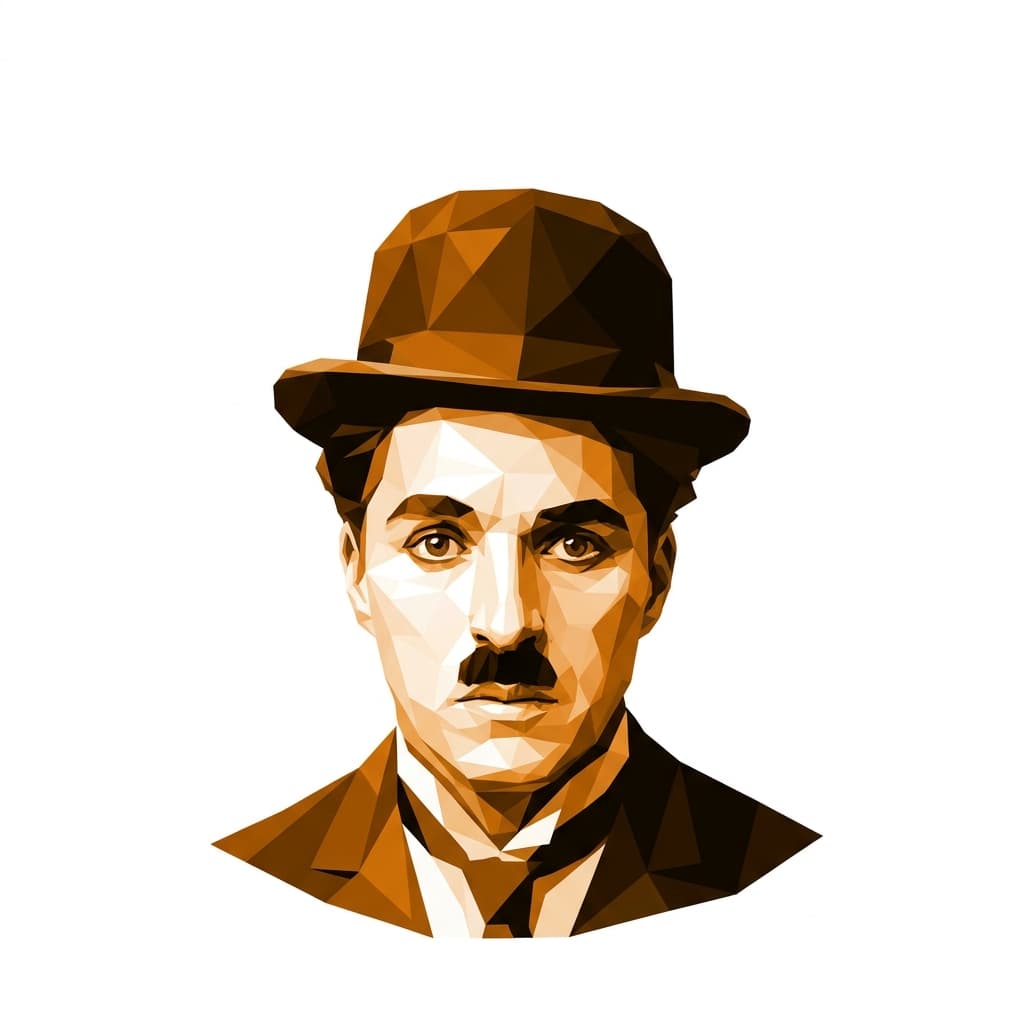
Silent film auteur and Little Tramp creator who turned slapstick into social commentary.
Design
- Q60.3
- h56.3
- R7.5
- g62.1
- i61.1
- S19.6
- T63.3
- U37.2
- V11.5
- W7.6
- X32.2
- Y8.6
- Z20.5
Personality
- Q3.1
- h50.1
- R44.2
- g53.1
- i54.1
- S51.3
- T2.6
- U2.1
- V58.5
- W7.1
- X57.5
- Y20.1
- Z20.5
Charlie Chaplin was a Manifesting Generator — wired to write, direct, score, edit, and star in his own pictures without picking just one role, and the arc of his career is exactly that. By twenty-five he was the highest-paid performer in the world; by thirty he was co-founder of United Artists, having decided the studios couldn't be trusted with what he made. He worked at a tempo that bewildered everyone around him, shooting hundreds of thousands of feet of film for a single short, then condensing it down with the kind of gut certainty that doesn't need explaining.
His childhood in Walworth was the workshop where the Tramp was forged. His mother committed to an asylum, his father drunk and gone, Charlie and his brother Sydney shuttled between workhouses and the streets. That early collision with hunger and shame gave him an unusually sharp antenna for what poor people actually need, and it shows up in every frame of The Kid, City Lights, and Modern Times. The 1/3 profile — investigator-experimenter — fits him almost too neatly: he researched a gag obsessively, then learned what was funny by failing in front of the camera until it wasn't.
The Tramp himself arrived by accident in 1914, when Mack Sennett told him to put on a comedy costume and Chaplin grabbed baggy pants, a tight coat, a bowler, and a cane on his way to the set. The character was an act of inventing a whole new figure where there hadn't been one, and audiences recognized him instantly. Chaplin spent the next twenty-five years refining the Tramp through trial, error, and meticulous tinkering with limitation — sometimes reshooting a single scene fifty or a hundred times until the gesture was exact.
He had a storyteller's instinct for turning his own life into pictures the whole world could feel, and he used it without much restraint. The Great Dictator, made in 1940 when half of Hollywood was still afraid to name Hitler, ends with Chaplin breaking character to deliver a six-minute speech directly to camera — the moment he stopped performing and just said what needed to be said. It was reckless, sentimental, and electrifying. His detractors called it propaganda; he didn't care.
The same nerve that made him brave made him politically dangerous. He refused American citizenship, was hounded by the FBI, dragged through a paternity suit, and in 1952 — sailing to London for a premiere — had his re-entry permit revoked by the Attorney General. He settled in Switzerland and didn't return to the United States for twenty years. Through it all he kept working: composing scores for his old silent films, writing Limelight, fathering eight children with Oona O'Neill. There was a restlessness that needed a new project to begin and a relentless drive toward making the next thing better than the last.
When he finally came back in 1972 to accept an honorary Oscar, the audience stood for twelve minutes — the longest ovation in Academy history. He cried. He looked surprised, which was strange, because he had always known, somewhere in his gut, exactly where he was headed.
Sources: biography · birth data
What do you and Charlie Chaplin have in common?
Enter your birth details to find out