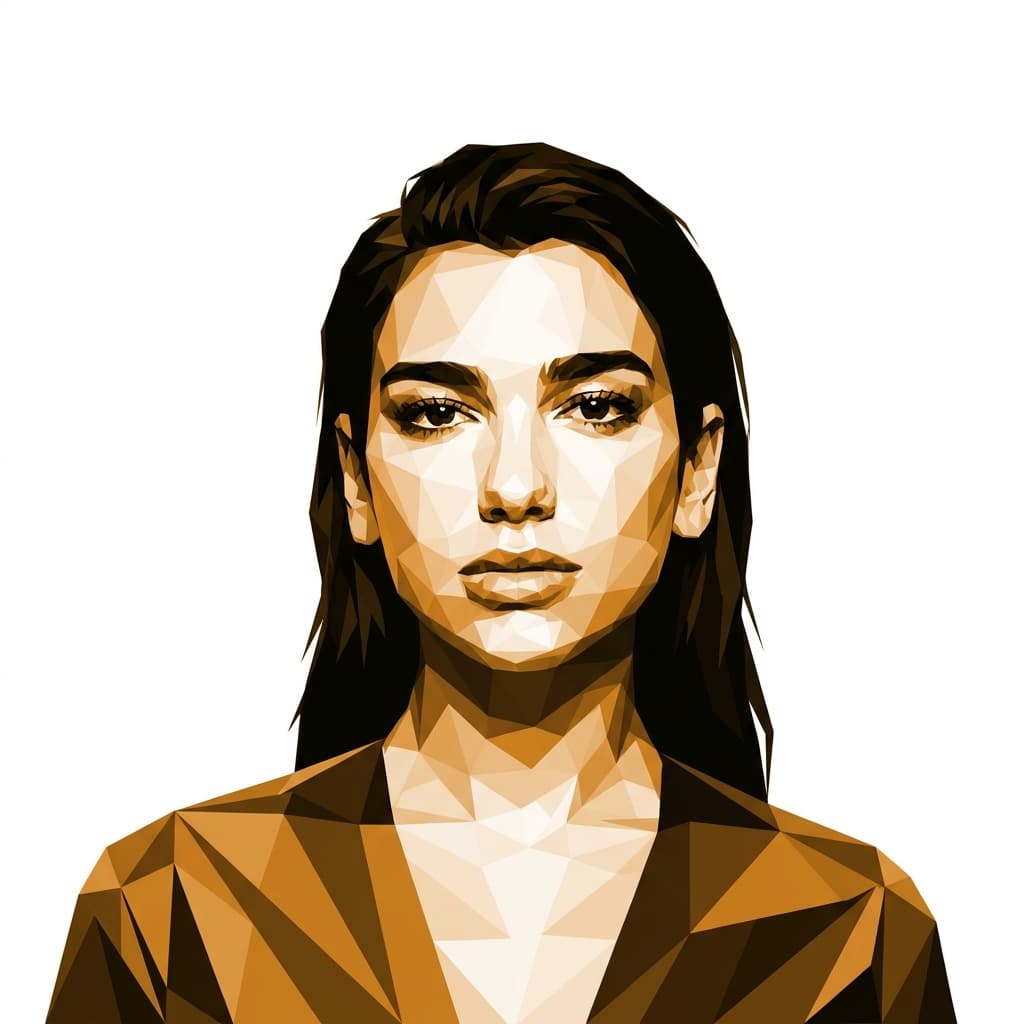
English-Albanian pop star whose disco-pop reinvention and side ventures made her one of the decade's defining hitmakers.
Design
- Q20.1
- h34.1
- R63.2
- g28.4
- i27.4
- S45.2
- T27.5
- U29.5
- V5.1
- W36.1
- X60.5
- Y61.5
- Z14.5
Personality
- Q29.5
- h30.5
- R53.2
- g50.3
- i3.3
- S47.4
- T29.6
- U57.5
- V9.1
- W36.1
- X60.1
- Y61.3
- Z14.4
Dua Lipa is a Manifesting Generator — wired to chase several passions at once and skip the steps that don't matter — and her career so far reads like a textbook case. Pop star, podcast host, book club founder, magazine publisher, occasional actress: she's been all of these inside a single decade, and none of them feel like a detour from the others. The throughline is appetite. When something lights her up, she moves.
Born in London to Kosovar-Albanian parents and uprooted back to Pristina at eleven, she talked her way into returning to London alone at fifteen to chase music. That move is pure 5/1 profile — the investigator-as-fixer, building a foundation before stepping out to solve a problem — except the problem she was solving was her own access to the industry. She modeled, sang covers on YouTube, signed to Warner at seventeen, and put out a debut album that did fine but didn't define her. The pivot came with Future Nostalgia, released into the first week of lockdown in 2020, which she insisted on dropping early when the leak hit. That was the kind of in-the-moment gut call that doesn't wait for committee.
The reinvention itself was an exercise in bringing order to a chaotic genre moment — she and her collaborators stripped late-2010s pop of its mumbled minimalism and rebuilt it around disco bass, four-on-the-floor, and choruses you could hear from a parking lot. Future Nostalgia was innovation that worked because it lived inside tight constraints, a deliberately retro framework that turned out to be exactly what a locked-down world wanted to dance to. The album won Best Pop Vocal at the Grammys and effectively redrew the map for what mainstream pop could sound like in the early 2020س.
What's more interesting is what she did with the leverage. She launched Service95, a newsletter and podcast where she interviews authors and activists with the visible focus of someone who actually did the reading. She started a book club. She produced a documentary. None of these are typical pop-star side hustles — they're the moves of someone directing real energy toward work that genuinely fulfills her rather than just slapping her name on a fragrance. Her interviews with everyone from Hillary Clinton to Billie Eilish carry a curiosity that reads as actually wanting to know.
On stage, she's present in a way that translates instantly to a stadium back row, and her live shows since Future Nostalgia have leaned into choreography and disco-era staging — committing fully to the bit rather than hedging with cool detachment. She's also been notably vocal about Kosovo, Palestine, and worker conditions in ways that have cost her press goodwill but seem to come from a place she's actually thought about.
The career so far suggests someone who treats staying excited as a non-negotiable — moving fast when the gut says yes, leaving the projects that don't, and quietly betting that her audience can follow her from disco hit to literary interview without needing the through-line spelled out.
Sources: biography · birth data
What do you and Dua Lipa have in common?
Enter your birth details to find out