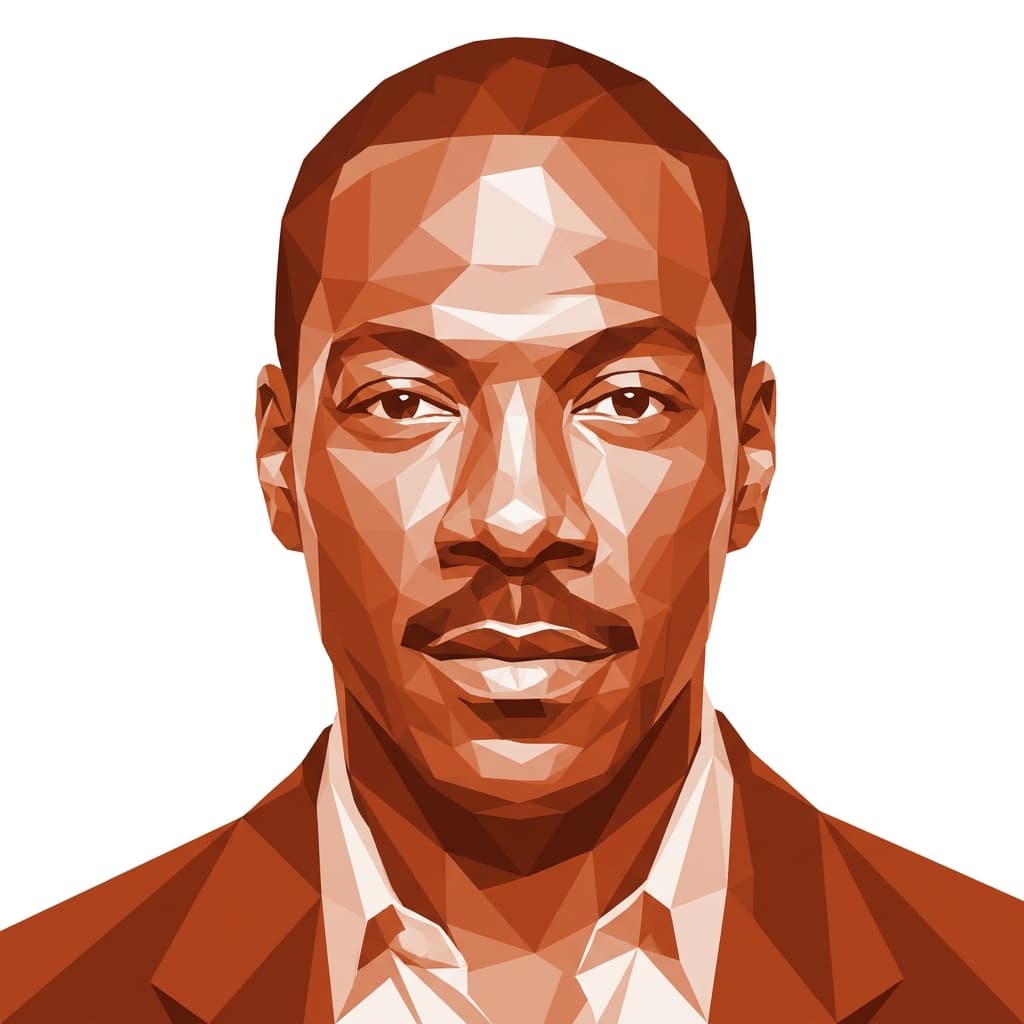
American comedian and actor whose stand-up and film stardom reshaped 1980s comedy.
Design
- Q54.1
- h53.1
- R59.3
- g40.2
- i37.2
- S54.1
- T55.2
- U52.3
- V54.1
- W54.6
- X29.1
- Y44.4
- Z40.3
Personality
- Q21.5
- h48.5
- R1.2
- g59.6
- i55.6
- S22.3
- T42.5
- U39.6
- V41.2
- W60.3
- X4.4
- Y44.4
- Z40.1
Eddie Murphy is a Generator — built for the kind of sustained, satisfying work that lets a person dive into one craft and master it before branching out. He started doing impressions for kids in his Roosevelt, Long Island neighborhood, was paid for a stand-up set at fifteen, and by nineteen had talked his way onto Saturday Night Live. The show was, at that moment, in collapse; Murphy walked in with the kind of gut conviction that says yes to the right room and walked out, three seasons later, as the only reason most people were still watching.
His 5/1 profile — the investigator who becomes the fix-it guy — shows up in how he actually built characters. Buckwheat, Gumby, Mister Robinson, Velvet Jones: each was the product of weeks of private study, watching tape, working the voice alone, then walking onto a live stage as if he'd been doing it his whole life. He had a researcher's patience for the small details that make a bit land, and the focused stillness to lock into one character until it was airtight. When 48 Hrs. and Trading Places hit, Hollywood treated him like a problem solver they could hand any script to — exactly the projection a 5/1 attracts and exactly the trap.
Beverly Hills Cop in 1984 made him, briefly, the biggest movie star in the world, and the run that followed — Coming to America, Harlem Nights, which he also directed — was a Generator's appetite for going and going when the work lights him up. Raw, his 1987 concert film, is still the highest-grossing stand-up movie ever made. But the Emotional Authority underneath all of it meant his decisions were never as instant as his on-camera energy suggested; friends and collaborators have described him as someone who needs to sleep on things, sit with them, let the wave pass before he commits. The choices he made fast — certain late-80s and 90s films — he tended to regret. The ones he sat with, he didn't.
The 1990s were rough, and he mostly disappeared from stand-up for thirty years. What he did instead was build a different career inside his house in Beverly Park: ten kids, a recording studio, a creative life lived largely out of public view. The Nutty Professor and Shrek were genuine reinventions — the comic instinct to start over with a completely new voice, to play eight characters under prosthetics, to become Donkey. Dolemite Is My Name in 2019 was a deliberate, intentional return after a long cycle of reflection, and his 2019 SNL hosting episode — Gumby, Buckwheat, Mister Robinson all back — landed like someone who'd spent the intervening decades quietly sharpening the blade.
What's stayed consistent is the originality that refuses to sound like anyone else on stage — the laugh, the swagger, the specific Eddie Murphy cadence that a generation of comedians have tried and failed to copy. He's fiercely private about family and unusually loyal to the small circle he actually trusts, protective of his autonomy in a business that constantly tries to manage him, and willing to provoke an audience until it finds something true to laugh at. At his best he's still doing what the nineteen-year-old at SNL was doing: waiting for the bit to light him up, then committing to it completely.
Sources: biography · birth data
What do you and Eddie Murphy have in common?
Enter your birth details to find out