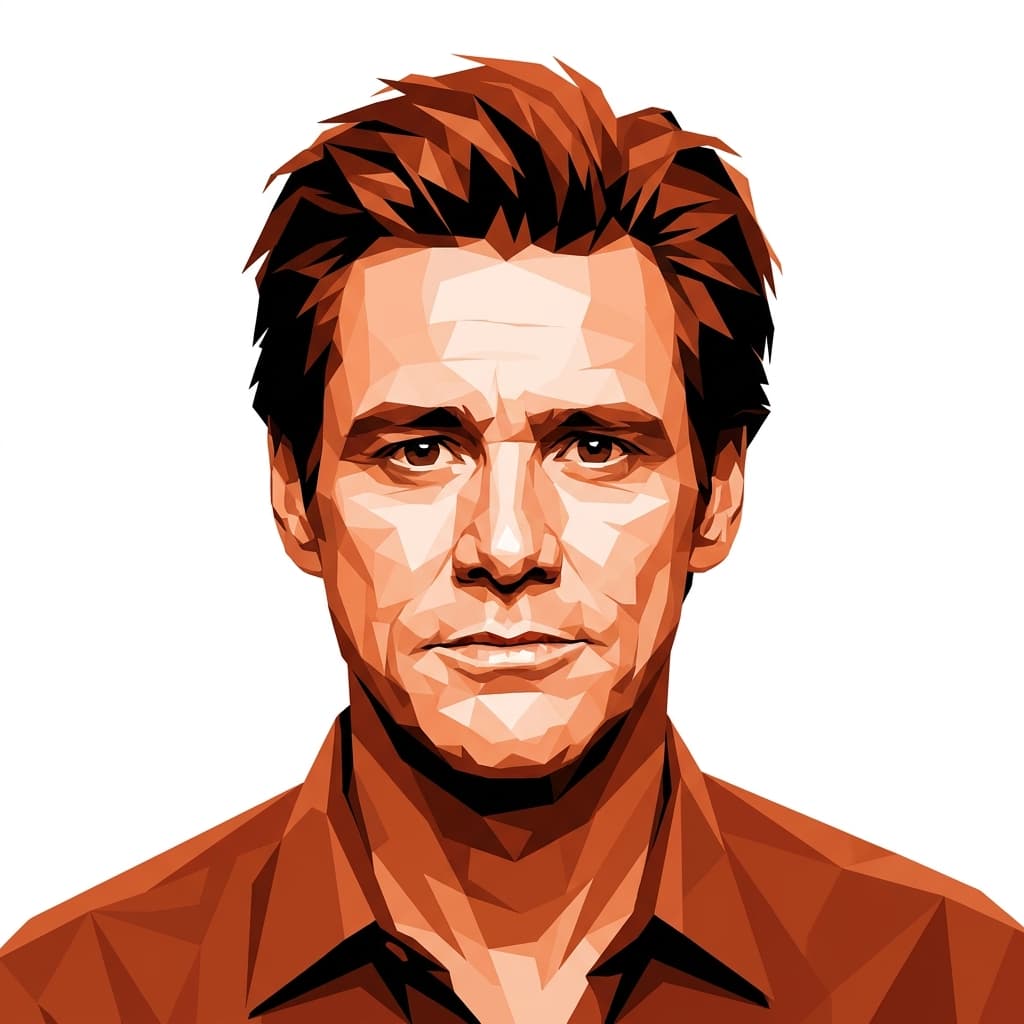
Canadian-American actor and comedian whose rubber-faced physical comedy reshaped 1990s Hollywood before he pivoted to dramatic roles.
Design
- Q50.3
- h3.3
- R17.5
- g29.1
- i30.1
- S50.4
- T18.2
- U1.1
- V60.3
- W61.4
- X29.6
- Y44.4
- Z40.4
Personality
- Q60.1
- h56.1
- R45.1
- g7.6
- i13.6
- S13.2
- T61.4
- U54.3
- V13.1
- W60.6
- X29.6
- Y1.1
- Z40.5
Jim Carrey is a Generator — built with the kind of deep, renewable engine that can sustain a two-hour facial workout in front of a camera and still come back the next morning to do it again. The story of his early career is the story of that engine looking for the right thing to power. He dropped out of high school at fifteen to work as a janitor while his family lived out of a van, and he was already bombing nightly at Yuk Yuk's in Toronto, learning by failing in public.
That public failing is its own signature. With a 1/3 profile, the investigator-experimenter, he was wired to research obsessively in private and then crash-test the results onstage. The classic Carrey story — practicing faces in the mirror for hours as a kid, mailing himself a ten-million-dollar check dated for Thanksgiving 1995 — is pure 1/3: building a foundation alone, then bruising himself in public until something works. He has talked openly about the years of committing fully to a bit even when it died, grinding through Vegas opening slots and a failed NBC sitcom (The Duck Factory) before In Living Color finally landed in 1990.
When the right vehicle showed up, his response was unmistakable. Ace Ventura, The Mask, and Dumb and Dumber all hit in 1994, and Carrey became the first actor to command twenty million dollars a picture. The performances are pure creativity that refuses to sit still or look like anyone else's — every elbow, eyeball, and vocal squawk doing something. He has described the work as physical possession, a hunger to actually feel the experience all the way through rather than gesture at it. Even in broad comedy, you can see him making meaning from his own lived material, pulling from a childhood shaped by his father's job loss and his mother's chronic illness.
The pivot is the more interesting part. The Truman Show and Man on the Moon arrived in 1998 and 1999, and Carrey disappeared so completely into Andy Kaufman that the documentary Jim & Andy later showed crew members visibly unnerved by him. He's spent decades since then asking what's actually underneath the performance — the famous "I think everybody should get rich and famous and do everything they ever dreamed of so they can see that it's not the answer" line is the public face of a private contemplative streak that includes painting, writing, and long stretches of withdrawal.
In recent years he's been more selective about where the engine goes, pattern-matching across his own history and refusing roles that don't light him up. His painting practice — large, vivid, often spiritual canvases worked on in a Brentwood studio — reads as the same energy redirected. He's an unlikely voice for collective conversations about meaning, mental health, and ego, showing up at Golden Globes podiums or in long-form interviews to say things most movie stars won't. The rubber face is still there when he wants it. But the more durable Carrey is the one protecting what actually matters to him and saying so out loud.
Sources: biography · birth data
What do you and Jim Carrey have in common?
Enter your birth details to find out