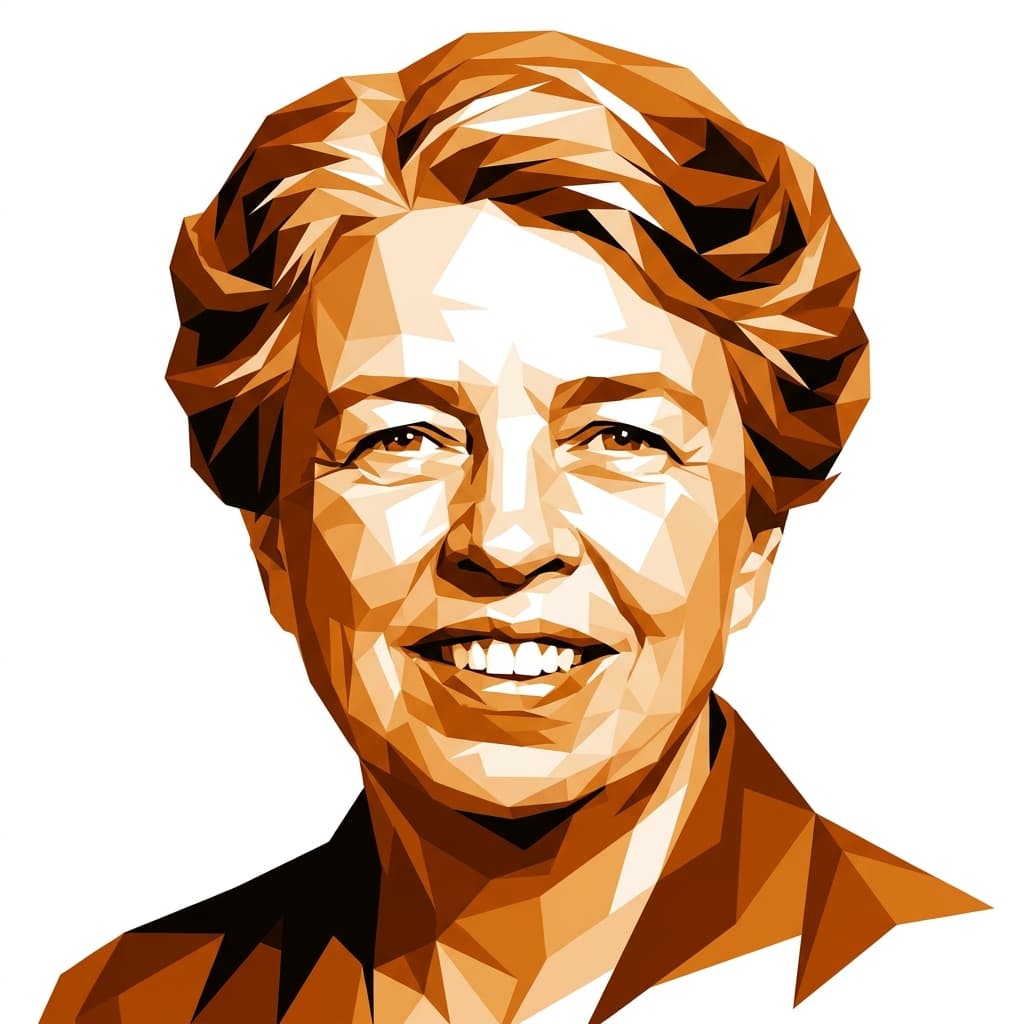
First Lady, diplomat, and human rights champion who redefined public service and women's political leadership.
Design
- Q53.6
- h54.6
- R63.1
- g57.4
- i51.4
- S53.6
- T53.5
- U47.5
- V33.3
- W45.2
- X6.3
- Y23.5
- Z20.2
Personality
- Q57.4
- h51.4
- R53.5
- g48.5
- i21.5
- S46.5
- T59.4
- U43.2
- V29.5
- W12.2
- X46.2
- Y23.5
- Z20.2
Eleanor Roosevelt was a Manifesting Generator — built to run several careers at once, and she did, somehow holding the roles of First Lady, newspaper columnist, radio host, civil rights agitator, and UN diplomat in the same decade. She never picked a lane. When Franklin contracted polio in 1921, she stopped being a society wife and started being a political operator, a public speaker, a labor advocate, and a teacher at the Todhunter School in Manhattan — often in the same week. The shape of her life was non-linear by design, the kind of energy that lifts up everyone around it when she was finally working on what genuinely lit her up.
Her 4/6 profile — the community-rooted role model — fits almost too neatly. The early decades were the experimental half: a painfully shy orphan, an awkward debutante, a wife humiliated by her husband's affair with Lucy Mercer, a mother bullied by her mother-in-law Sara. She later called those years her training. By the time she was fifty, she had moved fully into the role-model phase, writing the "My Day" column six days a week for twenty-seven years, turning lived experience into wisdom others could actually use. The mess, as she eventually understood, had been the curriculum.
She made decisions slowly, often agonizingly so, sleeping on things until the emotional charge passed. Friends noted she would raise a question, drop it, return to it weeks later from a different angle. Her famous press conferences — open only to women reporters, a deliberate lever to force newsrooms to hire women — were the product of months of feeling into the idea before announcing it. When she did commit, she committed completely: the persistence to stay with something through every ugly stretch, whether that meant decades of anti-lynching advocacy or the four punishing years chairing the drafting committee for the Universal Declaration of Human Rights.
That UN work showcased her instinct for managing resources and people toward a collective outcome. She ran the committee through 81 meetings, line by line, in three languages, refusing to let the Cold War kill the document. She also had an organizer's grip on the operational details — who needed to be in which room, which delegate could be flattered, which one needed to be ignored. Truman called her the First Lady of the World, and the title stuck because it was accurate.
Her voice carried the unmistakable weight of saying the thing at exactly the right moment — the 1939 resignation from the Daughters of the American Revolution after they barred Marian Anderson from Constitution Hall, announced quietly in her column and detonating across the country. She had a knack for naming truths plainly enough that ordinary people could hold them, which is why the column worked and why her radio broadcasts worked. She also had the nerve to walk into rooms no First Lady had entered — coal mines, segregated southern schools, Pacific war hospitals — and the appetite for starting things others wouldn't touch, from the Arthurdale resettlement community to the Tuskegee Airmen's funding fight. She was, by the end, exactly the kind of role model the 4/6 description promises: someone whose authority came from having actually been through it.
Sources: biography · birth data
What do you and Eleanor Roosevelt have in common?
Enter your birth details to find out