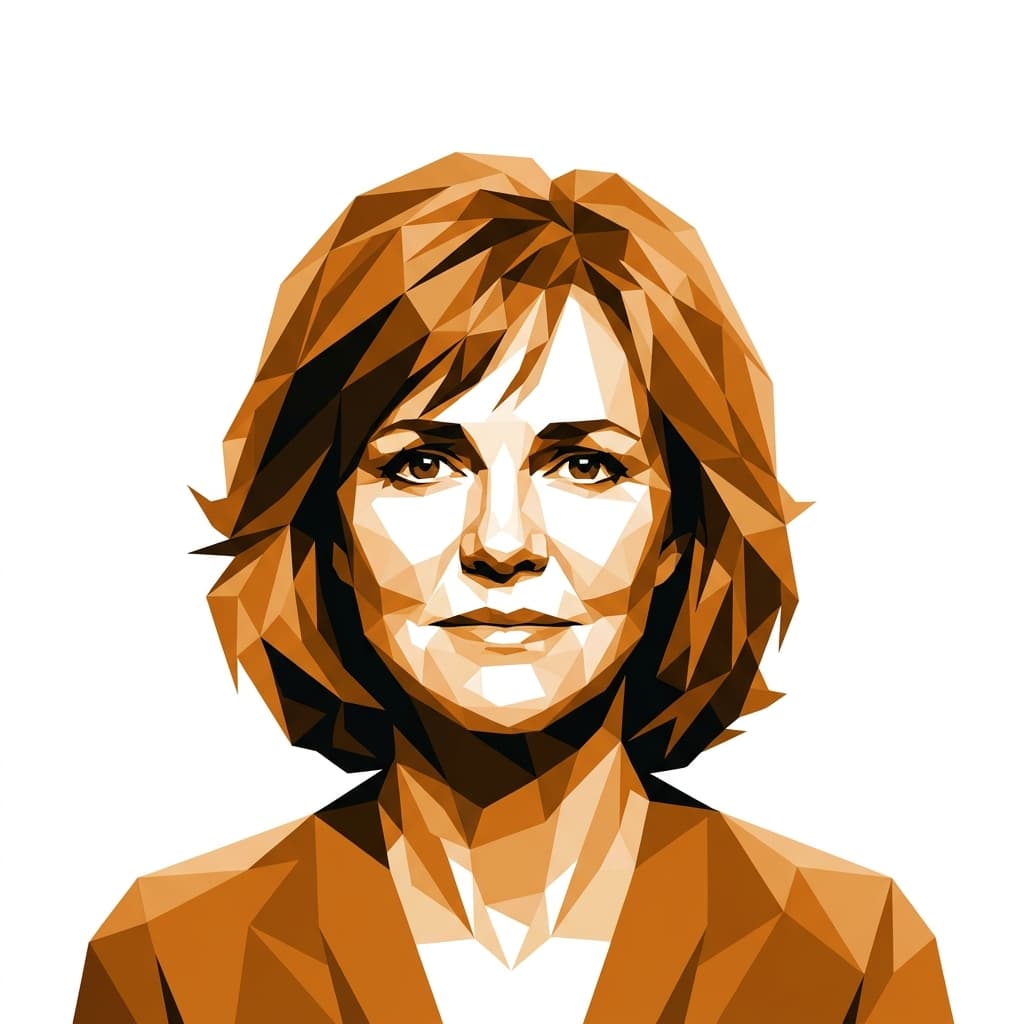
Two-time Oscar-winning American actress known for Norma Rae, Places in the Heart, and six decades of reinvention.
Design
- Q7.3
- h13.3
- R11.5
- g45.3
- i26.3
- S31.5
- T46.2
- U46.2
- V32.1
- W56.5
- X45.5
- Y18.3
- Z33.5
Personality
- Q1.1
- h2.1
- R17.3
- g35.1
- i5.1
- S9.1
- T34.1
- U14.6
- V44.2
- W33.2
- X45.5
- Y48.1
- Z7.1
Sally Field is a Manifesting Generator — built for speed, multiple passions, and reinvention — and her career reads like a case study in refusing to stay in the lane the industry keeps trying to draw for her. She started as Gidget at eighteen, became the Flying Nun at twenty-one, and by twenty-nine had willed herself into the title role of Sybil despite a town that had already decided she was decorative television fluff. Then she won the Oscar for Norma Rae. Then she won another for Places in the Heart. The trajectory is not linear; it is a series of gut-level pivots.
Her 1/3 profile shows up everywhere in the way she talks about the work. She researches obsessively — union organizing for Norma Rae, the mechanics of grief for Steel Magnolias, her own mother's private history for the memoir In Pieces — building a foundation before she'll let herself be seen using it. And she is candid, sometimes brutally so, about the failed experiments: the marriages that ended, the projects that flopped, the Burt Reynolds years she later described as formative precisely because they hurt. Every misstep, in her telling, became fuel rather than evidence of getting it wrong.
The famous 1985 acceptance speech — "You like me, right now, you like me" — is usually quoted as a punchline, but it's actually a pretty exact snapshot of the kind of decision-making that doesn't wait for the mind to catch up. She said what her body said, on live television, and spent decades explaining a sentence that needed no explanation. That same in-the-moment gut is what let her fight publicly for the Norma Rae role when Jane Fonda and Jill Clayburgh were the studio's shortlist, and it's what pulled her toward directing (Beautiful, 2000) when acting alone stopped satisfying her.
She has the reluctant leader's instinct for causes that actually need a voice, and she picks them carefully. Advocacy for the Human Rights Campaign after her son Sam came out. Testimony about domestic violence, drawing on her stepfather. ERA activism in the seventies. She doesn't do the celebrity-cause circuit; she waits until something lands close enough to speak with real weight, then commits with unusual endurance. It's the same engine that lets her sustain long, unglamorous work — a five-season run on Brothers & Sisters in her sixties, a Broadway Glass Menagerie at seventy — when most of her peers have quietly retired.
In Pieces, published when she was seventy-one, is where all of it converges. She wrote it herself, over seven years, refusing a ghostwriter. It is the book of someone who has been listening to other people's stories her entire career and finally decided to tell her own — the abuse by her stepfather, her mother's silence, the private cost of the public smile. She has spoken since about how much retreating to write it required, how necessary the solitude was after a lifetime of being watched.
She is still working. She is still, by her own account, figuring it out. Which is very 1/3 of her, and very on-strategy: she keeps waiting for the next thing that lights her up, and then she goes.
Sources: biography · birth data
What do you and Sally Field have in common?
Enter your birth details to find out