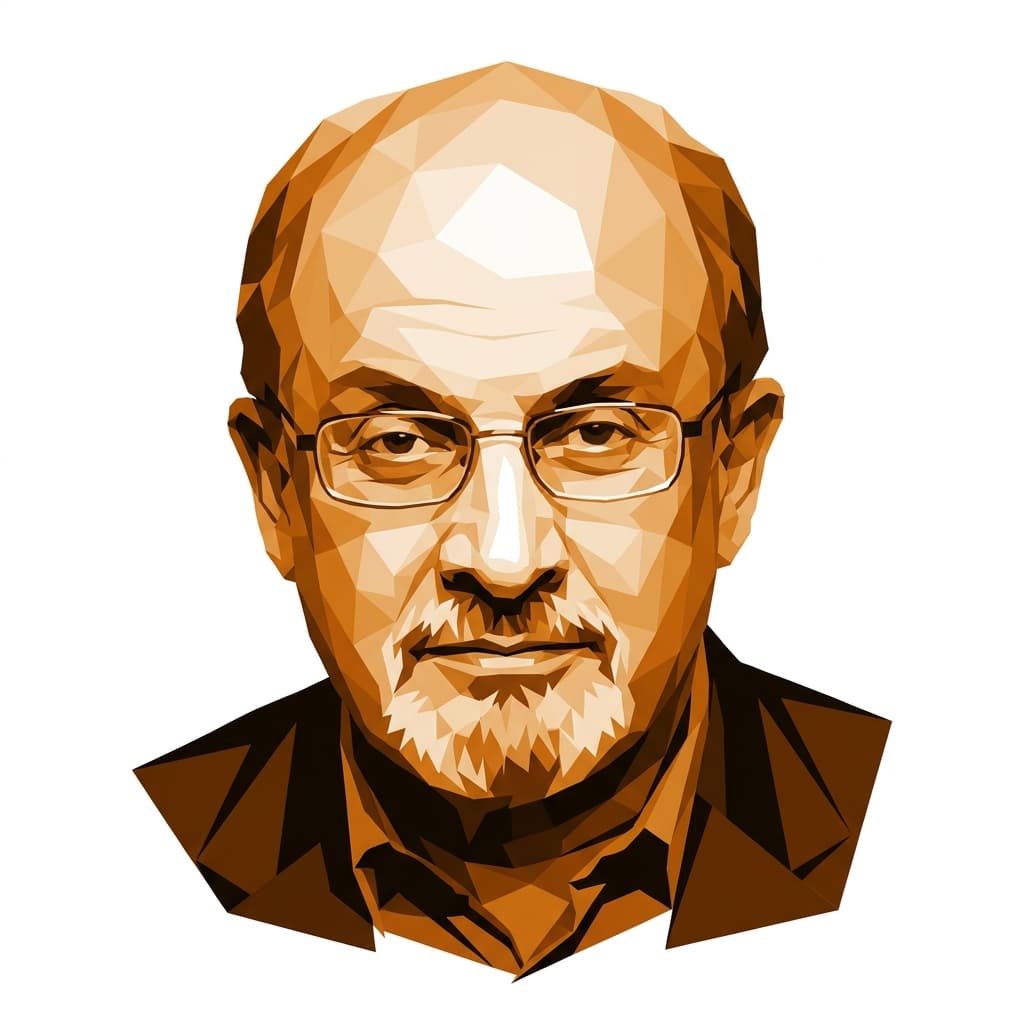
British-Indian novelist whose magical-realist fiction and life under fatwa reshaped modern literature and free-speech debates.
Design
- Q25.1
- h46.1
- R30.5
- g20.6
- i34.6
- S37.4
- T13.5
- U63.1
- V14.4
- W31.1
- X45.2
- Y48.1
- Z33.4
Personality
- Q12.5
- h11.5
- R12.5
- g20.3
- i34.3
- S62.1
- T16.1
- U23.3
- V1.6
- W31.5
- X45.6
- Y18.5
- Z33.5
Salman Rushdie is a Manifesting Generator — a writer wired for multiple obsessions at once, moving between mythologies, continents, and controversies without ever quite settling into a single register. Born in Bombay two months before Indian independence, educated at Rugby and Cambridge, he drifted through advertising copywriting (he coined "naughty but nice" for cream cakes) before Midnight's Children landed in 1981 and rearranged the map of English-language fiction. That novel's dense, comic, historically-drenched sentences announced a mind that couldn't help taking complex insights and finding cutting new language for them.
His path has never been linear. He writes historical epics, children's books, memoirs, essays on Wizard of Oz, screenplays; he pivots between forms with the restlessness of someone who treats every fresh idea as a live invitation. Shame, The Moor's Last Sigh, The Ground Beneath Her Feet, Quichotte — each book reinvents its own rules. He works with the raw stamina of a writer who can disappear into a manuscript for years, then re-emerge with something structurally unlike the last thing.
Then, in February 1989, everything changed. Ayatollah Khomeini issued a fatwa calling for his death over The Satanic Verses. Rushdie went into hiding under British police protection for nearly a decade, moving between safe houses, publishing under a pseudonym, watching his Japanese translator murdered and his Norwegian publisher shot. What's remarkable is not that he survived but that he kept writing — met the ordeal with a kind of stubborn open-heartedness that refused to curdle into bitterness. He came out the other side arguing more forcefully, not less, for the novel as a form that must be free to offend.
His 5/1 profile — the investigator who becomes the practical problem-solver — shows up in how he built himself into a public authority on the questions his own life kept forcing open: blasphemy, migration, hybridity, the right to imagine. He reads voraciously, footnotes his fictions with real history, and carries the depth of someone who researched the foundation before stepping onto the stage. Others project onto him constantly — martyr, provocateur, apostate, saint of free expression — and he has spent decades insisting on being the specific writer he actually is rather than the symbol people need him to be.
He is, by many accounts, warm and clubbable in person — a great collector of friendships across literary generations and continents, holding court at PEN dinners and Manhattan restaurants, mentoring younger writers, marrying and remarrying, moving to New York in the early 2000s to try to live a normal life. He speaks in public when the moment is his to take, and his essays on Rushdie-adjacent topics — censorship, exile, the imagination — carry the weight of someone who paid for those opinions in blood.
In August 2022, at a literary event in Chautauqua, New York, he was stabbed onstage and nearly killed, losing sight in one eye. Knife, published two years later, is his account of the attack and recovery — written in the same gut-level certainty that has always driven him back to the page, responding to what life keeps putting in front of him rather than retreating into silence.
Sources: biography · birth data
What do you and Salman Rushdie have in common?
Enter your birth details to find out