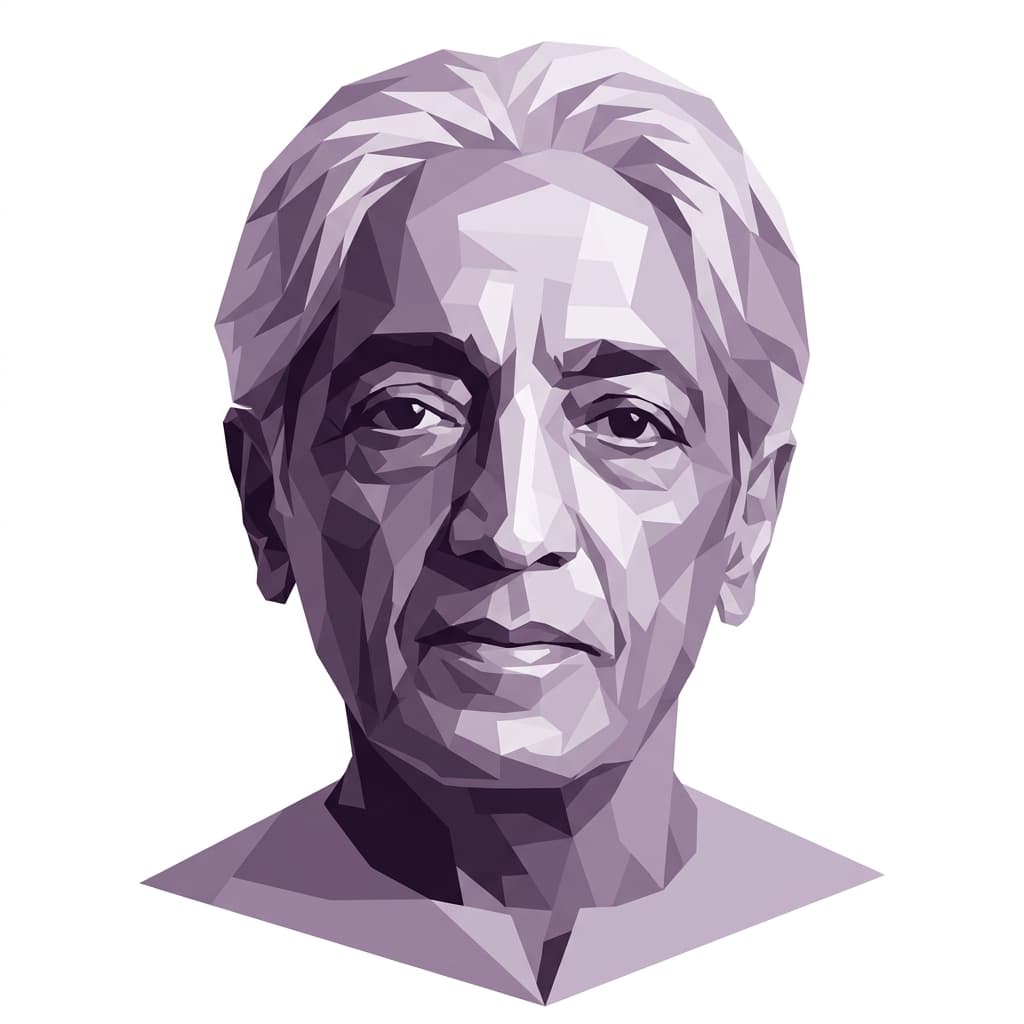
Indian-born philosopher and speaker who dissolved his own messianic organization and taught radical self-inquiry for six decades.
Design
- Q49.5
- h4.5
- R47.5
- g22.6
- i47.6
- S37.6
- T37.5
- U23.2
- V12.5
- W28.6
- X43.2
- Y35.2
- Z16.5
Personality
- Q23.3
- h43.3
- R11.3
- g22.4
- i47.4
- S8.5
- T15.1
- U39.3
- V52.2
- W28.1
- X1.5
- Y35.4
- Z16.6
Jiddu Krishnamurti was a Manifestor — designed to disrupt, initiate, and refuse the roles others tried to build around him — and the defining act of his life was exactly that kind of refusal. In 1929, at twenty-nine, he stood before the Order of the Star, a Theosophical organization of tens of thousands built specifically to prepare the world for him as the coming World Teacher, and dissolved it. "Truth is a pathless land," he told them, before returning the money, the estates, and the followers. It is hard to imagine a more literal enactment of the impulse to clear one's own path and inform the world afterward.
He had been discovered as a frail teenager on a beach in Adyar by Charles Leadbeater, who claimed to see in his aura the vehicle for a great spiritual awakening. For over a decade Krishnamurti was groomed, educated in England, dressed in Savile Row suits, and paraded as a prophet. The dissolution wasn't a tantrum; it was the culmination of years of quiet doubt, private grief after his brother Nitya's death, and the slow crystallization of a knowing that arrived from somewhere he couldn't quite name. Afterward he spent the rest of his life talking — in Ojai, Saanen, Madras, Brockwood — about why no guru, including himself, should ever be followed.
His method, if you can call it that, was relentless inquiry. He would sit on a stage and ask a question — "What is fear?" "Can the mind be free?" — and then think aloud with the audience for an hour, refusing to land on a formula. It was the classic 3/5 pattern of learning by living the experiment and then offering practical solutions to the crowd. He had tried the robes and the ritual himself; he had failed at being a messiah; now he could tell you, with authority earned the hard way, why the whole enterprise was a trap. His talks carried the cadence of someone waiting for the exact moment the sentence should land, and a gift for compressing enormous complexity into a plain, cutting phrase.
He questioned everything — nationalism, organized religion, psychological time, the self — with a mind that couldn't rest until it had understood the mechanism. His dialogues with the physicist David Bohm in the 1970s and 80s pushed both men into territory neither could have reached alone: consciousness as a field, thought as a material process, the observer as the observed. Krishnamurti provoked people into feeling what they'd long avoided, sometimes gently, sometimes with a sharpness that left listeners rattled for weeks.
He lived out of suitcases, traveled endlessly between continents, and thrived on rhythms most people would find punishing. He founded schools — in Rishi Valley, Brockwood Park, Ojai — because he genuinely believed education could produce a different kind of human being, one not conditioned by fear and comparison. He was not, by his own admission, easy to be close to; the emotional weather ran deep, and the decisions that mattered were made slowly, over years, not in single meetings. He died in Ojai in 1986, still refusing disciples, still insisting the teaching was not his and could not be inherited — an original who spent his life dismantling the idea of originals.
Sources: biography · birth data
What do you and Jiddu Krishnamurti have in common?
Enter your birth details to find out