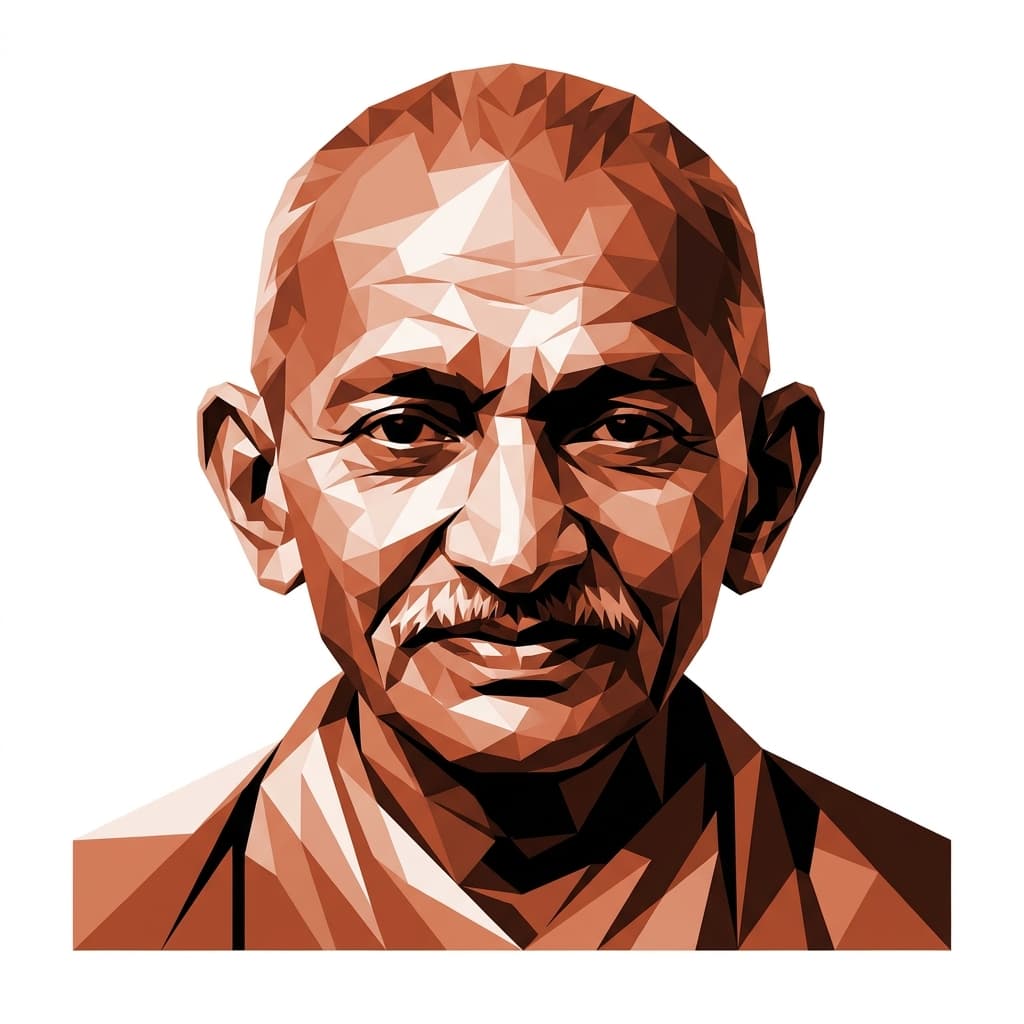
Indian lawyer turned anti-colonial leader who pioneered nonviolent resistance and helped end British rule in India.
Design
- Q39.2
- h38.2
- R51.5
- g33.1
- i19.1
- S15.2
- T62.6
- U47.4
- V2.1
- W5.1
- X53.3
- Y51.5
- Z2.5
Personality
- Q18.6
- h17.6
- R4.1
- g31.4
- i41.4
- S28.2
- T1.4
- U1.6
- V23.2
- W5.2
- X62.2
- Y51.4
- Z2.5
Mohandas Karamchand Gandhi was a Generator — built for sustained, ritualized labor rather than dramatic bursts, and the arc of his life is a long master class in stamina applied to a single, evolving question: how does a person live truthfully under an unjust regime. He spun cotton on a charkha for hours a day, walked the 240 miles of the Salt March at sixty-one, and outlasted the British Empire largely by refusing to stop doing the small, repetitive things he had decided were right.
His early life was the experimental stretch of a 6/2 profile that lived publicly before it lived wisely. A shy boy in Porbandar, a barrister-in-training in London eating boiled vegetables and trying to learn the violin, a young lawyer thrown off a train in Pietermaritzburg — these were the trial-and-error years. South Africa was where the experiments started compounding into method. By the time he returned to India in 1915 at forty-five, he was visibly stepping into the role of the wise guide that profile pulls toward, his earlier awkwardness now legible as preparation.
Satyagraha — "truth-force" — was the discipline he built around the kind of in-the-body certainty that doesn't reason itself into existence. He would announce a fast or a march and then simply not move from the decision, even when the Congress leadership, his family, or the Viceroy pressed him to reconsider. Critics found him maddeningly literal about his own conscience; he found their arguments beside the point. The decisions had already landed somewhere beneath language. He paired this gut-rootedness with a patient willingness to let events come to him — Champaran, Kheda, Amritsar, the salt tax — responding to specific provocations rather than manufacturing crises.
The texture of his politics lived in the gates. He had an unmistakable knack for naming exactly what India needed and pointing toward it, and a gift for compressing immense moral arguments into a handful of plain words — "Be the change," "An eye for an eye leaves the whole world blind." He was a relentless critic of systems he believed corrupted the soul, turning that eye on caste, on industrial textiles, on his own ashram's hygiene. He was also a fighter who chose his battles with eerie discernment, holding fire for years and then suddenly committing everything to a single campaign that exposed the regime's contradictions.
The shadow side ran through the same gates. His insistence on provoking emotion as a tool of moral pressure — the fasts unto death, the demonstrative simplicity — could shade into coercion of those closest to him, particularly his wife Kasturba and his sons. He could retreat into ashram life and silent Mondays when the country wanted him present, and his appetite for ascetic extremes — celibacy experiments in old age, the cycles of fasting — alienated even allies. The wisdom and the rigidity were the same instrument.
He was assassinated in January 1948 at seventy-eight, walking to evening prayer, five months after the partition he had tried and failed to prevent. The figure he left behind was not a saint but a stubborn, rhythmic, world-altering experimenter who had treated his own life as the laboratory.
Sources: biography · birth data
What do you and Mahatma Gandhi have in common?
Enter your birth details to find out