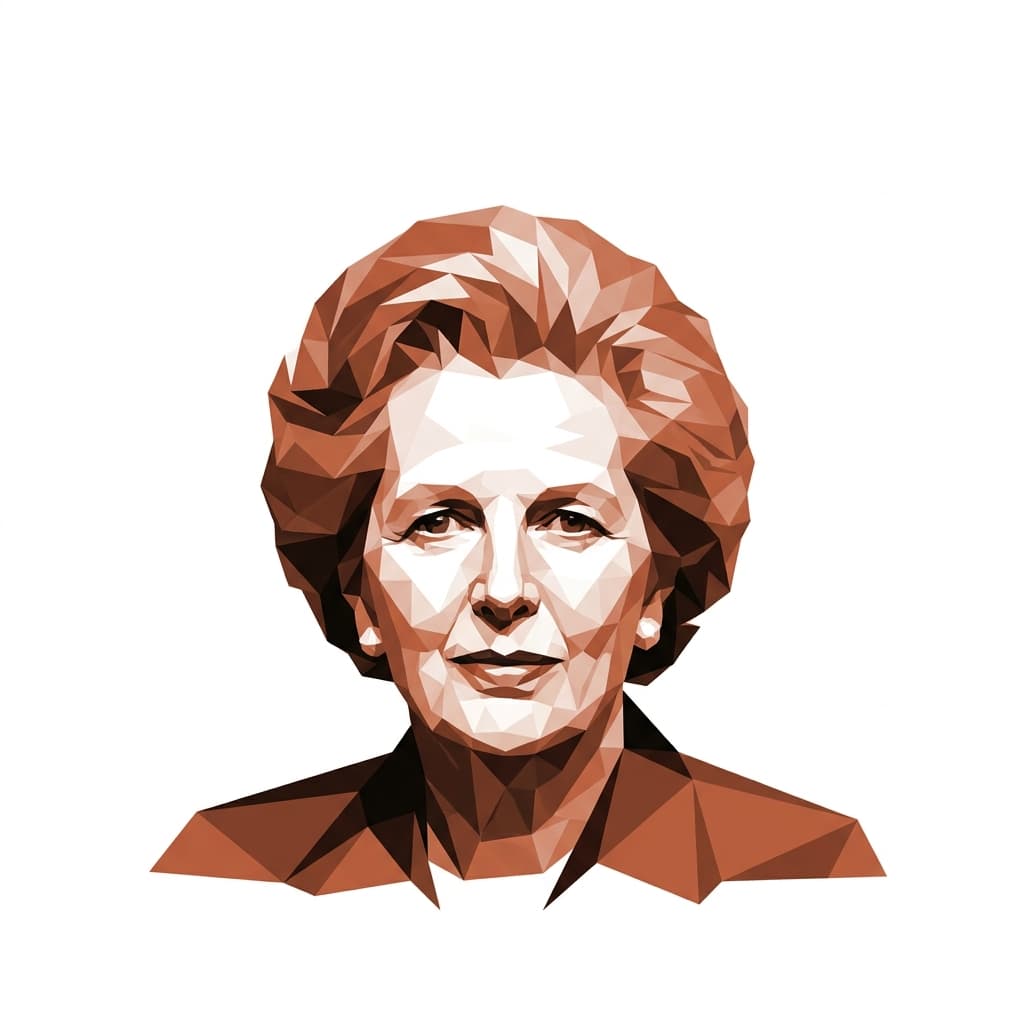
British Prime Minister from 1979 to 1990, the Iron Lady who reshaped postwar Britain.
Design
- Q62.1
- h61.1
- R24.4
- g31.3
- i41.3
- S7.2
- T7.1
- U33.5
- V54.3
- W44.1
- X36.3
- Y4.3
- Z39.5
Personality
- Q57.5
- h51.5
- R29.5
- g56.6
- i60.6
- S32.4
- T34.3
- U18.6
- V38.6
- W1.1
- X22.6
- Y4.6
- Z39.6
Margaret Thatcher was a Generator — built for sustained, deep work and the kind of stamina that lets a person grind through opposition for over a decade without flinching. The grocer's daughter from Grantham who became Britain's longest-serving twentieth-century Prime Minister didn't arrive at Downing Street through charisma or lineage; she arrived through preparation, repetition, and an almost monastic willingness to outwork everyone in the room.
Her 5/1 profile is visible across the whole arc. She trained first as a research chemist at Oxford, then as a barrister specializing in tax law — two professions that demand a solid foundation of facts before you open your mouth. When she finally stepped into political leadership, she did so as the practical problem-solver the country projected its hopes (and later its rage) onto: the figure expected to fix inflation, the unions, the Falklands, the welfare state. She wore the pedestal and the target with the same posture.
Decisions, when they came, came fast. The 1982 order to sink the Belgrano, the refusal to negotiate during the miners' strike, the snap conviction that Gorbachev was "a man we can do business with" — these were not committee outputs. They were the kind of full-bodied yes that doesn't pause to consult, delivered with a stamina for confrontation few of her cabinet could match. Her colleagues described her style as interrogation: she would test you, push you, and provoke until the real position came out. Weak arguments did not survive the kitchen table at Chequers.
The substance underneath the style was a relentless instinct for what was structurally broken and how to correct it. She read briefing papers until two in the morning, came in the next day with the costing wrong on page 14 circled, and expected her ministers to have done the same. Privatization, monetarism, council house sales — each was a framework she had personally stress-tested long before it became policy. She did not trust ideas she could not defend in detail, and she did not commit to a course unless she meant to see it through, which is why the U-turn became, in her famous formulation, something the lady was not for.
What kept her in office was also what made her impossible to work with. She fought every fight as if it were the one worth fighting, which served her brilliantly against Galtieri and Scargill and disastrously against her own Cabinet over the poll tax and Europe. By 1990 the colleagues she had bulldozed for a decade withdrew the invitation to lead, and Geoffrey Howe's resignation speech effectively ended her premiership. She left Downing Street in tears.
In retirement she wrote, lectured, and retreated into the long work of shaping the story — memoirs, the Thatcher Foundation, speeches that grew more uncompromising as her health declined. Her legacy remains genuinely contested: revered by those who credit her with rescuing Britain from decline, reviled by communities whose industries she dismantled. Both verdicts are, in their way, the projections a 5/1 spends a lifetime carrying.
Sources: biography · birth data
What do you and Margaret Thatcher have in common?
Enter your birth details to find out