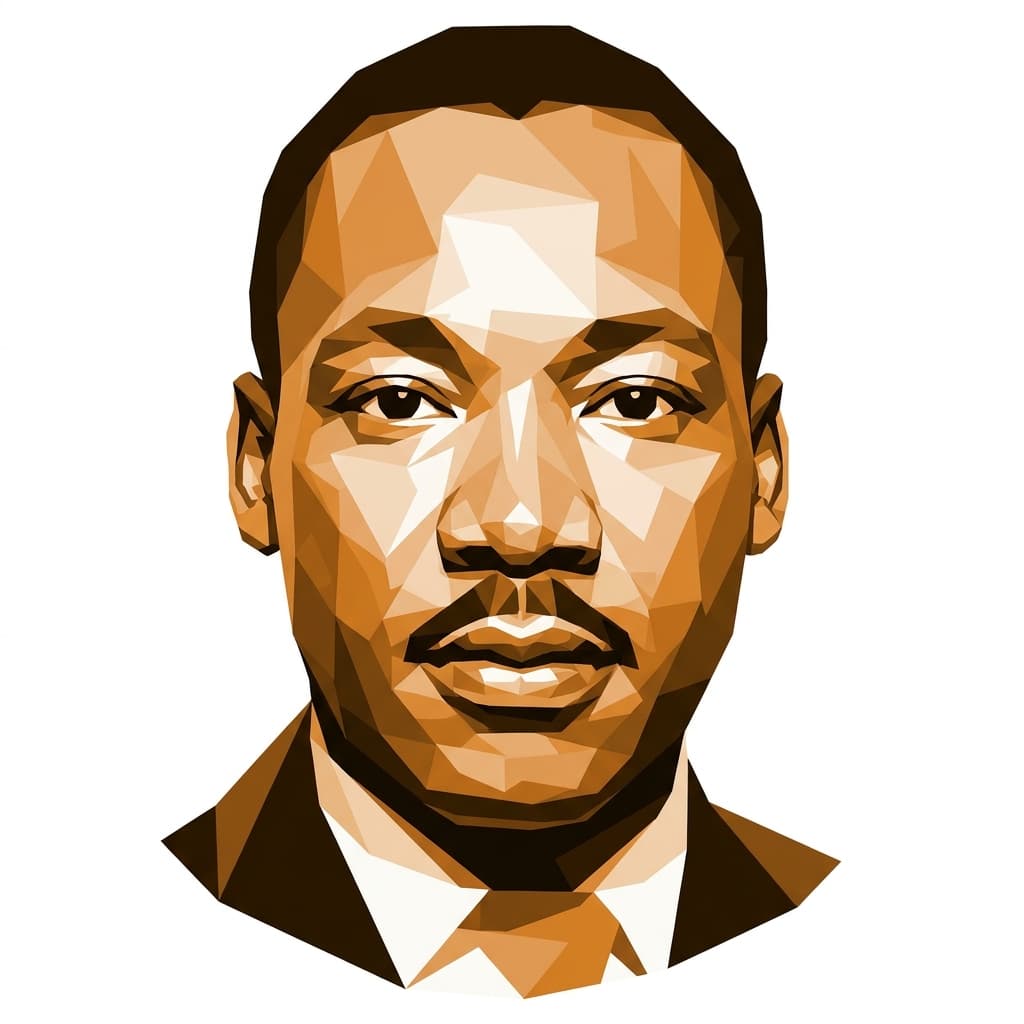
Baptist minister and civil rights leader whose nonviolent movement transformed American law and conscience.
Design
- Q50.1
- h3.1
- R38.6
- g20.1
- i34.1
- S28.4
- T14.2
- U52.3
- V27.5
- W5.5
- X17.1
- Y59.1
- Z53.4
Personality
- Q61.5
- h62.5
- R22.3
- g8.5
- i14.5
- S19.5
- T37.6
- U45.6
- V3.6
- W11.3
- X17.1
- Y59.1
- Z53.3
Martin Luther King Jr. was a Manifesting Generator — built for both speed and stamina, capable of preaching an unscripted sermon at midnight and organizing a boycott by morning. He didn't invent the civil rights movement any more than he invented the Black church tradition he came from; he responded to what showed up: Rosa Parks's arrest, a phone call from Montgomery's ministers, a jail cell in Birmingham. Each time, the response came from his gut before his mind had caught up, and each time he moved with a kind of speed that outpaced the older, more cautious clergy around him.
His 5/1 profile — the investigator who becomes a public problem-solver — shows up in the archive. Before he was famous, he was a graduate student at Boston University writing a dissertation on systematic theology, reading Gandhi, Rauschenbusch, Niebuhr, Thoreau. He built the foundation first. Then Montgomery happened and he was 26, unexpectedly at the head of something, and people began projecting onto him a savior figure he never claimed to be. He handled the attention by staying rooted in what he'd studied. The "Letter from Birmingham Jail" reads like a 5/1 document: patient, footnoted, addressed to eight fellow clergymen who had called him an outside agitator, methodically dismantling their objections with theology and history.
King's genius as an orator lived in rhythm and repetition, in cadences borrowed from the pulpit and made national. "I have a dream" wasn't in the prepared text at the March on Washington — Mahalia Jackson called out "Tell them about the dream, Martin," and he set the pages aside. What followed was pure waiting-to-respond made public, a preacher reading the room and going where the moment took him. He had an ear for what a crowd needed to hear and the emotional attunement to deliver it, even when the crowd was hostile, even when the room was a jail.
The movement was, at its core, an act of bringing order to what looked like unmanageable chaos — Jim Crow, lynching, poll taxes, systematic terror — and it required a warrior's willingness to keep showing up for something worth the fight. King chose his battles carefully and refused others: he broke with more militant voices, but also broke with liberal allies when he came out against the Vietnam War in 1967, reading the deeper needs of the poor and the drafted against the political calculus his advisors urged. That speech cost him allies, funding, and much of his mainstream standing. He gave it anyway.
By the last years he was exhausted, depressed, threatened constantly, and increasingly focused on economic justice — the Poor People's Campaign, sanitation workers in Memphis. The instinct to protect what mattered most in his community had pulled him away from the safer ground of civil rights legislation into the harder territory of poverty itself. The night before he was killed, he preached the "Mountaintop" sermon, and it reads, in retrospect, like someone who already knew what his gut had been telling him for a while. He was 39.
Sources: biography · birth data
What do you and Martin Luther King Jr. have in common?
Enter your birth details to find out