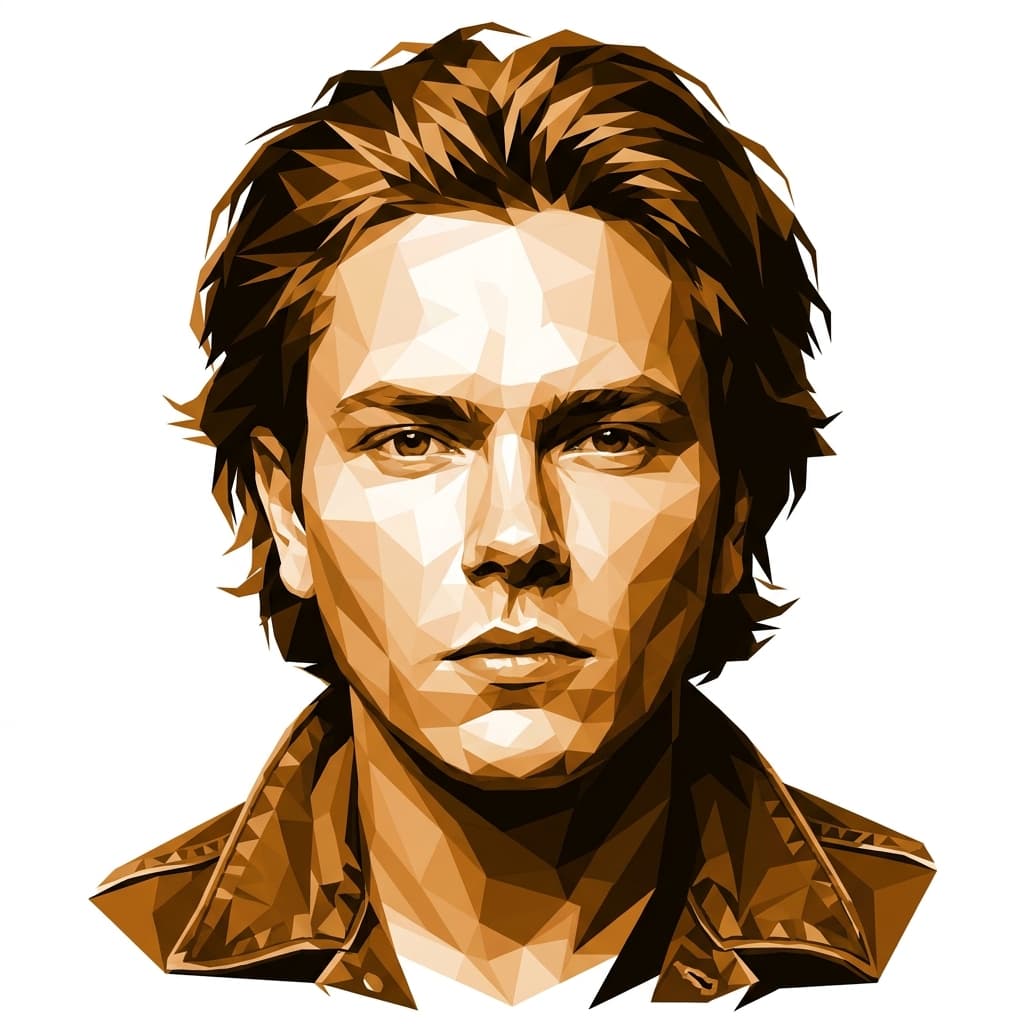
American actor and musician of luminous intensity who died at 23, remembered for Stand By Me and My Own Private Idaho.
Design
- Q20.3
- h34.3
- R58.4
- g37.3
- i40.3
- S2.1
- T15.4
- U12.2
- V50.2
- W2.2
- X18.2
- Y14.6
- Z6.3
Personality
- Q59.1
- h55.1
- R8.6
- g55.3
- i59.3
- S6.4
- T57.2
- U4.5
- V50.6
- W23.4
- X18.4
- Y14.4
- Z6.4
River Phoenix was a Manifesting Generator — wired to move fast across acting, music, activism, and family life without ever settling into just one lane. Born in a log cabin in Madras, Oregon to itinerant parents who briefly followed the Children of God, he spent his early childhood in Venezuela before the family hitchhiked back to the U.S. with five kids and a guitar. By eight he was busking on street corners in Westwood; by ten he had an agent. The trajectory from that childhood to Oscar-nominated actor at eighteen only makes sense if you accept that he was built to go, go, go across several passions at once.
He came up as a 1/3 profile, the investigator who also learns by getting his hands dirty. Cast members on Stand By Me remember a twelve-year-old who researched everything — the era, the props, the physics of a train — and then would just try things on camera, discarding what didn't work. That pattern held. He turned down roles obsessively, prepared with almost scholarly devotion for the ones he took, and then improvised freely inside them. Running on Empty, My Own Private Idaho, and Dogfight are essentially three different actors, connected only by the willingness to fail publicly and learn from it.
The performances themselves were emotional weather. As an emotionally-authoritative actor, he seemed to work from a wave that had nothing to do with the scene's stated stakes — the campfire monologue in My Own Private Idaho, largely written by him, is a young man waiting for the exact moment his voice could carry what he actually meant. He had an unusual gift for making complicated inner states legible in a single line reading, and directors from Peter Weir to Gus Van Sant described him as someone who found the truth of a scene and then quietly rearranged everyone else around it.
Off-camera, he was a vegan since age seven, a committed environmentalist, and the emotional center of a large, unconventional family whose finances and reputations he largely carried. He was the one people looked to for provision and protection, and his siblings — Rain, Joaquin, Liberty, Summer — grew up inside a household organized around values he refused to negotiate. He funded rainforest conservation, bought land to preserve it, played guitar in his band Aleka's Attic, and treated Hollywood as a means to fund the rest of it. Friends describe him as almost aggressively loyal — the glue in whatever room he walked into.
He also lived close to the edges. He loved the extremes of experience and drew close to people quickly, forming the kind of bonds that felt instantly deep and slightly dangerous. By his early twenties the persona of the clean-living idealist and the private reality had diverged. On the night of October 31, 1993, he collapsed outside the Viper Room in West Hollywood and died of combined drug intoxication at twenty-three. What he left behind reads less like a completed body of work than a vision cut short mid-sentence — a young performer still testing what he could do, still drawing an unusual amount of attention toward the things he thought deserved it.
Sources: biography · birth data
What do you and River Phoenix have in common?
Enter your birth details to find out