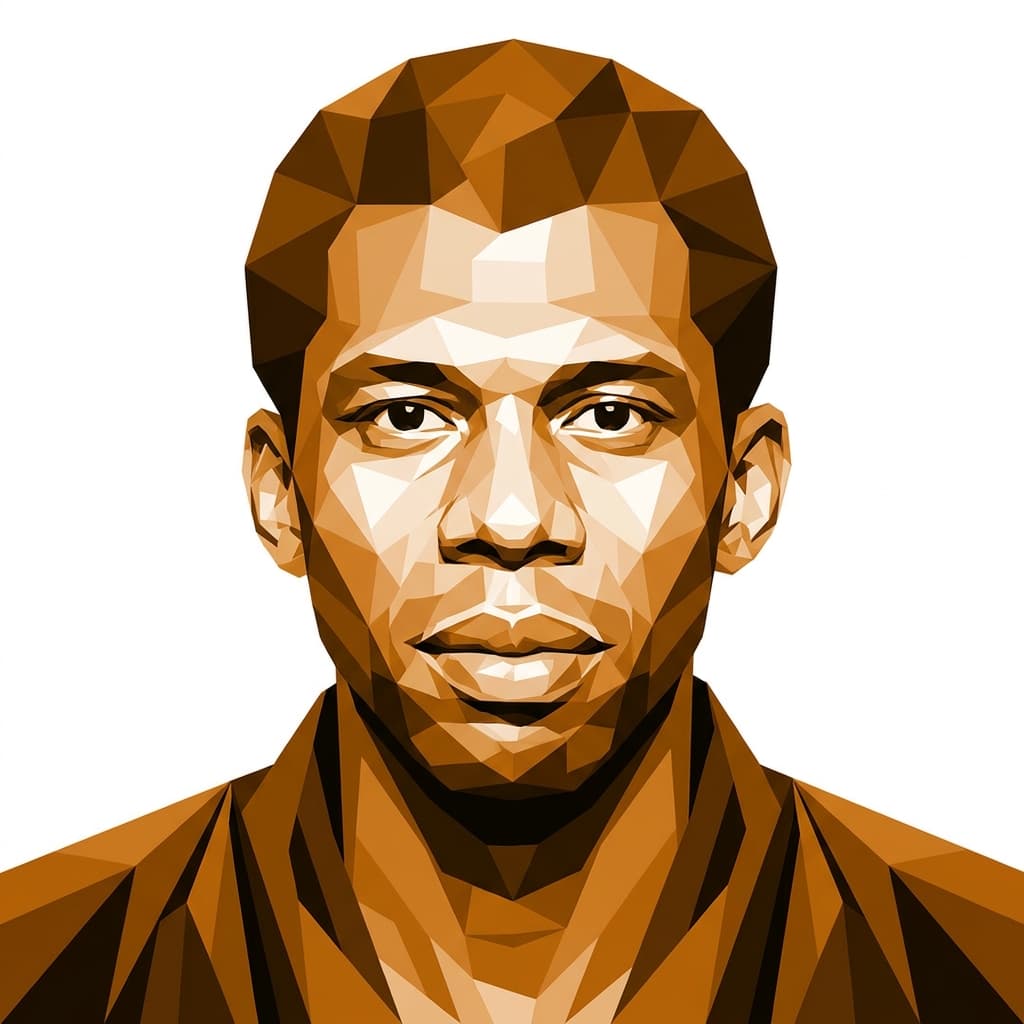
American jazz trumpeter and bandleader who repeatedly reinvented the sound of modern music.
Design
- Q37.1
- h40.1
- R7.3
- g62.5
- i61.5
- S63.4
- T19.4
- U38.3
- V19.5
- W14.2
- X36.2
- Y4.5
- Z39.4
Personality
- Q20.5
- h34.5
- R43.3
- g53.3
- i54.3
- S23.5
- T42.1
- U63.6
- V30.3
- W43.4
- X25.1
- Y4.4
- Z39.5
Miles Davis was a Manifesting Generator — wired to chase several sounds at once and to move on the moment his gut said go — and the shape of his career is exactly that restless arc. Bebop, cool, hard bop, modal, orchestral collaboration with Gil Evans, fusion, funk, hip-hop-inflected late work: each phase was abandoned almost as soon as he'd mastered it, to the frustration of critics and bandmates who wanted him to stay put. He moved fast, hated repeating himself, and treated genre boundaries as suggestions rather than rules.
He arrived in New York in 1944 ostensibly to study at Juilliard, but spent his nights tracking down Charlie Parker on 52nd Street — a 5/1 profile move, the investigator going deep into the foundation of an art form before stepping out as its authority. That dual instinct — research, then lead — defined him. He'd disappear into a new musical idea (modal scales after talking with George Russell, electric textures after hearing Sly Stone and Jimi Hendrix) and re-emerge with a fully formed band already playing it. Kind of Blue in 1959 was less a composition session than a quiet act of pulling something together that already made sense in his head; the musicians got sketches on the day and recorded mostly in single takes.
His decisions had the weight of choices made after sitting with them for days, not minutes. The five-year silence between 1975 and 1980 — addiction, illness, withdrawal from the music entirely — was the extreme version: a man who would not return until something in him was actually ready. When he came back, it was on his terms, with a new band and a new sound. He famously waited for the music to come to him before chasing it, assembling players (Coltrane, Hancock, Shorter, Zawinul, Jarrett) and then responding to what they offered rather than dictating note by note.
As a bandleader he was a reluctant but unmistakable guide, turning his back to the audience, saying almost nothing on stage, letting the trumpet do the directing. His playing was an exercise in saying only what needed saying — space, restraint, one note where another player would use ten. He found the raw power to drive a band for six-hour sessions when the work lit him up, and the corresponding collapse when it didn't: stretches of cocaine, isolation, and silence.
He could be cruel — to wives, to sidemen, to journalists — and he was a provocateur who pulled emotion out of every room he walked into, whether he intended to or not. The autobiography is full of feuds picked because the fight itself felt necessary, and just as many friendships kept alive across decades through a fierce loyalty to the few people who'd earned it. He had an appetite for new experience that made standing still unbearable — Ferraris, boxing, painting, the next record, the next band.
What survives him isn't a single sound but the principle behind all of them: closing one cycle cleanly so the next one could begin. He treated each great record as finished business. By the time the critics caught up, Miles was already somewhere else, listening for what came next.
Sources: biography · birth data

What do you and Miles Davis have in common?
Enter your birth details to find out