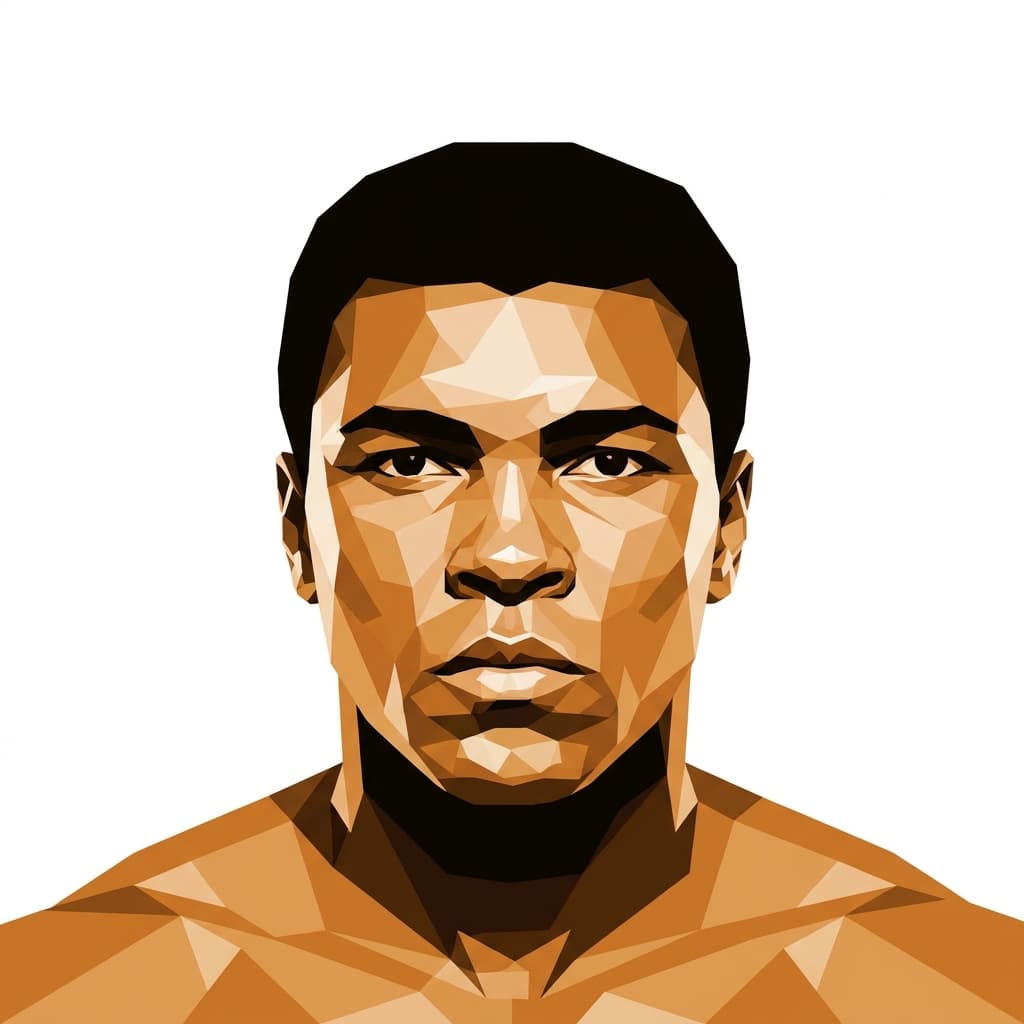
Heavyweight champion, poet, and conscientious objector whose voice reshaped sports, race, and global conscience.
Design
- Q50.4
- h3.4
- R34.5
- g47.6
- i22.6
- S44.1
- T5.3
- U21.5
- V45.5
- W8.3
- X8.6
- Y46.1
- Z31.4
Personality
- Q60.1
- h56.1
- R19.6
- g64.4
- i63.4
- S13.1
- T49.2
- U27.2
- V35.1
- W23.3
- X8.3
- Y46.2
- Z31.3
Muhammad Ali was a Manifesting Generator — built to move fast, juggle several lives at once, and let his gut tell him when to throw the punch. He was a boxer, a poet, a preacher, a draft resister, a diplomat, and a showman, often inside the same week. The arc from twelve-year-old Cassius Clay marching into a Louisville gym furious about a stolen bicycle to the man lighting the Olympic torch in Atlanta with trembling hands is the arc of someone who refused to pick one lane.
His boxing was pure vitality directed by conviction — the shuffle, the hands held low, the impossible speed for a heavyweight. He didn't train the way he was told to; he trained the way his body wanted to, and he won. Beating Sonny Liston in 1964 was the first public proof that his gut's green light was nonnegotiable. "I shook up the world," he shouted into the microphone afterward, eyes wide, and meant it as both observation and warning.
A 1/4 profile lives by going deep on what they love and then carrying it back to their people, and Ali did exactly that with Islam. He studied with Elijah Muhammad, then later with Wallace Muhammad and Sunni teachers, building the foundation before he ever preached from it. When he refused induction into the Vietnam draft in 1967 — "I ain't got no quarrel with them Viet Cong" — it wasn't a stunt. It was a principle he'd already lived with long enough to bet his career on, and he lost three and a half prime years for it.
The mouth was inseparable from the fists. He rhymed his opponents into smaller versions of themselves before the bell rang, then made the predictions come true. This was a storyteller's gift weaponized for the ring, and underneath it ran a showman's instinct for what the cameras needed — he understood spectacle before anyone in sports did. Howard Cosell asked questions; Ali answered in couplets. He was also, away from the lights, an unusually attentive listener, drawing stories out of kids in hospital wards and strangers at airports for the rest of his life.
His Emotional Authority showed up in the long arcs. He'd announce a retirement, sit with it, unretire. He'd feud with Joe Frazier viciously and later say he regretted the cruelty. The Rumble in the Jungle against Foreman in 1974 was the masterpiece of his patience — the rope-a-dope was a fighter willing to wait, absorb, and feel for the right round. When the moment came in the eighth, he uncoiled. Foreman, exhausted, fell like a tree.
Parkinson's took the voice but somehow not the presence. By the time he lit the Atlanta cauldron in 1996, he didn't need to speak; the gesture carried the kind of authority a community confers, not claims. He spent his last decades on humanitarian errands — hostage negotiations in Iraq, polio campaigns, quiet visits to sick children — moved by a steady attention to what people actually needed. The Greatest, by then, meant something larger than boxing. It meant a man who had told the world who he was and made the world catch up.
Sources: biography · birth data
What do you and Muhammad Ali have in common?
Enter your birth details to find out