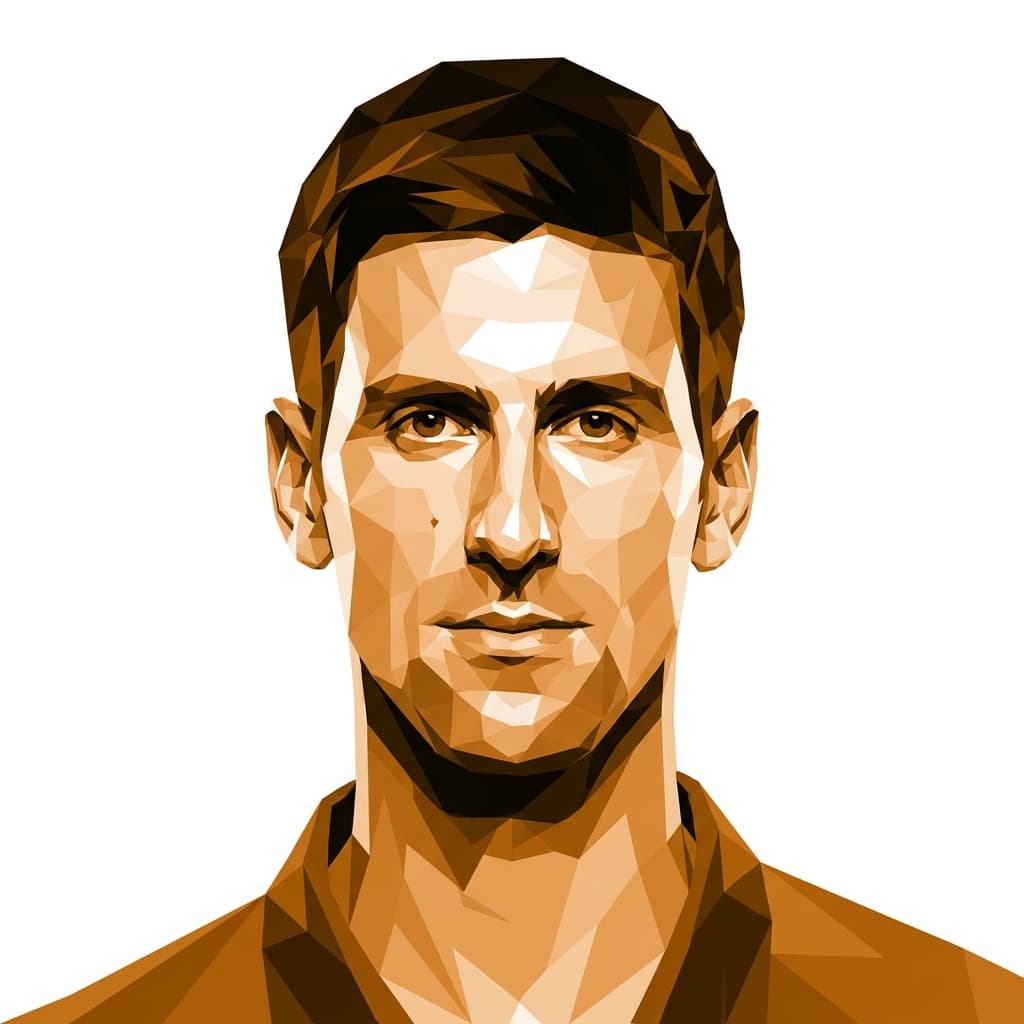
Serbian tennis player, 24-time Grand Slam champion, widely considered the greatest of all time.
Design
- Q55.4
- h59.4
- R26.1
- g21.3
- i48.3
- S63.3
- T54.5
- U3.6
- V36.6
- W26.4
- X11.4
- Y58.4
- Z44.3
Personality
- Q20.2
- h34.2
- R17.2
- g21.2
- i48.2
- S45.2
- T27.5
- U15.4
- V51.5
- W26.3
- X11.4
- Y58.4
- Z44.1
Novak Djokovic is a Manifesting Generator — built for relentless, multi-front output, capable of grinding through five-set marathons and also recalibrating his entire game on the fly between points. The arc of his career has been less about a single style than about a continuous refinement of body, mind, and method, each phase mastered and then mutated into the next. He doesn't sit still inside one identity for long, which is part of why opponents who finally figure him out tend to find a different player waiting for them six months later.
He grew up in Belgrade during the NATO bombings of 1999, training in drained swimming pools and bomb shelters — formative chaos that he later credited with a strange willingness to find order inside disorder. His 2/4 profile shows up clearly in the rhythm of his life: long stretches of monastic solitude (altitude camps, silent meals, meditative retreats, the famously specific gluten-free regimen) bracketed by intensely communicative weeks on tour, where his sponsors, foundation, and Serbian fanbase form the network through which everything else flows. He has always been an obvious extrovert who needs to disappear regularly.
On court, the Djokovic style is almost embarrassingly literal about responding to whatever the moment puts in front of him. He doesn't dictate the way Federer did or bludgeon the way Nadal does; he absorbs, redirects, and waits for the opening — then strikes with the kind of instant, unhesitating commitment that bypasses thought entirely. His return of serve, widely considered the greatest in the sport's history, is essentially a Sacral reflex trained to 0.4 seconds. Match point against Federer at Wimbledon 2019, down two championship points on his opponent's serve, he hit two clean returns and never blinked.
The behavioral specifics are where the chart gets loud. The famous on-court self-talk and crowd-conducting — that's the truth-teller's compulsion to make the unspoken thing audible, even when it costs him sympathy. His relationship with rankings, prize money, and the ATP Player Council reflects a real appetite for running the resource side of the sport himself, most visibly when he co-founded the PTPA in 2020 to negotiate for lower-ranked players. The vaccine standoff and the 2022 Australian Open deportation showed a willingness to be the disrupting variable even when the cost was a Grand Slam and global condemnation; he simply would not be moved.
His training philosophy is famously eccentric — hyperbaric chambers, pressurized "egg" pods, the gluten experiment that began after a nutritionist held bread to his stomach — all expressions of a restless drive to perfect the machine and a hunger for the edges of what a body can do. The career itself runs on pure, sustained ambition that doesn't decay with age, which is why he was still winning majors at 36 while his rivals retired. And the late-career project of breaking every numerical record — Slams, weeks at number one, Masters titles — has the unmistakable signature of someone who needs to be measurably, demonstrably the best, and who has, by most measures, succeeded.
Sources: biography · birth data
What do you and Novak Djokovic have in common?
Enter your birth details to find out